.

.
HOME OF THE LADY DENMAN - Local history isn't always about the big story - the everyday story of life in the early development of the region can be a fascinating, entertaining and educational journey.
Showing posts sorted by date for query WHALING. Sort by relevance Show all posts

12 May 2019

Whale sinks boat in Jervis Bay - One man drowns. 1878


A tragic incident which illustrates the precarious nature of life on a whaling vessel.


The whaling barque Asia from Hobart Town was a regular visitor to the waters around Jervis Bay.  Asia had been at sea hunting whales for approximately 9 months before casting anchor in Jervis Bay in November 1878 to "try out" their most recently caught whale. The process involved the ships smaller boats fastening a whale to their gunnels before hauling the whale alongside the larger ship.  Once alongside the blubber would be stripped from the whale then drawn onboard by large hooks and rigging where the process of boiling down the blubber in large vats to render out the oil would take place. The remaining oil was poured into barrels, this process was called "trying."


Poor "Hyderabad."

First mate Thomas Graham and a small party of men were aboard one of the boats with a whale held fast to its side,  without warning,  another whale stove in their boat by biting it. The crew were consequently thrown into the water and submerged, one of them, named John Cannooard, known by the sobriquet "Hyderabad"  could not swim and was drowned immediately despite the efforts
of the first mate to save him.  In his attempt to save Cannooard, Graham almost drowned himself.  The remainder of the crew were rescued after being in the water for about half an hour.

Floundering in the water near a bleeding dead whale would have been a frightening ordeal. The possibility of being attacked by sharks attracted by the smell was very real. Once a whale was brought alongside a vessel, crews had to work quickly to strip the valuable blubber off the carcass before sharks could do to much damage.

No further information is has been found on this incident. It was quite common for sailors to be buried at sea, or taken to the nearest land for burial as ships didn't have the facility to store a body for any length of time.


image

1 April 2019

Whaling Jervis Bay

As can be seen from this short and not complete list of whaling ships which came into Jervis Bay,  the bay was at one time a very busy location for the whaling industry.


1870 - The Hobart Town Barque Alladin towed two sperm whales into Jervis Bay to secure the blubber and boil down.

1871 - The barque Othello cast anchor with 65 tons of sperm oil.  She took a 10 sperm whale off Jervis Bay two day before anchoring in the bay..

1871 - The whaling barque Metaris came into the bay to try out a large sperm whale.

1871 - The American whaling barque Eliza put in to Jervis Bay for water. She carried 1400 barrels of oil.

1872 - The Sydney whaling barque Metaris, had been at sea for 10 months before putting into Jervis Bay to recruit. She had sixteen tons of sperm oil.

1872 - The whaling barque Waterwitch put into the bay to recruit. She carried twenty tons of sperm oil.

1872 - The barque Alladin put into the bay, she carried twenty tons of sperm oil.

1872 - The American whaling barque Asmanby has put in to recruit. She has been twelve months out, and has 700 barrels of black oil and 300 of sperm oil.

1872 - The whaling brig Louissa, 5 months at sea put in to recruit with 5 tons of sperm oil.

1872 - The barque Sea Shell towed two sperm whale into the bay for processing, they had been caught thirty miles off the bay.

1872 - The American whaling barque Three Brothers put into the bay to recruit, with 1400 barrels of sperm oil aboard.

1872 - Melbourne whaling barque Mary Hamilton 3 months at sea put into Jervis Bay to repair a lost bowsprit, she carried no oil.

1872 - The brig Velocity, four months at sea put into the bay with 4 tons of sperm oil.

1873 - The brig Velocity put into the bay to recruit. She reported green water and drift wood eighty mile offshore.

1873 - The Whaling barque Runnymede, 9 months at sea, put into Jervis Bay to recurit. She carried nine tons of sperm oil.

1873 - The barque Waterwitch put into the bay, fourteen months at sea, she carried 14 tons of sperm oil. During the voyage crew member Joseph Williams from Hobart, he fell from aloft and was instantly killed.


Continue on to more information about the whaling industry in Jervis Bay.


image


11 February 2019

A Sailors plight.

Jervis Bay, known for its beautiful serenity has had its share of tragic incidents which has resulted in the death of sailors.  

Marked by a headstone, the most well known would be the grave of the 19-year-old sailor Robert Johnson who drowned in Jervis Bay in 1892.  The headstone sits atop the small headland known as Tapalla Point ( sailors by the locals) and is passed every year by hundreds of people walking along the footpath winding its way around the top of the shoreline.


At this time there are two known graves sites in the grounds of the Trinity Church in Huskisson, possibly more.  One was reported to be of King Billy the chief of the Jervis Bay Aboriginal tribe, he died in the 1920's. The other is of Carl Niclasson a sailor off the whaling ship Loc Tay who died under mysterious circumstances.  The graves have disappeared over the years. Quite recently I went looking for the graves, I hunted around the grounds of the church, I spoke to people associated with the church, but no one I spoke to knew where they were located.

Carl Niclasson.
Searching for information on his death I came upon a newspaper article written in the Nowra Leader in 1912., about the death and subsequent burial of Carl Niclasson.

Carl Carl Niclasson, aged 33, a native of Golsburg, Sweden,  was a seaman aboard the whaling factory ship Loch Tay.  in 1912 the whale factory ship Loch Tay and her smaller whale hunting ships were operating from Jervis Bay.

Niclasson was onboard a small motor launch travelling between Huskisson wharf and the Loch Tay.  He had been drinking and was in fine spirits and good health the night before.  Niclasson was sitting down in the launch with two other men when he dropped down from the seat, this didn't alarm anyone on board, thinking he was still under the influence of alcohol.   On reaching the Loch Tay he was carried on board and placed in the room set apart for sailors.   Captain Egeness looked at him and felt for a pulse.  Prior to this Captain Egeness sent the launch to the beach to find the doctor of the ship (Jorg. B. Kolfiaath) who had gone fishing.

On the doctor's return, he examined Niclasson and pronounced him deceased.

Niclasson had been onboard the Loch Tay for six to seven months and was regarded as a good worker, he had never suffered from illness during his time on board, but was known to have a slight "heart disease"The official inquiry was held at Cambourne's Hotel Huskisson on Monday 24 November 1912, before the coroner (Mr C.J.B. Watson).


The first hotel at Huskisson.


The burial.
The body of the deceased was in a wooden shell made on board the Loch Tay, he was interred at a quiet spot close to the church at Huskisson, alongside the grave of a seaman drowned 42 years before. The coffin was draped with the Norwegian colours was borne to the grave by a number of the deceased late comrades. The Church of England burial service was read by the Rev. A. G. Perkins, followed by an impressive Norwegian service, conducted by Captain Egeness.


Dr, Albert Bobart (Government medical officer)  "I have seen the body of the deceased, Carl Niclasson It bears no marks of violence, In my opinion, the cause of death was heart disease."

The church is no longer used and sits on a large open piece of prime real estate which is earmarked for development. This will require the graves to be moved to another location.  I hope they are given a location befitting a sailor.

It was believed Niclasson at the time of his death only had one living relative, a married sister living in Sweden.


Continue reading about the Loch Tay, a factory whaling ship stationed in Jervis Bay.

Continue reading about Robert Johnson.

Continue reading about King Billy and Queen Mary.


image

17 December 2018

Perpendicular Smell–Jervis Bay

Daily Telegraph - March 1932

When one of the light-keepers at Point Perpendicular, at the entrance to Jervis Bay, came on duty one evening recently he sniffed the air, and observed, "Someone has been throwing dead fish out round here." No one could find the fish, but, whenever the wind blew from the northward the smell pervaded the air. As the days went on it grew stronger. But it was not fish, but a 50-feet whale, which had driven head on into a little opening in the cliffs near the lighthouse, and stuck there. Nothing could be done about it, and the light-keepers just had to hope that there would be an unusual prevalence of south winds for the next few months.


Continue Reading about whales and whaling in and around Jervis Bay.


image

5 June 2018

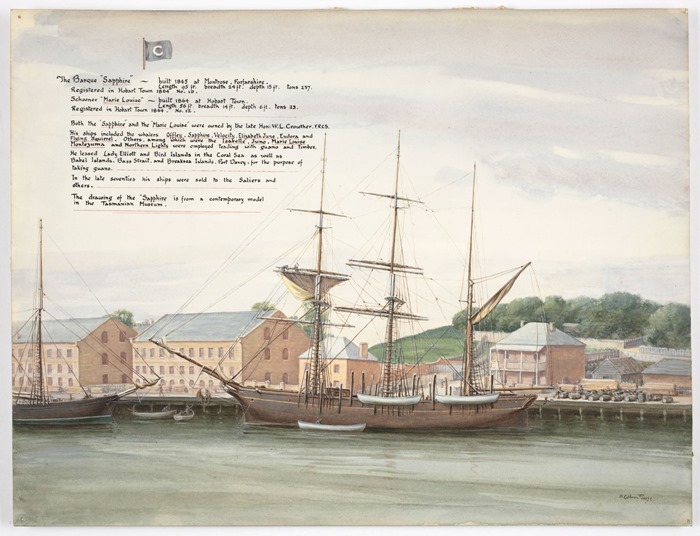
The Barque Sapphire and the Barque Narramissic 1874

historyofwhaling2
The sea near Jervis Bay and the clear waters of the bay ran red with the blood of the whale industry.|


Whaling was a dangerous and unforgiving enterprise.

When a whale was spotted, ships would begin the chase, trying to draw near enough to lower their boats, manned with hard weather-beaten men, armed only with a hand-propelled harpoon, determination, and hopefully, luck. If they managed to catch and kill this great leviathan the men would now have to tow the whale by sheer back-breaking effort back to the waiting ship.

Death and injury was a common occurrence for the chasers, but the danger didn't stop there, when the whale was drawn on board, danger was ever present.

Sailors survived on limited rations in cramped quarters aboard creaking ships, as one sailor expressed, "we worked like horses and lived like pigs." Timber decks soaked in the fluid from processing whales were extremely slippery, men came down hard onto the deck, men slipped overboard to the waiting sharks drawn by water running with blood, men could be crushed by the weight of blubber being hauled into copper cauldrons in the try-works, they suffered deep lacerations from the sharp tools used for processing the whales.
Everything, including the men were covered in whale oil, all this aboard a ship pitching and rolling on an unsettled sea, hot oil from processing cauldrons could spill onto the fires, this could easily spread engulfing the ship and the crew, many ships left port and were never seen again.

When the processing was complete which could take 6 hours or more depending on the size of the whale, the crew would scrub and clean the ship as best they could,  despite their best effort, ships sailing downwind would always know when a whaling ship was approaching by the smell.

Collision at sea.

There were dozens of ships plying the coast chasing whales, collisions between ships occurred.


One such incident occurred 30 miles south of Cape St George between the whaling barque Saphire and the barque Narramissic.

10 September 1874 - The barque Narramissic left Newcastle bound for Melbourne and ran into heavy weather and was forced by leaks into Sydney Harbour.

20 - September 3am - The barque Narramissic left Sydney Harbour continuing her voyage to Melbourne, 30 miles south of Cape St George, in the pitch black the silence was shattered by the violent sound and vibration of two timber ships coming together.

The Hobart Town barque Sapphire,which was not displaying any side lights, struck the Narramissic with her flying jib-boom on her mizzen chains. The Sapphire lost one boat and her spritsail yard.  The Narramissic had her stanchions and gaff carried away, her covering board and spritsail were also damaged, five of her crew, thinking she was about to sink, jumped on board the Sapphire, leaving the master and three men to bring her into Jervis Bay, where repairs would have to be carried out before she could sail again.  The Sapphire came into Jervis Bay the following day.

The Narramissic stayed in the bay for 4 weeks wind bound because of terrible gales which had damaged other vessels caught at sea.

Once the repairs were finished the Narramissic sailed out of Jervis Bay continuing her journey to Melbourne.  She ran into more heavy weather, the second mate and a seaman named Christopher Tomkin went aloft to secure the yard-arm of the upper main topsail, which had got adrift from the gaskets. The sail caught Tomkins, who was 36 years of age and a native from Berwick, England, and knocked him overboard. A life-buoy was thrown to him, and the master hove a line to the drowning man, which he almost clutched but did not catch, the vessel drifted away from him, the weather being so bad as to preclude the possibility of rendering
him any assistance.

The Narramissic's voyage had been cursed with near disaster and tragedy.

sapphire

The whaling barque Sapphire was a regular visitor to Jervis Bay,

1872 December - she put into Jervis Bay after a 10-month voyage from Hobart Town to recruit. She had taken 28 tons of sperm oil.

1875 February  - during a 14-month voyage she came into the bay to try-out 9 tons of oil,
the total take of oil for the trip was 21 tons.

By 1885 the romance of going to sea chasing whales was starting to decline, many whaling ship owners found it difficult to secure suitable crews and were forced into taking anyone that offered himself.  The Sapphire was involved in an incident when as was customary at the time, the owners would advance the willing a small sum in advance of the voyage.  Taking the advance these larrikins would often spend the money, then not join the ship as required when it was time to sail. The police would be called and these reluctant absconders would be arrested and taken aboard the ship.


image


10 April 2018

Whaling in Jervis Bay.

15 July 1914.

image

Debate about the benifits of whalers operating from Jervis Bay was still going on.

News of the prospective arrival of Danish whalers in the bay was viewed with abhorrence by local residents. The locals could not see any benefit for the local economy saying the ships brought
all necessary supplies and did not deal locally, they also complained about the stench from the operation being unbearable.

Supporters of the whalers denied this and said the ships spent considerable amounts on stores and goods.

"It certainly does not seem possible for a vessel to carry provisions to last 100 men some months, let alone bunker coal."

Supporters saw the whaling industry growing and urged the Huskisson residents to reconsider the matter by welcoming and assisting the ships when they arrived in the bay.

Supporters  - The smell in the bay was not nearly as bad as alleged.  Anyhow, there's surely room for all.


- That last statement doesn't seem all the convincing! -


Have you wondered what whale oil could be used for.
Taken from the same paper.

image


image

13 February 2018

Drama at sea, two barques collide and make for Jervis Bay.

131820946


Most ships at this time used oil lamps to indicate their position at night to other ships who may be in close proximity, but not always, and in this case the lack of lights nearly ended in disaster.

Tuesday 20, 1874 - The barque Naramissia from Newcastle bound for Melbourne was sailing 40 miles south of Cape St George, it was 3 am in the morning when without warning she was struck by the whaling barque, Sapphire.   The Sapphire carried no side lights and struck her with her flying jib-boom on her mizzen chains.  Five of the Naramissia's crew, thinking she was about to sink jumped on board the Sapphire leaving the master and three men onboard.  Fortunately, the ship remained afloat, the master took her into Jervis Bay where the Sapphire joined her the next day. The Naramissia stayed in Jervis Bay for four weeks wind bound, during which time they carried out repairs

The Sapphire lost one boat and spritsail yard. The Naramissia had her stanchions and gaff carried away, and her covering board and spritsail damaged.

1872 - The Sapphire had been to Jervis Bay before, she often hunted whales along the coast near the bay. In 1872 she put into the bay to recruit, She had been at sea for 10 months and had taken 25 tons of sperm oil.
1875 -  She put into Jervis Bay to try out 9 tons of whale oil. The total take of oil for the voyage was 21 tons.

1885 image
1885 Long hard dangerous months at sea with small rewards meant finding experience crew was becoming harder,  ship captains and owners were forced to take anyone who was willing to come aboard, most were scoundrels with no experience of working aboard a ship, this led to conflicts. 
In 1885 some of the newly recruited crew of the Sapphire, as was customery were paid some of their wages in advance, absconded,  and after a merry chase for four days were caught and
forced back aboard the boat by the police. They mutinied and refused to go to sea throwing essential equipment overboard in an attempt to stop the ship leaving port.  The police were called again arresting the two ringleaders removing them from the ship.  New equipment was loaded and the ship finally sailed.

Ref: https://stors.tas.gov.au/AUTAS001131820946

Meaning - mizzen-chains: Plates of iron bolted to a ship's sides abreast the mizzen-mast for securing the shrouds and backstays of that mast.


image


28 September 2017

Wreck of the Martha and Elizabeth May 1855.


There are many shipwrecks in the Shoalhaven area, some have a story to tell while others leave us in wonder as to the fate of the ship, crew and passengers.  The people involved in this story found themselves in a rapidly deteriorating life-threatening situation where small decisions and quick actions made the difference between life and death.

The story of the Schooner Martha and Elizabeth is one of heroism, and a great deal of luck. 
The fact that there were no casualties in such dire circumstances is amazing.

As you read the story try to put yourself in their situation.   It's pitch black, you trying to stay upright on a twisting, pitching, rolling ship,  all around you the noise of the ship smashing and grinding against the cliffs down both sides of the ship,  timbers are splintering and coming apart around you, the rigging is hanging everywhere,  the ship is quickly breaking apart.   The fearful shouts and screams from the passengers trying to be heard over the sound of crashing waves engulfing the ship, the captain shouting orders to his crew, the wind-driven rain against your exposed wet and cold skin.  These people were in a desperate struggle for survival.

The schooner Martha and Elizabeth under the command of Captain Anderson was on a voyage between Melbourne and Newcastle when she ran into difficult weather and currents
close to Jervis Bay.


April 26th -  At 5.30pm. nearing Jervis Bay they sighted Cape St George,  the wind at this time was variable from the S.S.E, with rain and thick weather, Captain Anderson steered the vessel N.E by N. 

7.30pm - The wind was variable, with heavy showers and the current setting was very strong to the southward.

8.pm - Captain Anderson found the current setting put the vessel down upon Point Perpendicular, he immediately tacked to the southward.

8.40pm - Finding the schooner would not fetch the south-head of Jervis Bay, on the port tack, the captain tacked to the N.E.

8.50pm - At this time all was calm,  but, the vessel was setting in fast to the breakers with a heavy swell from the eastward. 

9.pm - Finding the vessel close to the cliff,  with no possibility of saving her, they cleared away, and launched the boat but owing to the heavy ground swell the boat filled and parted from the ship with one hand,  Robert Jellicar in her, but he, fortunately, caught a rope  and was saved by hauling him over the stern of the schooner.

9.30pm - the vessel came stern on,  the main boom struck the cliff and she parted amidships.  the vessel payed around to starboard and was driven into a gully in the cliff just large enough to admit her lengthways. Upon entering the vessel struck instantly abaft,  the sea breaking furiously over her. 
Finding she could not last many minutes they endeavoured to get a line ashore by means of a small grappling.   Finding the grappling would not hook the rocks one of the hands R. Jelliear,  got footing by swimming from the stern,  while another,  John Rogers,  jumped from the bowsprit, which instantly afterwards parted from the vessel.  The remaining hands, with the captain's wife and sister, had robes slung around their bodies and hauled ashore by those ashore,  the captain was the last to leave the vessel. The crew and the captain's wife and sister had scarcely any clothing,  and not a shoe to their feet. They had scarcely secured a footing on the slippery rocks when the vessel broke up.

11.pm. - The vessel had broken into small pieces.  After some searching in the dark, they found a small ledge in the rocks where they all assembled for the night.  It was intensely cold, with a strong easterly wind and incessant rain throughout the night. 

April 27th.
First light revealed a desperate scene.
 
- The survivors could see nothing of the Martha and Elizabeth other than some small pieces of wreckage,  nothing could be saved.

Assending the cliff
. They found themselves at the base of steep cliffs, they now had to find a way to the top,  which they did with great difficulty.   The area they were in was isolated with no help close by,  to make their way to the Shoalhaven they had to contend with thick high scrub trees and in some places wade through waist-high swamps.   Having no shoes and scarcely any clothes made the task more painful.  After walking about 18 miles they had the good fortune to come across Mr Kinghorn's whaling station.   Captain William Kinghorn set up a land based operation on the northern side of the bay near Montague Point on the Mount Jervis property belonging to his father Alexander Kinghorn.  How long the station remained in operation is unknown

They remained with Captain Kinghorn for the night and were kindly treated.

image

Captain Kinghorn.


28th April - The party proceeded to the Shoalhaven where they were heartily made welcome by Captain Noel,  of the steamer Nora Creina, and received from him a passage to Sydney.

30th April - After an uneventful trip, the party arrived in Sydney at about midnight, they were most grateful for their lives and to those from whom they received so much kindness.

An amazing story!.


Specifications: Martha & Elizabeth. Schooner, 81 tons. Built Clarence River, 1843; reg. Melbourne, 277/1854. Length 67 ft. Operated in the timber trade off Wilson's Promontory in the 1850s.

                         Nora Creina 142 gross tons, 93 net. Lbd: 133'7" x 18' x 7'7". Iron paddle steamship built at the Neptune Foundry Waterford Ireland for the Commercial S N Co., Waterford. 1853 owned by A G Robinson, Sydney. 1854 purchased by the Shoalhaven S N Co., Sydney and worked the Sydney - south coast ports of New South Wales as a passenger - cargo vessel. February 1857 of the unofficial Illawarra S N Co. (read - Kiama S N Co) Sold 1861-2 to Far East interests. Wrecked October 1849

Meaning: Abaft - in or behind the stern of a ship.

Ref: https://www.flotilla-australia.com/iscsnco.htm


image


12 May 2017

Fishing report for Jervis Bay 1912

"The bay at present is discoloured to a milky whiteness by the whale-oil factory operations."


image
Sun (Sydney, NSW : 1910 - 1954), Thursday 24 November 1912, page 12

This fishing report makes interesting reading, especially the part about the bay being covered with a white slick from the whaling operation.  The correspondent actually wrote the article aboard the whale processing factory ship the Loc Tay.  The Loch Tay and another factory ship the Polynesia were a permanent fixture in the bay at this time and were part of a larger whale hunting operation being carried out off the NSW coast using Jervis Bay as a base.
By December whale numberes had dropped,  catches were becoming harder to secure and many of the whales contained small amounts of oil, the small numbers of whales could not support the whaling operations.
This is the second reference to the discoloured water I have found,  and was also one of the reasons whale processing and hunting operations were eventually completely stopped inside Jervis Bay.
 You can read this disturbing story below.

The second interesting part of this story describes the Southerly winds arriving in  Sydney as the "JB wind".  I found a previous article that told a similar story and  mentions -  "Jervis Bay, where the weather comes from."


Writing aboard the Loch Tay In Jervls Bay, my angling horizon for the moment is naturally limited, but it has also been perceptibly broadened, for there is nothing the old fisherman likes better than to see new fishing grounds. Jervls Bay is the place where the southerlies branded J.B. in Sydney are first recorded, and there is no doubt the expansive inlet has more than its fair share of the breezes that are actually brewed on the fringe of the ice further south.  My last experience of Jervls Bay was aboard the Thetis, where the trawl swept across tho bottom for a couple of miles and the catch turned out to be chiefly red weed and skates. More intimate investigation during trip 3 to Captain's Point, where the Naval College is being built and to the little town of Huskisson, where the Dent clan predominates, revealed the fact that off Bowen Island and Captain's Point are good schnapper waters. On a new pier in front of the college site several workmen were fishing and catching large coloured leather-Jackets, slippery mackerel, yellowtail, and other fish, and a Dent party was wooing the red fish a mile further towards the strait between Bowen Island and the mainland. At Huskisson the little river is a first-class flathead, bream, and blackfish ground, and about 300 yards from its entrance a reef is the feeding ground for several varieties of marine fish. Around the bay are innumerable hauling grounds, where whiting, mullet, and bream were catchable, but there were no workers on them most of the time, although the Loch Tay folk would have been ready purchasers of a couple of baskets a day. At Huskisson no bait was procurable,  but no doubt a day's notice would suffice for the local haulers to bring some ashore. The bay at present is discoloured to a milky whiteness by the whale-oil factory operations.

Continue reading about the Loc Tay and Whaling in Jervis Bay.
Continue reading about - "Jervis Bay, where the weather comes from".
 

The S.S.Thetis mentioned in the article was a steam trawler which worked the coast from Sydney to Jervis Bay,  she was involved in the search for the S.S. Dandenong which sunk off Jervis Bay in 1876,  becoming one of the worst maritime disasters near our shores, 40 people went down with the ship including women and children.   The story of the disaster is about the amazing struggle for survival in impossible conditions,  involving great acts of bravery and sad loss - Continue reading about the S.S. Dandenong.


image
Sun (Sydney, NSW : 1910 - 1954), Thursday 28 November 1912, page 12

Serious complaints have been made at Jervis Bay respecting the discoloration of the water,  resulting from the work aboard the factory steamers on which the whales brought in by the gunboats have been treated.  A Nowra resident, Mr J. Miller, writes: -  The waters of Jervis  Bay are being polluted to such an extent that the fish are leaving tho bay instead of entering it,  as is their habitat this time of year.  The waters are of a milky appearance, and have a peculiar odour, while the shores are strewn with large pieces of blubber, intestines and the oysters to are turning white.   We have seen large schools of fish approaching the entrance, but as soon as they reach this discoloured water they immediately turn back. We attribute the above causes to the presence of two large factory ships, with their attendant gunboat whalers one, the Loch Tay, causing the greater pollution, we presume through the use of acids, chemicals, etc, in the treatment of the whales.  This boat has dealt with over 150 carcases, according to press reports.  This is ruining the fishing industry, and keeping tourists and amateur fishermen from patronising Jervis Bay.  We also understand that no revenue is being collected from these foreign ships. They carry all their own goods, butter, plumbers', materials, fitters, and coopers goods, in fact, they are fully equipped to do all their own work with their own men and materials.   This is no good to Australia.  I would also point out that in parts of Jervis Bay the deposited grease causes the sand to adhere to the feet when one walks on it.  - 

This complaint is true In the main, but during a recent visit to the Loch Tay,  the "Sun" representative found no evidence of the use of chemicals on the steamer.  The waters were certainly coloured milky white, but sharks were by no means deterred from entering them,  and off Captain's Point the fishing was good.  It is probably correct that shoals of fish outside, noting the discoloration, refrained from entering the bay,  but fish are curious creatures, and it Is quite likely that before long there will be a great rush of fish into the bay for the decomposing whale-meat.  At present they are puzzled by tho oil, which,  being on the. surface causes the water to lose Its pristine clearness. The oysters were certainly being spoiled in flavour by the oil.  A protest has been arranged at Huskisson and Nowra, but before it reaches dimensions sufficiently large to command attention the  Loch Tay will have followed her gunboats to New Zealand waters. The Polynesia and her two gunboats have gone, and the Loch Tay is expected to depart in a few days.


image

13 April 2017

Huskisson snippets 1919

As reported in the Shoalhaven News and South Coast District Advertiser.
image

Huskisson folk were delighted to read,  through the medium of the "Shoalhaven Telegraph," that permission has been granted for whaling at the bay.
--------------------------------------------------

Schnapper fishing is the order of the day. Many large catches are reported by visitors.  Several local men make big money by schnapper fishing. Many are caught weighing 14 il to 2 ib,  These fish sell at 1 shilling 3 pence per pound.

----------------------------------------------

Last Sunday Mr Timbery made one haul,  and landed about 80 boxes of beautiful bream.  Fishing is good as, if not better than dairy farming.

----------------------------------------------

The new launch on Dent's stocks is nearing completion,  and looks well.
She will be launched in a  month or so,  and the launching will be a gala day. The vessel is to be fitted with a very large turbine engine,  and is commonly reported to be for the whaling industry.

-----------------------------------------------

The new sawmill when completed will be one of the most up to date on the coast.

----------------------------------------------

If the sand spit was removed and a break-wall put in to allow ocean going steamers to get to the wharf,  Jervis bay Jervis Bay would take it's place as one of the greatest commercial ports in Australia.

---------------------------------------------

It is a shame and disgrace that the bay is not connected by railway.  If this were done,  the wheels of industry would soon be moving,  and a big infux of population would soon follow.

--------------------------------------------

Dr, Rodway had a very nusy day on Sunday at the bay inoculating against the flu.


image

24 January 2017

Jervis Bay - ship movements.

Below are small snippets of information that appeared in different newspapers illustrating how Jervis Bay was being utilised by the ships working along the NSW south coast.

Of particular interest are the whaling boats . The Othello,  Metaris, Waterwitch, Asmanby, Alladin, Sea Shell and Runnymede are all mentioned below, all hunting whales during this period….It’s little wonder the whales migrating along the coast were quickly depleted.
 
1871
image
1871
image
1872

image

1872
image
1872
image
1872.
image
1872
image
1872
image
1873
image
1873
image
1875

image

1876
image


image

17 August 2016

Old Barrels Exposed

Two local friends, Nina and Michael Strachan,  were exploring the north side of the bay on the weekend 13/14th August 2016 - in their canoes and came upon a very interesting discovery .

The recent large swells have eroded the shoreline,  and the remains of what appear to be two timber barrels are sticking up out of the clay bank.

They appear to have a black substance within the remains,  and are surrounded by small rocks.

Their located in the area where Captain Kinghorn’s land based whaling operatation was conducted in 1840.  If indeed they proved to be from that era, that would make them around 176 years old.

It’s hard to imaging timber surviving that long,  but entraped within the mud and protected from the air you never know..

However old they are,  they are very interesting…

four
seven
Read more on Captain Kinghorn and whaling in Jervis Bay.
 
Thank you Michael and Nina for sending us these photographs.
 
 
BACK


5 July 2016

Whaling Jervis Bay.

These small pieces of information are important insights into the movement of steamers into and out of Jervis Bay.
They appear hidden away amongst long lists of shipping movements advertised in the old newspapers.


inward-outward-bound-1


BACK

27 June 2016

Museum Artifacts.

Here are just a few glimpses of some of the items in the museum’s collection that aren’t on display at the moment.
HARPOOJHead of a whale harpoon, launched from a harpoon gun.
harpoon-gun-trigger
Detail of the the firing mechanism of a hand held rifle used to launch small harpoons.
harpoon-tip
Tip of the bomb lance from the gun above.
harpoon-tail
Flight from the bomb lance above.
IMG_7186The gun is very heavy and I should imagine would produce quite a kick on firing.


The hand-held shoulder gun was invented by the American whaler Captain Eben Pierce around 1868.

Used in whaling during the late 18th and early 19th centuries. The projectile was a bomb lance or whaling bomb, which exploded when it hit the whale.

Bomb lances were introduced with shoulder guns to solve the problem of getting close enough to a whale to lance it, particularly in ice fields, and eliminate the often hazardous hand lancing operation.

The bomb is provided with a fuse which is set to fire automatically when it is discharged,  and burns for three seconds before exploding the bomb itself.
This arrangement gives the bomb plenty of time to strike the whale and become embedded in the flesh before it explodes.
The bombs are filled with a pound of powder, so the result of the explosion is likely to be fatal.


REF:
http://trove.nla.gov.au/work/167756867?q=bomb+lance&c=picture&versionId=182879775

firing a bomb lance
Firing a bomb lance.
The recoil from such a gun often resulted in the whaler being thrown into the water.


BACK