.

.
HOME OF THE LADY DENMAN - Local history isn't always about the big story - the everyday story of life in the early development of the region can be a fascinating, entertaining and educational journey.
Showing posts sorted by relevance for query sailors grave. Sort by date Show all posts

15 April 2014

Sailors Grave ?

On this day, 15th April 1892

Why is it called Sailors?
I have talked to people that have lived in the local area for more than 20 years, that don’t know why the wave and the point is known as Sailors or that the grave exists.

robert-johnson-grave
In memory of Robert Johnson.
If you take a walk along the new boardwalk that winds it’s way around the headland of Tapalla Point Huskisson, next to the path you will come across a single grave site of the Seaman Robert Johnson who Drowned on the 15th April 1892 aged 19 years.
Robert Johnson was serving on the First class cruiser, HMS Orlando, built in England in 1886.

Circumstances surrounding the accident.
H.M.S. ORLANDO.—FATAL ACCIDENT. 
The flagship yesterday returned to her moorings in FarmCove. She has been away several days at Jervis Bay for  target practice, and while there a fatal accident occurred.  On Friday last, between 3 and 4 p.m., while one of the ship's boats was proceeding from the shore to the ship, a  heavy sea running at the time swamped her. All the occupants, with one exception, were picked up. An ordinary seaman, named C. Johnson, a native of Yorkshire, sank,and was not seen again. An attempt was made with grappling-irons to find the body, but without success,owing to the heavy range in the bay.

tapalla-point At the time of the accident, the Orlando was involved in training operations in the bay and was at anchor near Tapalla Point.


Johnson was initially buried near the beach but upon the matter being brought before the notice of Flag Captain
Dicken, of the Royal Arthur, that officer raised by subscription amongst the naval people a sufficient sum
to have the body of young Johnson removed to a point which overlooks the anchorage of the men-of war.

hmsorlando The Orlando and the Boxer Rebellion.
In the whole record of the operations in China there is nothing more stirring than the splendid effort made by Admiral Sir E H Seymour to relieve the Peking Legations at an early stage of their beleaguerment. In the mixed force under the Admiral's command there was a strong detachment of ordinary seamen from HMS Orlando. When within 23 miles of Peking, the force had to retire, as it was utterly impossible to cut a way through the masses of well-armed Chinese troops between it and the capital. In the retirement, leading seaman George of the Orlando specially distinguished himself by his gallantry in towing junks full of wounded out of the enemy's fire For this splendid action George was given the Conspicuous Gallantry Medal, and was also presented with a gold medal by the United States Government.

hmsorlando PET BILLY THE GOAT orlando2


HMS Orlando was sold for scrapping on 11 July 1905 to Ward of Morecambe for £10,000.

REF:
http://trove.nla.gov.au/
http://trove.nla.gov.au/ndp/del/article/14372740?searchTerm=%22robert+johnson%22+drowned


On this day 1943
HMAS STUART, (destroyer), rescued the crew of an Anson aircraft which crashed into the sea off Port Perpendicular.

ANSON AIRCRAFT REF:
http://www.navyhistory.org.au/

http://www.awm.gov.au/exhibitions/underattack/mobilise/raaf.asp
http://ozatwar.com/nsw29.htm
http://en.wikipedia.org/wiki/File:Bristol_Beauforts_217_Squadron_in_flight.jpg

The first two B/W images are from Movietone News footage shot by Eric Bieve.

BEAUFORD CRASH 2 BEAUFORD CRASH bombers
p1 plaque  
Outside the Museum you will find a display dedicated to the Air Crews and Ground Staff that gave their lives during training in World War 2 in the Shoalhaven Area including the propeller from a Beaufort Bomber

11 February 2019

A Sailors plight.

Jervis Bay, known for its beautiful serenity has had its share of tragic incidents which has resulted in the death of sailors.  

Marked by a headstone, the most well known would be the grave of the 19-year-old sailor Robert Johnson who drowned in Jervis Bay in 1892.  The headstone sits atop the small headland known as Tapalla Point ( sailors by the locals) and is passed every year by hundreds of people walking along the footpath winding its way around the top of the shoreline.


At this time there are two known graves sites in the grounds of the Trinity Church in Huskisson, possibly more.  One was reported to be of King Billy the chief of the Jervis Bay Aboriginal tribe, he died in the 1920's. The other is of Carl Niclasson a sailor off the whaling ship Loc Tay who died under mysterious circumstances.  The graves have disappeared over the years. Quite recently I went looking for the graves, I hunted around the grounds of the church, I spoke to people associated with the church, but no one I spoke to knew where they were located.

Carl Niclasson.
Searching for information on his death I came upon a newspaper article written in the Nowra Leader in 1912., about the death and subsequent burial of Carl Niclasson.

Carl Carl Niclasson, aged 33, a native of Golsburg, Sweden,  was a seaman aboard the whaling factory ship Loch Tay.  in 1912 the whale factory ship Loch Tay and her smaller whale hunting ships were operating from Jervis Bay.

Niclasson was onboard a small motor launch travelling between Huskisson wharf and the Loch Tay.  He had been drinking and was in fine spirits and good health the night before.  Niclasson was sitting down in the launch with two other men when he dropped down from the seat, this didn't alarm anyone on board, thinking he was still under the influence of alcohol.   On reaching the Loch Tay he was carried on board and placed in the room set apart for sailors.   Captain Egeness looked at him and felt for a pulse.  Prior to this Captain Egeness sent the launch to the beach to find the doctor of the ship (Jorg. B. Kolfiaath) who had gone fishing.

On the doctor's return, he examined Niclasson and pronounced him deceased.

Niclasson had been onboard the Loch Tay for six to seven months and was regarded as a good worker, he had never suffered from illness during his time on board, but was known to have a slight "heart disease"The official inquiry was held at Cambourne's Hotel Huskisson on Monday 24 November 1912, before the coroner (Mr C.J.B. Watson).


The first hotel at Huskisson.


The burial.
The body of the deceased was in a wooden shell made on board the Loch Tay, he was interred at a quiet spot close to the church at Huskisson, alongside the grave of a seaman drowned 42 years before. The coffin was draped with the Norwegian colours was borne to the grave by a number of the deceased late comrades. The Church of England burial service was read by the Rev. A. G. Perkins, followed by an impressive Norwegian service, conducted by Captain Egeness.


Dr, Albert Bobart (Government medical officer)  "I have seen the body of the deceased, Carl Niclasson It bears no marks of violence, In my opinion, the cause of death was heart disease."

The church is no longer used and sits on a large open piece of prime real estate which is earmarked for development. This will require the graves to be moved to another location.  I hope they are given a location befitting a sailor.

It was believed Niclasson at the time of his death only had one living relative, a married sister living in Sweden.


Continue reading about the Loch Tay, a factory whaling ship stationed in Jervis Bay.

Continue reading about Robert Johnson.

Continue reading about King Billy and Queen Mary.


image

16 April 2017

Sailors bones lay bleaching on the shore of Jervis Bay.

15th April marks the anniversary of the death of Robert Johnson.

It took 8 years after the tragic death of Robert Johnson for his remains to be shown the respect this young man deserved.

April 15 1892 a young 19 year old Blue Jacket named Robert Johnson was serving aboard the HMS Orlando when he was involved in a tragic boating accident near Tapalla Point Huskisson that cost him his life.  Robert Johnson was  burried just above the high tide mark near Tapala Point and his grave was marked with a simple white picket fence.
Unfortunately a few years later higher than normal tides causing erosion exposed the remains of this poor sailor to all that passed by.

The deplorable state of the grave gained a lot of attention when it was bought to the media's notice.


image_thumb5_thumb

image_thumb6_thumb


An illustration showing the erosion and the exposed bones of Robert Johnson.

image

1900 - Captain Dicken, of the Royal Arthur, set about giving Robert Johnson a properly marked grave and show him the long overdue respect he deserved. He went about raising by subscription amongst the naval people a sufficient sum to have the body of young Johnson removed to a point which overlooks the anchorage of the men-of-war at Tapala Point.  The crew of the HMS Boomerang were assigned the sad duty of removing the body from the grave.  The government of the day agreed, and a beautifully designed monument was set above the grave.

HMS_Boomerang_AWM_300001

The Sharpshooter-class  torpedo gunboat,  HMS Boomerang 1900

I covered more of the story in 2014 which you can read here.
http://jervisbaymaritimemuseum.blogspot.com.au/search?q=robert+johnson


image

9 January 2015

The shark infested waters of Jervis Bay.


A dramatic headline, but that was how Jervis Bay was often described by early sailors and correspondents.
shark-pic-2
Since the earliest recordings, sharks have always featured in writings about Jervis Bay.
Countless reports in regional newspapers attest to the excitement of shark encounters.
Sailors have always had an uneasy relationship with sharks, and non more so than the early sailors, and steam ship crews that plied along our coast.
I have found numerous reports of fishermen catching sharks in the 1800’s, and upon examination of their stomach contents, found, buttons and pieces of rotting cloths.

Fishing was mostly carried out on small timber launches. Jervis bay was seen as a “Fisherman’s Paradise”

Below are just a few of the more interesting examples of stories that appear in newspapers all over the country. There are many more.
.
1886. Evidence of a man eater.
A correspondent of the “Colonist” writes:
Mr G. Dent, snr, on Saturday last, caught a shark of the Blue Pointer species, measuring 10ft, in length. Upon opening the monster, Mr Dent was surprised to find a pair of boots and a pair of trousers inside.
Making light of the situation the correspondent goes on to say.
” We have often heard of persons finding their cloths gone after coming from bathing,  and being unable to trace the thief. Perhaps this shark incident explains it.  Still one can hardly understand the shark leaving the bather and taking his cloths.
 
1893. Disecting Sharks
An article in the Sydney Morning Herald about fishing in Jervis Bay
goes on to explain the practice of dissecting sharks.
”Everyone, and more especially sailors, love to see a shark caught, and as a general rule they are dissected to discover what they have been eating last. Sometimes there are buttons, or hideously suggestive fragments of clothing, fortunately we did not come across any traces of man eating”.

1914. Shooting Sharks. The Evening News Sydney.
pics-of-shark-fishing-in-bay
These images appeared in the Sydney Mail 1926. This photo appears to be taken inside Honeymoon Bay, a popular spot for fishermen to seek shelter.

pics-of-shark-fishing-in-bay-2


The story of Sydney fishermen on a trip to Jervis Bay.
“While out fishing on a sandy bottom for whiting, were surprised to see the water simply swarming with sharks. Fishing under the circumstances was out of the question so the launch returned to the shore. Two rifles, and a couple of harpoons were secured, and the boat returned to the shark infested spot.
When a large shark rose to the surface two shots were fired at it, after dashing around in a circle, the wounded brute came close to the launch, again, when the harpoon was embedded in it’s side. The shark did not put up much of a struggle”.  This pattern went on all day until the tally of sharks accounted to no fewer than thirty.
444-Fishing-at-Honeymoon-Bay
A typical early fishing party at rest in Honeymoon Bay.
Doesn’t everyone fish in a suit and tie?

1925. Capture of a shark at Jervis Bay.
Cootamundra Herald.
T
his story is about a couple from Wagga who had just returned from a holiday at Jervis Bay.
“Standing on the beach watching a number of fishermen hauling in their nets, when a large shark was seen to break through the nets, and it became stranded amongst the breakers on the beach. After much struggling, and telling how the shark lunged at their legs causing great excitement, they lashed the tail with a rope and hauled the shark on shore, tied it to a tree overnight, next day it was discovered to be a 9ft Whaler, with jaws 21inches across.
661-Harold-Christiansen-in-the-Nurmi-with-Mrs-Myers-shark
Early Huskisson wharf, this shark attracted quite a crowd.


1937. DRUM FISHING. The Shoalhaven News.
A story appears about Reg Jarman and S. Parnell using heavy lines set to oil drums for a float, “it didn’t take them long to land three blue pointers – one 5ft, one 8ft, and one 9ft”.

The slaughter of the Grey Nurse shark.
SHARKS - Jervis Bay Wollongong City Library.Large hauls, up to 30 sharks at a time have been reported, mainly used for their oil, fishermen knew where to find them, and how to catch this slow moving beautiful harmless creature.

Grey Nurse Shark Catch, Currarong NSW.
Wollongong City Library.


By 1937. A big game fishing angling club
Was established at Huskisson. Tournaments attracted anglers from all over the country.
“The visit of so many head-liners of the angling world was very gratifying” -  sharks were an easy target and put up a good fight.
1953. “Bikini’s and sharks disturb Jervis Bay. Canberra Times.
The bikini part of the headline, referred to an amusing story about the trends in swimming attire, and the angst they were causing in Jervis Bay. I will post that as a separate article in the future.
image
Shark Net Beach.
Because of complaints at the amount of sharks seen in Jervis Bay and the common fear that comes with such creatures, a large shark net barrier was suspended across the small beach that became known as “Shark Net Beach”, Remnants in the form of large concrete supporting blocks can still be seen on either side of the beach today.
The story continued: 
”Sharks have again invaded the swimming pool, according to the second letter from the association.
The association complained that the pool had not been cleaned out, and the gap in the net not mended, despite promises by the council 12 months ago.
The association claimed a shark 7ft long, swam into the pool recently.
image
Many large sharks have been captured.
1937, White Death.
‘Another fishing record was created at Jervis Bay last Saturday night, Milton Kent, well known Sydney airman and big game fisherman landed a 1000lb white pointer shark, after a fight lasting 4 hours and 40 minutes.

1928. Torpedo hits shark.
One of the more unusual stories appeared in the Northern Standard. Darwin.
”A shark was struck by a torpedo fired from the Cruiser ‘Sydney” at Jervis Bay and lost it’s tail. When it was struck it swam in a circle several times leaving a trail of blood. The tail was later seen floating on the surface of the ocean.
 
With a small amount or research one can find numerous stories in old papers about sharks, shark fishing and close encounters in Jervis Bay.

These days most sharks that are caught in our local waters are tagged and let go, occasionally someone will bring in one of these magnificent creatures to hang on the scales at Huskisson wharf. This practice still draws a crowd, fascinated by these denizens of the deep.
 
1918 An old time swimmers miraculous adventure.
OUT OF THE JAWS OF DEATH.
The late Henry Gordon of Nowra N.S.W is credited with winning the first swimming race in Australia had a lucky escape from death while swimming in Jervis Bay.
One of his exploits was to swim across the mouth of the Shoalhaven river and back with one of his boy’s on his back.
This day in Jervis Bay, while going for a dip.
He swam out half a mile and on the return swim and within 20 yards or so of the shore, he saw and heard a great commotion among the blackfellows on the beach,
They were shouting out and gesticulating in a most excited way, and Mr. Morton at once jumped to the conclusion that a shark was after him.    He at once made frantic efforts to reach the landing-place, but before he could get there a huge shark bore down upon him
   And then a miraculous thing happened, which almost passes belief. So fierce was the rush of the shark after it’s intended prey that the speed it attained proved the swimmer’s salvation.
The onward rush of the monster carried it past the swimmer as he was just a few feet from the rock where he was trying to land, and it landed high and dry out of the water. As it dashed past the swimmer it scraped his thigh, the marks of which he carried with him his to his grave.   While the stranded shark was withering to get back into it’s native element the startled swimmer was able to clamber out safely.   The shark measured about 20ft in length, and the swimmers escape was one of the most remarkable on record.
The mirror Feb 1918.

5 March 2018

The Oakland Gale – Jervis Bay

image

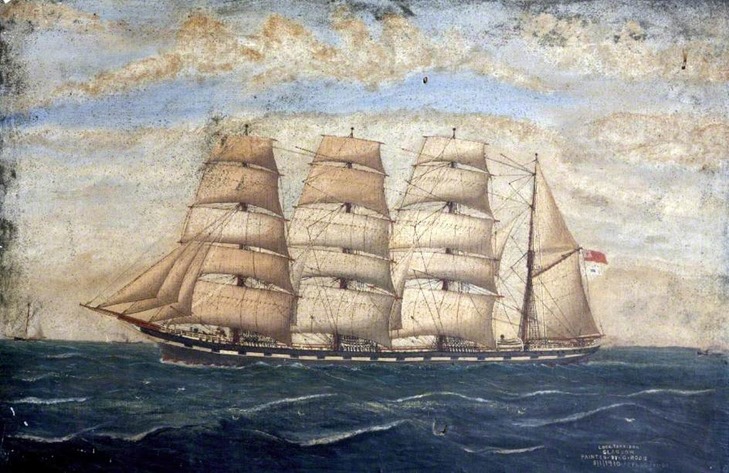
Loch_Torridon_(ship,_1881)_-_SLV_H27568-105
May 1903.


The Loch Torridon was a well known 4 masted iron barque trading between London and Sydney renowned for her speed and admired for her grace and elegance. 
Before her latest voyage, she had been for a long time held in Sydney Harbour unable to secure a freight.  The competition from steamships cut badly into the supply of cargos for companies employing tall ships. After so long being port bound, Captain Mearns and his crew must have been happy when the Torridon finally secured a shipment and headed to sea. 

The Torridon left Port Jackson and proceeded to Port Pirie where she shipped a cargo of ore destined for Antwerp.

70162657

Thursday, May 14 - Leaving Port Pirie,  via New Zealand before making her way around the Horn,   splendid progress was made until the vessel was 10 days out, when a heavy southerly gale was encountered.

Monday, May 25 - Labouring in the big seas she was struck by a tremendous wave which swept over the vessel.  Some 20 ft of bulwarks snapped off like twigs forward of the main rigging, while another 30ft aft was damaged. Fortunately, no water found it's way into the hold despite tons of water sweeping across her decks, one of the sailors was knocked over and badly injured.

Thursday, May 28 - Badly damaged and in the grip of the gale the Torridon had no choice but to make her way to Sydney.

Friday, May 29 - The steamer Clam passed the Torridon off Jervis Bay.

Saturday, May 30 - Concerns were raised for the Torridon in Sydney newspapers after the captain of the Clam which had now arrived at Sydney, reported passing the clipper off Jervis Bay in a dismasted condition. 

Sunday, May 31 - The Torridon suffered the heavy weather until Sydney, entering the harbour at
1 am, anchoring below Garden Island to await survey.


The Four-Masted Barque 'Loch Torridon'


The gale hit the southeastern seaboard hard putting many ships in danger of floundering.
The British Barque Shakespeare was towed into Port Jackson in a crippled condition.
The barque Caithness-shire lost two lifeboats and a lot of deck gear.
The Huddart, Parker steamer Zealandia arrived in Sydney in a battered state.
The ship Abby Palmer was in reported to be in tow from Newcastle to Sydney but because of the heavy weather was unable to enter.


image

The vessel which suffered the most and after which the gale was named was the Steamer Oakland which foundered on May 27 taking 11 of the 18 crew including the Captain to a watery grave. The story of the Oakland is one of bravery and endurance against overwhelming odds.
Continue reading about the Oakland - http://waratahrevisited.blogspot.com.au/2018/02/steamer-oakland.html

Torridon Specifications
- 2000 Tons. Built at Glasgow 1881 She was 287.4ft in length, a beam of 42.6ft and 24ft in depth.

The  Loch Torridon survived until 1915 when she foundered near the entrance to the Channel in the last days of January, and it is possible that she was torpedoed by a German submarine.

In 1904 John Arthur Barry, the Australian writer, wrote of her:—“She is exceptionally lofty as to her masts, exceptionally square as to her yards.  She carries nothing above a royal, but her royal yards are as long as the topgallant yards of most vessels. Her lower yards are enormous.
The vessel is uncommonly well-manned with 20 hands in the foc’s’le, with the usual complement of petty officers, together with three mates and four apprentices aft.  Looking forward from the break of the poop, one is struck by the immense amount of clear room on her decks, giving a visitor a sense of spaciousness and freedom in a marked contrast to the often lumbered up decks of the average sailor.”
Ref - https://www.gutenberg.org/files/52897/52897-h/52897-h.htm

Ref- https://collections.slsa.sa.gov.au/resource/PRG+1373/15/32
        https://artuk.org/discover/artworks/the-four-masted-barque-loch-torridon-95464#image-use


image

9 October 2014

Without a witness

The waters surrounding Jervis Bay, and the Shoalhaven have been known as an area where “the most amount of caution needs to be observed”  by sailors since it was first explored, vessels and boats have come to grief in and around the waters of the south coast on many occasions.
Many leave port full of hope, filled with cargo and are never heard of again, crews are lost and relatives and authorities can never know their story.
GAFF-CUTTER


The Cutter Brisbane.

One such story is about the 16 ton Cutter Brisbane in August 1832.
”Known as well adapted for the coasting trade”..

She left Nulladolla. (the early name for Ulladulla) for Sydney with a cargo that included cedar and cheese.
Selling products and produce like these were vital to the small coastal towns and ports, roads weren’t adequate for transporting large quantities' of goods, shipping the goods by sea was the most efficient way to get your goods to the markets and buyers.

Wreck found in Jervis Bay.
Captain Maraspin and her owner Kendall with her crew set off for Sydney and were never seen again.
The Wreck was later found in Jervis Bay by Aboriginals, but no trace of the crew was found, it was presumed the cutter over was lost after running into a severe storm.

Wreckage plundered.
Thomas Barker, on hearing of the tragedy, advised Thomas’s widow Jane to try to recover the missing papers from a Mr. Morris’s men, who had apparently plundered the wreck of the ship. The papers were never recovered.

Lucky escapes were also a part of the coastal trade.

It wasn’t the first time the cutter had been involved in an incident at sea.
”The Rev. Mr. Kendall and his boat’s crew had a miraculous escape, on Tuesday night, from a watery grave. They were sailing, with a stiff breeze, from Illawarra to Sydney; about 10 o’clock a sudden gust blew the boat completely over, and being eight miles from land, the unfortunate passengers gave themselves up for lost; the men contrived to get upon the keel, but Mr. K. was entangled in the boat, and could only just keep his head out of the water. After remaining in this perilous position for some time, inevitable death staring them in the face, the boat suddenly righted, and all hands were providentially saved.”
Extract from THE LIFE HISTORY OF MELINDA KENDALL THROUGH HER WRITINGS. by Peter Knox
http://peterknox.wordpress.com/thesis-in-progress/
There’s more to this story it’s a fascinating read.

Further evidence.
Investigations into history always finds contradictions and in this case the captain of the cutter in our initial research is named as “Captain Marispin”, but further research has provided other evidence by an ancestor claiming it was
“Captain James Florance on the ‘Brisbane’  wrecked near Jervis Bay, 1832”
Ref: http://www.roymorgan.com/~/media/Files/Papers/2009/20091206.pdf 

We will try and tell the story of these missing vessels as information becomes available and further research is carried out.
If you find a story/information and would like to contribute to this blog, please don’t hesitate to contact us
information is the key to knowledge.

Cutter definition.
The Cutter during the 18th and 19th centuries was a small, single-masted vessel, fore-and-aft rigged, with two or more headsails, a bowsprit, with a mast set further back than in a sloop.

10 March 2016

S.S Chimborazo ran headlong into Point Perpendicular.

Morning mist

Below this post there are some pictures of a dense fog taken on the 8th of March 2016.  At 5.30 am the bay was very clear, the water was as smooth as glass, with a very slight almost undetectable offshore breeze,
the stars were still visible, Jupiter was bright in the eastern sky and Point Perpendicular and the revolving lighthouse could be clearly seen from Huskisson.
At the time I was at Moona Moona Creek looking back at Huskisson, the town was shrouded in a rising mist, that was slowly drifting offshore, becoming thicker by the minute.
By 7 am. visibility had been reduced to around 40 meters, Point Perpendicular had disappeared,  the rising sun was reduced to a strange subdued glow, it looked like a dim light globe in the mist.

S.S Chimborazo

chimborazobw

138 years ago on March 14th 1878 the grand steamer S.S Chimborazo was passing Jervis Bay Under the command of Captain John Vine Hall, known as a gentleman of some experience in Australian waters,  she was travelling to Sydney carrying cargo and passengers.
The ship was making good way at full speed in fine weather on a remarkably smooth sea, shrouded in a heavy veil of mist.

Captain Hall was hugging the coast more closely than would have been prudent in such a large vessel.  At a quarter to 10a.m. St Georges Head was observed "not far off" the port bow,  the officer on deck sent word to the captain that the course the vessel was steering would bring her close to land.  Captain Hall merely altered her course to be N. by E. which would cause the vessel to go a little more to eastward than she would otherwise had done.

A second message was sent about seven or eight minutes later,  to the effect that the ship was close to land,  and that the officer on watch had hauled out.  This bought the captain on deck,  he found the ships heading to be N.E. by compass,  with a deviation of two points E. he saw Cape St George not very far distant; and when he was asked by the second officer whether he should keep the vessel's course up the coast his reply was - "No keep her as she is going at present."  all this time her speed was 12 knots an hour.

It's important to remember the sailing rules of the mercantile marine direct that when in fog the whistle should be sounded and the speed slackened, the Chimborazo was going ahead at full speed despite being in a heavy mist..

image

"Breakers ahead!"

Suddenly the alarm was given by the look-out on the forecastle in a tone bespeaking terrified earnestness  "breakers ahead".  There was no possibility of averting the danger,  quickly responding to orders the machinery was promptly stopped in it's action, but then quickly followed the crash, which was severe enough to throw passengers off their feet. There was a rush of passengers to the deck,  and before many moments had passed the shock explained the meaning of the sudden stoppage.

There was intense excitement and confusion particularly amongst the ladies.   The whole of the ships crew came swiftly into action,  and the steady and quick way in which orders were attended to spoke of the excellent nautical discipline.

The first order was to swing the ship's boats out in their tackles ready for lowering if the worst fears were realised,  and simultaneously guns were fired to inform the lighthouse - keeper of their distress.

The water was found rising forward of the collision bulk heads,  and then in the forward compartments,  but none had made it's way into the main compartment. It was found the ship had struck the rocks on the inner side of point perpendicular, and rested with her bows on the rocks,  and that round the place there was 23 to 25 fathoms of water,  while on the starboard side a sunken rock was visible.

15 or 20 minutes had elapsed when efforts were made to get the ship out of her critical position;  orders were given for all the passengers to run aft with a view of tilting the ship up,  and the engines being
reversed the ship slowly moved off but was not yet out of danger,  for grave fears were entertained that the fire compartments bulkheads might give away,  and in that case would have gone plumb to the bottom.

A coasting ketch observing the danger,  ran down and stood by the ship until she had got to an anchorage.

As the ship drifted into Jervis Bay,  all the passengers behaved admirably,  and were soon transferred to the boats,  the ladies and children being first placed in them with a supply of provisions.

In about half an hour all the passengers were landed on a little beach,  a few hundred yards from where the vessel struck,  the sailors  and others carrying the women and children through the slight surf.

The Chimborazo then went to Darling Roads,  a sheltered position in the southern part of Jervis Bay.

The passengers re-embarked onto the A.S.N. Companies steamer Collaroy,  which had been chartered by the agents, Messre. Gilchrist, Watt and Co,  to take them to Sydney.

chimbozaro repair

The ships bottom was examined by a diver and it was found that about 24 ft of keel from the cultivator aft, is gone;  some of the garboard planking is also damaged,  and there is a hole about 10 feet long in the garboard.

The cargo was unloaded onto the steamer 'Corea" to lighten her, and after a few days she slowly made the rest of her voyage to Sydney, where she was shored up in the government dock at Cockatoo Island.
The repairs were carried out at Messrs, Mort ADN Co's establishment.

'The bulkhead saved the vessel."
"Every one who has seen the fissure made by the rocks cannot but wonder and be thankful that she did not founder on the passage"

Fortunately the Chimborazo was built in compartments and, as Captain Hall laconically put's it 'the bulkhead saved the vessel."

download(4)

June 14 1878 - The Chimborazo's repairs were complete and she was launched from the dock at half-past 5' o'clock in the evening in the presence of some 400 spectators,  who cheered as the ship floated out into the bay.


Marine Board Inquiry.
After all the facts were presented the Marine Board decided the Captain Hall would have his license suspended  for six months.

This caused an uproar in the press of the day.

The Argus Tuesday 23rd April 1878.

"The punishment is ludicrously disproportionate to the offence.  If the Chimborazo had gone to pieces,  and the coast strewn with corpses of her passengers and crew,  with her valuable cargo, and with the wreck of a noble piece of marine architecture - her master would have been legally and morally responsible for the terrible disaster,  By  a wonderful stroke of good fortune this calamity was averted, but the culpable negligence or temerity of Captain Hall was so great as to deserve a commensurate penalty, if only to serve as a warning to other master mariners occupying similarly responsible position.
The temptations to make a rapid run from port to port in coasting voyages are so great,  while the means by which it is accomplished are full of peril to life and property that these adventurous experiments require to be sternly discouraged and repressed. But the decision of the Marine Board in Sydney in the case of Captain Hall is more likely to encourage than to refrain other 'smart" skippers who may be addicted to hugging the coast where the unnoticed inset of a current and a few minutes' fog,  are sufficient to doom a magnificent vessel, with all on board, to total destruction"

Hugging the coast.
The issue of vessels hugging the coast to reduce their time spent travelling from port to port and thereby reducing costs comes up time an time again in relation to ship wrecks.  in this case as described,  “It was a perfect marvel" the Chimborazo incident didn't become another tragedy that could have been avoided.


BACK