.

.
HOME OF THE LADY DENMAN - Local history isn't always about the big story - the everyday story of life in the early development of the region can be a fascinating, entertaining and educational journey.
Showing posts sorted by relevance for query whaling. Sort by date Show all posts

1 April 2019

Whaling Jervis Bay

As can be seen from this short and not complete list of whaling ships which came into Jervis Bay,  the bay was at one time a very busy location for the whaling industry.


1870 - The Hobart Town Barque Alladin towed two sperm whales into Jervis Bay to secure the blubber and boil down.

1871 - The barque Othello cast anchor with 65 tons of sperm oil.  She took a 10 sperm whale off Jervis Bay two day before anchoring in the bay..

1871 - The whaling barque Metaris came into the bay to try out a large sperm whale.

1871 - The American whaling barque Eliza put in to Jervis Bay for water. She carried 1400 barrels of oil.

1872 - The Sydney whaling barque Metaris, had been at sea for 10 months before putting into Jervis Bay to recruit. She had sixteen tons of sperm oil.

1872 - The whaling barque Waterwitch put into the bay to recruit. She carried twenty tons of sperm oil.

1872 - The barque Alladin put into the bay, she carried twenty tons of sperm oil.

1872 - The American whaling barque Asmanby has put in to recruit. She has been twelve months out, and has 700 barrels of black oil and 300 of sperm oil.

1872 - The whaling brig Louissa, 5 months at sea put in to recruit with 5 tons of sperm oil.

1872 - The barque Sea Shell towed two sperm whale into the bay for processing, they had been caught thirty miles off the bay.

1872 - The American whaling barque Three Brothers put into the bay to recruit, with 1400 barrels of sperm oil aboard.

1872 - Melbourne whaling barque Mary Hamilton 3 months at sea put into Jervis Bay to repair a lost bowsprit, she carried no oil.

1872 - The brig Velocity, four months at sea put into the bay with 4 tons of sperm oil.

1873 - The brig Velocity put into the bay to recruit. She reported green water and drift wood eighty mile offshore.

1873 - The Whaling barque Runnymede, 9 months at sea, put into Jervis Bay to recurit. She carried nine tons of sperm oil.

1873 - The barque Waterwitch put into the bay, fourteen months at sea, she carried 14 tons of sperm oil. During the voyage crew member Joseph Williams from Hobart, he fell from aloft and was instantly killed.


Continue on to more information about the whaling industry in Jervis Bay.


image


2 January 2014

Whale hunting – Jervis Bay

whale-harpoon-4
It doesn’t matter how many time you see a whale, it will always be an amazing experience and will be relived in your conversations over and over.

Between the months of May and July whales can be seen passing Jervis Bay during their annual migration north to their breeding grounds in the warmer waters of northeastern Australia.
There are many places to observe this annual migration and one of the local favourites is the lookout atop the cliffs near the old ruined lighthouse in Broderie National Park.
During September and November the whales will be seen heading south on their return journey, many with calves. During their return many call into the bay, sometimes they can be seen a short distance off the beaches.  In 2012 a southern right whale confounded the experts and attracted large crowds of onlookers by staying just outside the entrance to Currambene Creek, the experts had all sorts of theories, it was resting, it was sick, it might have been attacked by sharks or hit by a boat, we heard it all, but the whale surprised everyone because a few days later it gave birth to a beautiful calf before moving off with its new baby to finish their migration south.

Jervis Bay has a number of tour operators more than willing to give you a close encounter with these magnificent marine mammals. Detail of these can be found at the visitor's centre inside the museum.


Types of Whales Hunted. There were two main types of whales pursued in our waters, the
Humpback (Megaptera novaeangliae) and the Southern Right Whale. (Eubalaena australis)

Other whales were also caught along our coast, the much rarer giant of the sea the Blue Whale was also caught and processed inside Jervis Bay.


hb


srw


Haunting whale sounds here.

’Bend ya backs and row me lads and take me to me whale”
In the past this annual migration was exploited by whale hunting companies.  Whale oil and other parts of the whale were a valuable resourse.  All of which can be replaced with synthetic equivalents now.

I didn’t know they hunted whales from Jervis Bay?

Whalers visited the bay hunting whales as early as the 1790’s right up until 1913.
Large whaling ships called into the bays sheltered waters during whale operations along the southern coast and reprovisioned their ships at Bristol Point.

_MG_4483
1790’s
Whaling was a messy, smelly and dangerous low paid job and when gold was discovered in the hills behind Jervis bay many of the ship crews would desert the ship hoping to strike it rich in the gold fields around Nerriga and Yalwal. Calling into the bay became less desirable for ship owners and eventually stopped.


cpt-william-kinghorn 

1840
Captain William Kinghorn set up a land-based operation on the northern side of the bay near Montague Point on the Mount Jervis property belonging to his father Alexander Kinghorn. There is an area of land between Culburra and Currarong named after the family,  Kinghorn Point, and can be accessed from the road out to Currarong. There are two streets named after the family as well, Kinghorn Street in Nowra and Goulburn. Captain Kinghorn in his 80's died in his home at Goulburn in 1878.

1859
It is unknown how long his whaling operation existed in the bay, but the Caroline was wrecked at Point Perpendicular and the crew made their way through the bush and came upon the station of James Kinghorn, Esq., “who’s superintendent rendered them every assistance”. so it appears that the whaling station was possibly still operating in 1859.

Read more - Captain William Kinghorn

 whale-harpoon6
1912 
The Norwegian factory ship the Loch Tay, plus three chasers the Sorrell, Campbell and Lionel arrived in the Bay to hunt whales with the full support of the NSW government. During the opening season they harpooned 158 whales.
Their eventual take totalled 537 whales in two seasons, but they were forced to close because of the strong odour which drifted across the bay  during the summer northeasters, reaching the Royal Australian Naval College (HMAS Creswell) and Huskisson.  There were also complaints about the putrid offal floating in the bay which attracted large sharks and made the navy’s training operations dangerous.

ih


One of the beautiful paintings by Ian Hansen on display in the museum, depicting whale operations near Bristol Point.

1917

Records show there was also a small whale hunting operation running on the southern side of the bay, near Bristol Point and Greenpatch, this operation may have been used to supplement the fishing families income.

whale-harpoon5


1919
An investor Mr Moore, was willing to spend large sums of money to set up another large land-based operation in the bay. With the experience of the previous operation and after correspondence between the NSW Premier and the serving Prime Minister William Watt, the Prime Minister stated!
“it would be unwise to permit the establishment of a whaling station which is in close proximity to the Naval College  HMAS Creswell" and with that, all whaling from Jervis Bay ceased.

 whale-harpoon-2
Today: Fortunately for us all, most countries have ceased whaling operations. In the oceans close to Australia the Japanese are still conducting operations under the ridiculous facade of research.
Despite this the whale population around the world is slowly recovering, but sits on a knife edge, with more pressure being applied to the few remaining whale hunting countries to stop operations. Hopefully we will see some common sense and a return of large numbers of these amazingly beautiful creatures to our oceans.

The museum has a fine collection of equipment and information on display from the whaling industry, some can be seen on this page,  pay us a visit and take a walk back into an era long since past!

bone-ship
One of the museums finely detailed model of a ship made from whale bone.


Continue reading about whaling in and around Jervis Bay.

REF: Read more:


image

5 June 2018

The Barque Sapphire and the Barque Narramissic 1874

historyofwhaling2
The sea near Jervis Bay and the clear waters of the bay ran red with the blood of the whale industry.|


Whaling was a dangerous and unforgiving enterprise.

When a whale was spotted, ships would begin the chase, trying to draw near enough to lower their boats, manned with hard weather-beaten men, armed only with a hand-propelled harpoon, determination, and hopefully, luck. If they managed to catch and kill this great leviathan the men would now have to tow the whale by sheer back-breaking effort back to the waiting ship.

Death and injury was a common occurrence for the chasers, but the danger didn't stop there, when the whale was drawn on board, danger was ever present.

Sailors survived on limited rations in cramped quarters aboard creaking ships, as one sailor expressed, "we worked like horses and lived like pigs." Timber decks soaked in the fluid from processing whales were extremely slippery, men came down hard onto the deck, men slipped overboard to the waiting sharks drawn by water running with blood, men could be crushed by the weight of blubber being hauled into copper cauldrons in the try-works, they suffered deep lacerations from the sharp tools used for processing the whales.
Everything, including the men were covered in whale oil, all this aboard a ship pitching and rolling on an unsettled sea, hot oil from processing cauldrons could spill onto the fires, this could easily spread engulfing the ship and the crew, many ships left port and were never seen again.

When the processing was complete which could take 6 hours or more depending on the size of the whale, the crew would scrub and clean the ship as best they could,  despite their best effort, ships sailing downwind would always know when a whaling ship was approaching by the smell.

Collision at sea.

There were dozens of ships plying the coast chasing whales, collisions between ships occurred.


One such incident occurred 30 miles south of Cape St George between the whaling barque Saphire and the barque Narramissic.

10 September 1874 - The barque Narramissic left Newcastle bound for Melbourne and ran into heavy weather and was forced by leaks into Sydney Harbour.

20 - September 3am - The barque Narramissic left Sydney Harbour continuing her voyage to Melbourne, 30 miles south of Cape St George, in the pitch black the silence was shattered by the violent sound and vibration of two timber ships coming together.

The Hobart Town barque Sapphire,which was not displaying any side lights, struck the Narramissic with her flying jib-boom on her mizzen chains. The Sapphire lost one boat and her spritsail yard.  The Narramissic had her stanchions and gaff carried away, her covering board and spritsail were also damaged, five of her crew, thinking she was about to sink, jumped on board the Sapphire, leaving the master and three men to bring her into Jervis Bay, where repairs would have to be carried out before she could sail again.  The Sapphire came into Jervis Bay the following day.

The Narramissic stayed in the bay for 4 weeks wind bound because of terrible gales which had damaged other vessels caught at sea.

Once the repairs were finished the Narramissic sailed out of Jervis Bay continuing her journey to Melbourne.  She ran into more heavy weather, the second mate and a seaman named Christopher Tomkin went aloft to secure the yard-arm of the upper main topsail, which had got adrift from the gaskets. The sail caught Tomkins, who was 36 years of age and a native from Berwick, England, and knocked him overboard. A life-buoy was thrown to him, and the master hove a line to the drowning man, which he almost clutched but did not catch, the vessel drifted away from him, the weather being so bad as to preclude the possibility of rendering
him any assistance.

The Narramissic's voyage had been cursed with near disaster and tragedy.
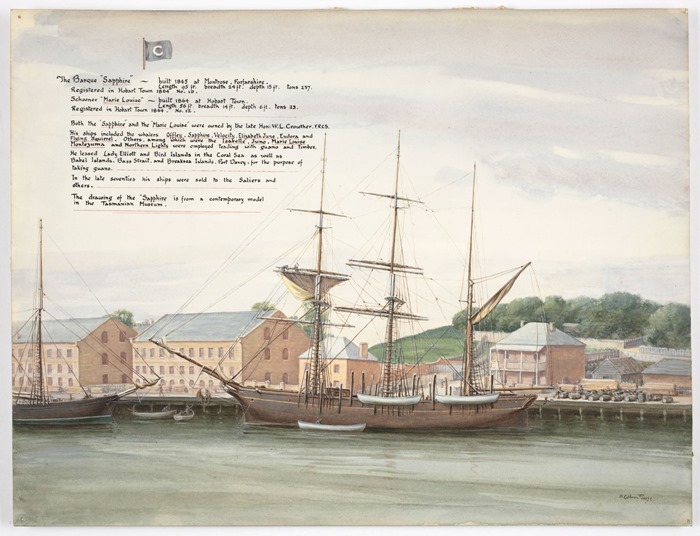
sapphire

The whaling barque Sapphire was a regular visitor to Jervis Bay,

1872 December - she put into Jervis Bay after a 10-month voyage from Hobart Town to recruit. She had taken 28 tons of sperm oil.

1875 February  - during a 14-month voyage she came into the bay to try-out 9 tons of oil,
the total take of oil for the trip was 21 tons.

By 1885 the romance of going to sea chasing whales was starting to decline, many whaling ship owners found it difficult to secure suitable crews and were forced into taking anyone that offered himself.  The Sapphire was involved in an incident when as was customary at the time, the owners would advance the willing a small sum in advance of the voyage.  Taking the advance these larrikins would often spend the money, then not join the ship as required when it was time to sail. The police would be called and these reluctant absconders would be arrested and taken aboard the ship.


image


26 August 2015

1919 – Huskisson, population 200.

 
image

When these pictures appeared in the Western Mail Perth in 1919 along with a short story about the neglected but beautiful Jervis Bay,  there was only around 200 people living at Huskisson,   most people were employed in the timber, fishing,  and ship-building industry.

Gone were the days when large bullock teams loaded with wool, tallow and hides from the big Monaro and Riverina Stations lumbered to the bay along the wool road to be loaded onto ships waiting safely at anchor near Lambs Point, known then as South Huskisson,  they were loaded from a stone wharf built  near the present day suburb of Vincentia at a place  better known these days by local surfers as the  “ Viny boat ramp”.

boat-ramp
The bustling township that once thrived, comprised hotels, blacksmith shops, and stores that grew around the wool industry had long since disappeared back into the landscape,  the wharf had fallen into disrepair and most of the people had moved away. – Continue reading about South Huskisson

image


Sydney Mail 1931

 image

Huskisson was now the only town existing on the shores of the bay, timber was still being cut from the surrounding forests of Wandandian and Tomerong and transported to Huskisson to be loaded onto waiting steamers.  Despite having to go further back into the forests  and deep gorges to secure the slowly disappearing timber,  a new timber mill was built near Huskisson employing the latest technology available for the time.

image

Tourism was becoming more important, a look through local papers from the time reveals many stories about how good the fishing and shooting was.

”The bay was an ideal but little known tourist resort, offering splendid facilities for fishing, shooting,  boating and surfing”. 

  The Shoalhaven News and South Coast Districts Advertiser – 1919.  
 

“Schnapper fishing is the order of the day.  Many large catches are reported by visitors.  Several men make big money by schnapper fishing.  Many are caught weighing from 14ib, to 20 lb.  These fish sell at 1, shilling 3 pence,  per pound”.

”Last Sunday Mr Timbery made one haul,  and landed about 80 box’s of beautiful bream.  Fishing is good if not better than dairy farming”


The Dents and other ship-builders were still building wooden ships,  steamers and sail,  on the banks of Currambene Creek.

Whaling was still being carried out from the bay,  an application was made to the Land Board for 80 acres on the north side of the bay fronting Montague Roadstead to build a new whaling station and factory to extract oil and treat the residue. This proposal was eventually rejected on environmental grounds.   Despite these activities the bay was still relatively unknown.
Whaling Jervis Bay, Continue reading
image
Progress was slow, local business people pushed for progress,  but they were constantly frustrated by the lack of interest shown by politicians from all parties to see the bay for what it could offer the colony.

image

Big hopes for the prosperity of the bay".
At this time the biggest change to come to the bay and one that many hopped would once again attract industry and prosperity to the bay was the Australian Naval College constructed on a small protected headland on the southern shores of the bay known as Captains Point,  400 men were employed in it’s construction, promises of naval dockyards and repair shops and the work being carried out on a clearing for the long promised railway line that would connect the bay with the Federal City gave local business people great hope for the future prosperity of Jervis Bay.

image

By 1919 most of the work had been completed on the college,  but right from the beginning there were protests coming from Sydney politicians in opposition to the facility because of the costs associated with training the cadets.

195-bullock-teams-timber-for-Creswell-1912-aBullock teams bringing timber for the construction of the Australian Naval College - 1912

The base came under further attacks when a Shoalhaven News report had a story about a meeting being held in Nowra to protest against the proposal by Sydney to convert the the Naval College into a quarantine Station.
Fortunately this proposal never saw the light of day.

But like so many other grand visions,  the promised railway was never constructed, no major industries came to the bay, and the bay essentially stayed the same as it had always been,  a tranquil beautiful place.
BACK


17 March 2015

Whale stoves in boat – Jervis Bay

image

The greatest gamble on earth, with life as the stake, that is the industry of whaling.

Whaling meant many months at sea for the crews involved, long periods of boredom staring at the ocean looking for whales, the time was spent maintaining equipment and the ship. Once a whale was spotted, adrenaline charged excitement pulsed throughout the ship, men scurried to their positions and the chase began.
Dangers were ever present for the sailor, with many sailors loosing their lives in the pursuit of a meager living.

One such incident happened inside Jervis Bay in 1878 as reported by Captain Folder.


“ Mr. Thomas Graham, the first mate,  was fast to a whale in Jervis Bay, on November 8, another whale stove in the boat by biting it.   The crew were subsequently submerged, and one of them, named John Cannoord, known by the sobriquet of ‘Hydrabad,’  who could not swim was immediately drowned, notwithstanding the efforts of the first mate to save him.  In endeavouring to rescue Cannooard, Graham was also nearly drowned, Graham and the reminder of the crew, except the one alluded to, were rescued,  after being in the water for about half and hour.

 
.
This short incidental account, appeared in the Hobart Mercury, amongst other shipping and whaling news.
Old whale song.
 

Oh!  the rare old whale, mid storm and gale,
       In his ocean home will be,
A giant in might,  where might is right,
       A king of the boundless sea.


10 March 2015

Whaling - Jervis Bay

Sydney Mail (NSW : 1912 - 1938), Wednesday 4 March 1914, page 5

Below are just a few of the many articles appearing in newspapers about whale operations being conducted in and around Jervis Bay in the late 19th and early 20th century.

They highlight how active early whale hunting was and how Jervis Bay was used by many whalers for processing, shelter, and recruiting crews, but how over time, objection to the industry started to mount.

   
image Article appeared
1871.
image 1870.
 image 1871.
image 1872.
image 1872.
image 1872.
image 1872.
image 1875.
 image 1912.
 image 1912.
Whales started to disappear.  
image 1912.
image 1914.

Norwegian’s want to re-establish whaling operations at Jervis Bay.
The Commonwealth and local residents express their concerns..

1914.
 image 1914.
image 1914.
image 1919.
.  
whale-harpoon5

The Museum has an extensive collection of information and artifacts from the whaling industry on display.

Whalers – Jervis Bay

The Factory ship Loch Tay.
The history of the largest factory whaling ship to work from Jervis Bay.
TBG14219110220001 Loch Tay

Built 1893. and named the SS Loch Tay, Newcastle UK for the Dundee Loch Line Steam Ship Co. Ltd.
5,474 tons gross and 3,300 tons net. 410 ft long – 49ft. 3inches in breath and 30ft deep.
1911. Sold to the  Australia Whaling Company Norway and converted to a whale processing vessel.
The Loch Tay and three new whale catchers Campbell, Lionell and Sorrell began operations off Jervis Bay, but found the whales merely passed our coast at certain seasons.   After 3 months of operation only 150 whales had been caught, one of them measuring 90ft in length.
They up anchored and proceeded to test the New Zealand waters, after only a few months they found the same problem there, despite catching thirty three sperm whales, which are one of the best obtainable for oil,  the fleet returned to Jervis Bay.

image

 
  thick-heads  

After returning to Jervis Bay for a second season it proved to be a good season for whales and no fewer than 329 were caught and dealt with.
.

The Sydney Morning Herald (NSW : 1842 - 1954), Wednesday 6 August 1913,

   text  

1912. They moved the operation to Western Australia but ran into the same sort of problems with the authorities as they had with their Jervis Bay operation, and with the Freemantle Whaling Company.
1913 they closed their operation because of rising costs and the ongoing conflicts with authorities and trade unions.
1914. The company was liquidated, and the Loch Tay was converted to a cargo ship.
1918. She was Grounded and wrecked at Cap Ruby, Morocco with a cargo of wheat.

   scent  

Ambergris  is a solid, waxy, flammable substance of a dull grey or blackish colour produced in the digestive system of sperm whales.

Freshly produced Ambergris has a marine, faecal odour. However, as it ages, it acquires a sweet, earthy scent commonly likened to the fragrance of rubbing alcohol without the vaporous chemical astringency. Although ambergris was formerly highly valued by perfumers as a fixative (allowing the scent to last much longer), it has now largely been replaced by synthetics.


wikipedia

Ref: Loch Tay image.
http://skipshistorie.net/Tonsberg/TBG142AlfMonsen/tekster/TBG14219110200000LochTay.htm

29 March 2016

Whaling Jervis Bay

historyofwhaling2

Jervis Bay has a thriving tourist industry based on whale and dolphin spotting.
These companies still hunt whales,  but in a completely different way.

Between June and August the magnificent Humpback Whales move north along the east coast of Australia, coming from the cold Antarctic where they have spent the summer feeding on krill, they head north to the sub tropical waters of north Australia to mate and give birth.

Then between September and November the whales travel south again, heading back to the Antarctic to feed.

Just like the whale hunters did in 19th century the tour operators today head out from Jervis Bay in large boats seeking whales, but now the boats are filled with tourists all hoping to capture a glimpse of these magnificent animals during the migration.

But,  it wasn't that long ago whales were being chased in the waters near and inside Jervis Bay for a totally different reason.    Between 1949 and 1962,  8300 whales were killed along the east coast of Australia.  mostly humpbacks as the more favoured blue whale and southern right whale had became scarce.

I came across this article from 1918,  about whalers lobbying the government to allow a whale station and processing operation to be built inside Jervis Bay.

Thankfully this operation was never allowed.


This small article is from the 

  • Albury Banner and Wodonga Express (NSW : 1896 – 1938.  Fri 19 Jul 1918
image
_MG_4485a

You can see this harpoon gun and much more on display inside the museum,  the display is a real eye opener into the role Jervis Bay played in the whaling industry on the south coast.

You can also see other posts about whaling and jervis bay by typing whales into the search box in the right column.