.

.
HOME OF THE LADY DENMAN - Local history isn't always about the big story - the everyday story of life in the early development of the region can be a fascinating, entertaining and educational journey.

9 May 2015

Moon rise over Jervis Bay

We have had some spectacular moon rises during last week, the moon came up over the horizon as a huge orange ball.  After all the recent rain it’s been a magnificent week of crystal clear skies and offshore winds.
IMG_9089

8 May 2015

Kingfisher returns home

Today was another historic day in the history of local shipbuilding and the museum.
4.30p.m today, the timber trawler Kingfisher arrived securely tethered to a large trailer all the way from the central coast town of Wow Wow.

She has returned not far from the area where she was built by local boat builder A.W.M Settree.
I took a few photo’s of the historic occasion and soon I will supply more details about this hand crafted vessel, and how and why she has returned to Huskisson.

 kingfisher-2015-arriving-at-museum---f

John Settree who worked along side his father Alf Settree and grandson of A.W.M. Settree, building timber boats on the foreshore of Currambene Creek,  can be seen here in blue watching the unloading of the Kingfisher.

8th-may-2015 8th-may-2015---b 8th-may-2015-l
The men worked into the dark to secure the Kingfisher.
panna

 BACK

7 May 2015

Shoalhaven Snippets

 
Small stories from local newspapers.
Shoalhaven Telegraph, January 7th 1903 _ The new Shoalhaven by-laws

“Any person who shall suffer any kind of swine or any ass,  horse, mule, sheep, goat, or any horned cattle belonging to him or her,  or under his or her charge, to stray or go aboard or to be tethered or de-pastured in any street or public place within that portion of the municipality beyond the town boundary shall,  on conviction,  forfeit and pay for such offence a sum not exceeding forty shillings and not less than five shillings”

Moona Creek 1903.
A correspondent,  writing from Jervis Bay,  draws attention to the need of a footbridge across Moona Creek.
Moona Creek Footbridge design - Shoalhaven Telegraph, July 1921.
The trustees of Deas-Thomson Estate, of 2500 acres,  submitted a design for a footbridge over Moona Creek 340 ft long. _ It was decided by council that the plan was not up to a standard design.
1106-Footbridge


walking-bridge-remnants-2walking-bridge-remnants

I took these this morning, 7th May 2015, there are still some remnants of the footbridge to be seen.

image

Daily coach to Captains Point – The Shoalhaven News and South Coast Districts Advertiser. 1913

Ben Loutit has started a daily coach to Captain’s Point, arriving here about seven o’clock each night,  and departing the next morning early for Nowra via Huskisson.
    It is also the intention of Mr Thomson to start a similar line for the convenience of Captain Point residence.

In 1913, Travellers were transported by horse and buggy with the journey from Nowra to Huskisson taking 2 hours or more,  depending on the weather and road conditions.

Ben-Louttit's-passenger-coach 
By 1916, vehicle’s had replaced the horse drawn passenger coaches.
The roads were still in a bad state, potholed, corrugated, and poorly maintained, the trip would often have been a very uncomfortable affair.

First-service-car-of-George-Dent

George Dent, always one of the first to see opportunity, quickly invested in transporting visitors and locals.
Above is George Dents first Service Car.

image

The above advertisement appeared in the Shoalhaven Telegraph 1916.

School of Arts Huskisson. 1913
The School of Arts is making headway just now.  Cards and Dominoes and Chess for the winter evenings,  with and occasional concert.

Meaning: Moona, Aboriginal for plenty.

BACK

6 May 2015

Rainbow Warrior leaves the bay

I was Johnny on the spot today – pure chance had me in the Booderie National Park with camera in hand,  and was lucky enough to catch the Rainbow Warrior leaving the bay.
The vessel has been anchored near Honeymoon Bay for some days now and today the winds were a brisk offshore westerly, the roll of the ocean had calmed down,  it was a good day for sailing.
The photo shows her passing under Point Perpendicular,  sails set as she headed north towards Sydney.
See previous post with video.

 IMG_8965a shooting into the morning glare and reflections without a polarising filter wasn’t the ideal.
pana
IMG_8984a Also the sky has a little dust from out west being blown in by the strong westerly winds, the air wasn’t a clear as normal….
BACK

5 May 2015

100 YEARS AGO – Jervis Bay

I found this article titled “HINDS HUSKISSON HAUL” in the Shoalhaven Telegraph dated Wednesday 28TH 1915, while I was researching information about the early days of fishing in and around Jervis Bay.   It turned out to be something completely different.
It appears the local police 100 years ago were kept very busy as well.

image


At the Police Court, yesterday before the P.M Constable Hinds, of Huskisson,  presented a batch of offenders.

    Peter Kinimont pleaded guilty to two charges of over-loading and was fined 10s and 6s costs,  for each indiscretion,  14 days allowed to pay.

    W. A McKenzie,  for exceeding his liquid-carrying capacity, was fined 5s and 6s costs.
 
     Jim Casey,  against whom a prohibition order is in operation,  pleaded guilty to being found on licensed premises.  - The Jervis Bay Hotel, The constable said that Casey went into the bar and called for drinks,  but the licensee refused to serve him, Fined 20s and 14s costs.

     Jimmy May pleaded guilty to using language that the P.M. characterised as vile,  and was fined 40s and 6s costs.   On a further charge of carrying excess cargo,  Jimmy was fined 10s and 6s costs.  He was allowed 14 days to induce the ghost to walk.

     Robert Turnbull,  who carried a fair load to the court,  was fined 10s and 6s costs for being “moiled” and 60s and 6s costs for using insulting language to Constable Hinds.
     “Can you pay that ?” asked senior constable Donnellan.  “Sixty bob ? – Oh No.” said Robert,  and he went to the seaside at Wollongong for a month.

      John Manning who failed to appear,  was fined 5s and 6s costs for being unable to disguise his insobriety.


Interesting set of fines for an interesting set of offences.
Meaning: Moiled - move around in confusion or agitation.

image

Following on from the previous story about insobriety and alcohol affected locals, I came upon another story.  This one had the Jervis Bay Licensee, W. J. B. Cambourne,  prosecuted for serving drinks to 5 sailors from the HMAS Franklin of the College at Captains Point on a Sunday.

Franklin copy1916: Tender HMAS FRANKLIN at the RAN College, Jervis By Malcolm Perkins
https://www.flickr.com/photos/41311545@N05/5250499965/
you can see this mage and more on the Horatio J. Kookaburra flickr page.


Constable Hinds’ was a busy man.


In 1915 it was illegal to sell alcohol on a Sunday,  unless the person was a lodger or bone-fide traveller,  to be a bona-fide traveller one had to live 10 miles or more from the establishment serving alcohol..

To make it more interesting,  the party concerned had travelled by sailing boat from the college and not by road.


The prosecution, after expert opinion was tendered by Lieutenant Morton Henry Moyes from Captain’s Point,  an expert in measuring distance,  told the court,  “the college by water was less than ten miles,  and less than 10 by road, even if you had to use alternative routes when the road was in a bad way after rain, it was still 10 chains short of 10 miles”.

In the Licensee’s defence they argued the licensee had asked the men if they were bona-fide travellers?  and the men had answered yes!.   
    The licensee presumed the men had travelled by road and was unaware they had come by boat, they were in their uniforms, so he knew they were from the college.
    The defence argued there had never been any warning given to the licensee before,  and the hotel under other licensee’s had served many men from the college for many years  beforewithout any problems.
    It also stated it was a general belief,  the college was 10 miles from the hotel in question, and 10 chains was only a small shortfall, and could be accounted for, depending on which track you had to use.
    The defence also argued that travel via the bay,  should not be considered a public thoroughfare.

After much argument.

The final Judgment.
The P.M. Mr Clegg, thought it quite possible the defendant thought it reasonable to serve the men from the college on a Sunday because it had been a custom to serve liquor to men from the college in the past.
        P.M. :  “That was not a reasonable conclusion,  the licensee should have made better enquiries to elicit the facts and made reasonable enquiry to the distance travelled”.
       He also stated, “A man was not a bona-fide traveller if he visited a hotel solely for the purpose of obtaining a drink, and in this case the party in question appeared to have had no other object in going to the hotel but to obtain a drink”.

The P.M. said he had weighed the evidence without any bias,  but he was glad he had been able to come to a decision,  as it was a bad thing to have the temptation of a hotel where the men and boys at the college could get a drink on Sundays.

”How times have changed”

A fine of 3 pounds was imposed.

The P.M, allowed 30s each for the witnesses.
8s for Constable Hinds.
8s costs to Court.
2 pounds 2s professional costs.


Meaning - A chain is a unit of length. It measures 66 feet, and 80 chains in one statute mile.
.

The above story has a sad story attached to it,  it involves the 5 sailors, loss of life and heroism. I will post that another time.

BACK

4 May 2015

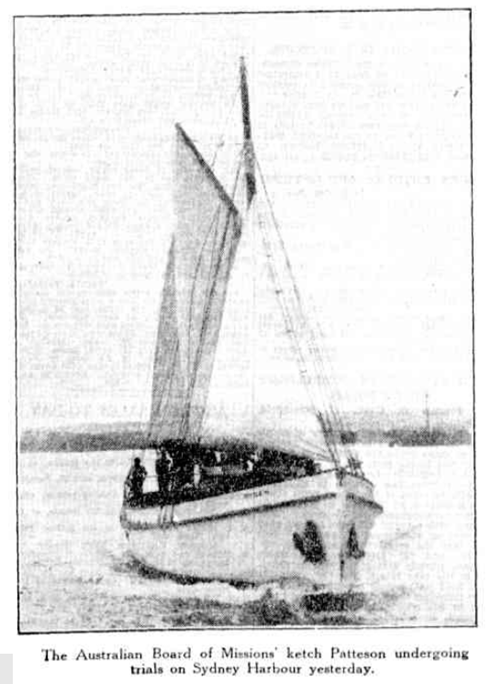
The Ketch Patteson 1934

image

 The new mission ketch Patteson, entered Jervis Bay seeking shelter from heavy seas.

Sydney Morning Herald Jan 19 1934.

image
The vessel which was completed for the Australian Board of Missions in January 1934 measures 46' x 13' x6'3" (13.72 m x 3.96 m x 1.91 m).

image

January 19 1934
Leaving Sydney on January 19 she encountered heavy weather,  battling on, it was noticed that two large sharks were following the vessel.  The Patteson kept her engines running continuously for four days, with mountainous seas sweeping over the little vessel.  Finally, it was decided that the ketch should put into land to ascertain it’s exact where-a-bouts.  To the surprise of the crew, it was found that they were at Jervis Bay,  87 miles down the south coast when they had imagined they were well on their way north towards the New Hebrides. The ketch had traveled 800 miles during this time.
The Patteson proceeded back up the coast to Sydney,  and adjustments were made to the faulty compass and instruments. 


image
The crew from the Patteson – left to right, Carl Halverson.  Capt. W. Delmer, A.Cant. L.J.Warren.

Her adventure didn’t end there.

In what was an amazing piece of navigation, during her second attempt to get to her destination she was forced back to Sydney after her rudder broke near Middleton Reef,  the crew were forced to sail 600 miles with the aid of a jury rudder back to Sydney for repairs.
The rudder consisted of two paddles from the small life boat, strapped to either side of the ketch.  Running into heavy weather and huge seas,  the paddles required two men to work,  it was extremely difficult and tiring to try and steer the vessel in heavy weather,  strong winds blew her many miles off course,  but she handled the conditions admirably, and was regarded by her crew as an exceptionally fine sea boat. 


1


Third attempt.
Leaving Sydney on March 8 for the third time, the crew must have been thinking “what next”, On this trip she battled through a cyclone between Lord Howe Island and Noumea and finally made their destination on March 21,  four days later than expected..


Details of vessel.

The   Patteson   was   built   at   Neutral   Bay at   the   yards   of   Mr.   Lars  Halvorsen,   and she   sailed   on   January   15   for   the   New Hebrides,  where   she   will   be   used   for mission   purposes. She   is   fully   rigged,  and   is   fitted   with  a   30   horse-power   Fairbanks-Morse-Diesel engine,  which   will   enable   her   to   maintain an   average   speed   of   eight  knots,   and   to attain   a   maximum   of   about   12   knots.   The main  cabin,   situated   in   the   centre   of   the ketch,   is   10   feet   long,   and  has   a   width   of 13   feet.   Quarters   are   provided   for   the crew  forward,   and   there   is   a   hold   aft   for passengers’   luggage  and   stores.   The engine-room   is   fitted   with  fuel   and   air tanks,  and  contains   a   dynamo   and   accessory engine  in   addition   to   the   main  equipment.   Electric   lighting   is   installed,  and a   small   searchlight   will  be   carried.


Meaning: Jury rudder – a rudder constructed for temporary use.

REF: Australian Maritime Museum - http://collections.anmm.gov.au/en/objects/details/64543/rig-and-sail-plan-for-ketchrigged-vessel-patteson;jsessionid=9AC31D95EAD0FB9A77E54BFEE5072C33?ctx=2898f0bb-0225-4dba-840d-86012ccd4700&idx=145


image

2 May 2015

Rainbow Warrior

If your wondering what the two masted ship is anchored on the far side of the bay at Montague Roadstead is ?,…..  it’s the Greenpeace vessel the ‘ Rainbow Warrior”.  It looks like a scene from the early 19th century, when sailing ships would call into the bay and seek shelter at Montague Roadstead from storms, or to resupply their water and food, and sometimes recruit men for a life at sea on the old whaling ships..
rainbow-warrior
The sailing ships of their time were  highly evolved technical achievements,  this ship is no different.  view the video to find out more about this amazing ship.

Early this morning before dawn I could see a large array of bright red lights reaching into the sky on the far side of the bay, on what appeared to be a four masted boat of some description. It wasn’t until after the sun rose and I shot this pic with my long lens, I could make out what it was,  it still didn’t explain the four masts, until i watched the video.
 

HOME

1 May 2015

30 April 2015

Latest Exhibition

IMG_5684

It’s a great time to visit the museum, there are currently two exciting exhibitions on display. In the Vera Hatton Gallery we have the Gallopoli Exhibition, a collection of images from the Gallipoli campaign.

The other exhibition is a collection of beautiful prints by local artist Lois Johnson, Lois lived in Japan between 1986 to 2007,  she studied and learnt traditional Japanese woodblock painting techniques, her work interprets these themes and subjects through the eyes of a western observer, as part of the display are skillfully carved woodblocks that clearly illustrates the skill involved in making these prints.

IMG_5683Lois incorporates subdued embossing in her artwork, the work is stunning and should not be missed.


28 April 2015

Jervis Bay Snippet.

image

Evening News Thursday 2 1903

Seagoing tugs ventured up and down the coast looking for incoming vessels to tow into ports, it appears from the story below, the race to secure a tow became very competitive and dangerous.

It was reported in Sydney to-day that a some what exciting incident occurred off Jervis Bay on Tuesday afternoon,  between two well known tug-boats.  The boats involved are the Port Jackson, of Messrs, J and A Browns fleet, and the Advance,  one of the Messrs, Fenwick’s well known tugs.

It is understood that the tugs had been off the coast,  as usual,  looking for a tow,  and their quarry was the Italian ship Beecroft,  a wheat laden vessel from the Argentine for Sydney.

The two tug boats were both racing for the Beecroft – the Port Jackson on the starboard side,  and the Advance on the port side.  The former was about half a length off the Advance,   and looked as if her captain was going to have first say to the captain of the ship.
The Advance,  it is alleged,  then ported,  and came up under the ship’s stern,  to the starboard side,  and,  in doing so,  struck the Port Jackson a sliding blow on the port side,  cutting through an iron band into the hull,  and gliding forward carrying with her part of the band,  and buckling it somewhat,  The Advance it is further alleged,  ported just before,  thus accounting for the sliding blow and buckling of the band.  The Port Jackson was struck almost amidships,  and near the coal bunker. She then steered a bit seaward,  but afterwards straightened up,   and proceeded alongside the Beecroft,  and made terms with the captain.  The Port Jackson,  therefore,  got the tow.

Both tugs were eventually wrecked.

1908 - The Advance: The Tug Advance was involved in another collision of Catherine Hill Bay,  this time while she was engaged in trying to secure the tow for the 4 masted Barque the Iverna on Christmas Day 1908.  No explanation for the collision was forthcoming, other than it there was heavy fog at the time.  the collision resulted in the  Advance overturning,  the boiler exploded and she foundered,  despite the captain of the Iverna lowering boats, and an exhaustive search no crew were found,  the following morning the mate of the Advance floated onto shore and was rescued.

Follow this link to see a Youtube video of the wreck. – very interesting – video link

1910 - Port Jackson:   The Port Jackson went ashore 5 miles North of Nora Head and become a total wreck.  All hands reached shore safely.

If you would like to read more about the fascinating story of Tugs,  follow the link below. 

image Tugboats

by Randi Svensen, 2011.

Early steam tugs oiled the metaphorical wheels of trade by freeing sailing ships to make or leave port in unfavourable winds or by towing them between ports when there was insufficient wind. When oversea ships became powered, tugs assisted these large, unwieldy vessels to manoeuvre in ports, and also provided valuable salvage and fire-fighting services.

Continue Reading

24 April 2015

Anzac Day.

Huskisson Street March –  commencing at 11.00am.

A camera on Gallipoli.
Opens Saturday 25th – 10am.
To coincide with the 100th Anniversary of the Gallipoli Campaign, the museum will have an amazing collection of images by Charles Ryan on display – this is another quality exhibition and one you should not miss.

war-poster
  IMG


The Museum has a book by Alan Clark about the Waratah Recruiting March that set off from Nowra on Tuesday November 30, 1915, it was the biggest crowd Nowra had ever seen.
It’s a fascinating book with some amazing images from the time.
Available from the Museum’s gift shop.

HOME

23 April 2015

Jervis Bay snippet.

It’s well worth reading this story, it gives us a fascinating look at Huskisson and the Bay in 1899, shooting, fishing and camping, the hospitality and interaction of strangers.

Shoalhaven Telegraph December 17th 1899,
CAMPING AND FISHING AT JERVIS BAY
.
It details two men’s holiday at the bay and gives us some interesting details of their trip, of Huskisson and surrounds and the relaxed attitude of the time.


My brother, Dr S------, with a busy practice in an inland town of New South Wales, feeling the want of rest and a complete change for a month,  invited me to join him in a fishing trip,  and having visited the bay similarly about six years ago,  I proposed the same place for our tour,  as being in every way suitable.

We left Redfern station on Monday morning early in April by the 8.30 train,  and after a very pleasant journey through the Illawarra country,  reached Nowra at 1 o’clock – in good time for a wash and dinner at a good hotel.

We arranged for a two horse buggy to drive us and all our traps to the bay,  distance 16 miles,  and after purchasing a liberal supply of provisions made a start about 3.p.m.   The road is an excellent one - very suitable for cycling - and the weather being lovely,  we enjoyed the drive immensely.

The village of Huskisson,  as the chief settlement at the bay is called,  is old,  but very quiet and small,  and consists of a public school,  post office,  sawmill,  hotel and store combined,  and a few scattered cottages and fisherman's humpies.  it is prettily situated on the banks of a large creek,  at the entrance of which is a good wharf for the vessels engaged in the timber trade
.
We drove a mile further on,  to a good camping ground at Moonie Creek,  and at once proceeded to put up our tent and make snug for the night.

I would here like to describe our bunks,  which are easily made,  and are most comfortable.  Two large sacks are placed end to end and stretched on stout saplings,  supported by uprights spread as an angle of about 40 degrees,  sunk in the ground,  and lashed at the top.

We rowed from Huskisson to boat harbour, taking 2 hours.
After a hearty camp tea and smoke,  we turned in early and slept the sleep of the just.  Next morning up with the sun and on to the beach for a swim; then breakfast and on to the village to get a boat,  Most of the craft available are big and heavy,  but we luckily secured the only light one in the bay,  covered in bow and stern, with sail and all gear.  The fishing on the west side is not very good and the water is shallow,  so after a couple of days we decided to cross over towards the heads,  seven miles.  Struck camp,  and started at 9 o’clock on a perfect morning,  no wind__water like a pond__so had to pull all the way,  doing it in just two hours.

A nip of whisky all round.
We met a fishing boat on the way,  and got all information as to camping ground, water, etc,  and parted after a nip of whisky all round,  drunk out of the billy tea lid__as the mugs being buried to deep to find amongst the dunnage.  Before landing we dropped lines in a likely spot,  and were rewarded by some nice squire and bream,  after which we made for the place which was to be our home for the next fortnight or so.

image 
What our correspondent is describing as “Boat Harbour” we now know as “Honeymoon Bay” the Government Wharf is still there in the top of this picture, but with no need for steamers it is much shorter today.

Boat Harbour was our destination,  and it is well named,  being a most beautifully formed little bay,  sheltered from every wind,  with a narrow rocky entrance opening out into a perfectly natural harbour about half an acre in extent,  with a nice beach__oysters galore –level grass banks for the tent__wood and water close__an ideal spot.  We immediately christened it “The Smugglers Retreat, or the “Pirates Lair”  and set to work at once to settle down,  soon feeling very snug and comfortable in our new quarters,  and pleased as having made the change.

Moving goods and chattels.
Although so isolated,  we found congenial company near,  as a couple of sturdy young farmers from the Shoalhaven way had bought cattle down for grazing,  and were camped close by,  sleeping at night in their cart, in straw,  covered by a tarpaulin;  also there were some locals engaged in moving the goods and chattels from the old lighthouse on the South Head (Cape St George) to the fine new one just completed at North Head (Point Perpendicular),  a distance of five miles by road from the new Government Wharf at Benjajine Beach__about a mile north from our camp.  Everybody we met was most friendly and obliging,  one lending a water jar and shark spear,  another a gun when wanted,  others bringing fresh supplies when crossing,  and carrying our letters to and from the post.
loading-wharf-for-point-perp-lighthouseA steamer approaching the  Government Wharf at Benjajine Beach, it was used to supply the Point Perpendicular Lighthouse. 

When out of bread we made some capital dampers,  and once soared into trying a cake.  The ingredients consisted of flour,  eggs,  sultanas,  breadcrumbs,  sugar,  lemon peel,  salt,  and rum:  and although rather heavy,  it was pronounced a great success.  We made a camp oven out of an old kerosene tin,  surrounding it with hot ashes.

And now with regard to the main object of our trip__the fishing.  We could always catch plenty of bait at the mouth of our little bay__yellow tail and Mackerel:  also garfish,  the later of which we would keep for grilling on the ashes,  and which are most tasty and delicious eaten thus hot and fresh.

The sharks were troublesome as times.
Then off to the Snapper grounds,  good fish being plentiful nearly everywhere.  The only drawback was the sharks,  which were very numerous and troublesome at times.   Before getting the spear,  we lost most of these pests,  together with hooks and sinkers,  but afterwards killed a lot,  averaging 6ft to 7ft long,  and being mostly females with young,  we had the satisfaction of feeling we were doing some good for getting rid of such prolific brutes.  They really spoilt our sport with the red fish,  although we always caught more than we could possibly eat,  besides keeping our friends ashore well supplied.

Our favourite ground was called Dart Point__a mile and a half south__where we never failed to get good snapper,  mixed with squire averaging 3lb to 4lb.  Our biggest fish weighed 14lb,  which we sent tot eh lighthouse; the next 12 lb we gave to the Thetis crew,  who came down with the Marine Board to open the new lighthouse.  Smaller fish of about 6lb we would stuff and bake in the ashes,  or grill slowly.   Some we would steam in plates over a boiling pot,  some fry with egg and breadcrumbs,  and others we made into fish soup. 

One day seeing some fine black beam in the cove,  we tried for them in the evening,  after tea,  and caught six beauties in half an hour,  weighing between 2lb and 3lb each.  These fish being so rich,  are excellent grilled over a clean wood ash,  and are very nice for next days cold lunch in the boat.

We saw no fresh meat for eighteen days,  and with the exception of a wild duck (which we shot on a pretty little creek two miles off) a plover,  parrots,  and oysters__ all of which made delicious stews__we lived almost entirely on fish,  and throve exceedingly on it.

Of course, the whole conditions were responsible for such a satisfactory state of things,  and for those whose tastes lie that way,  nothing could be more beneficial or enjoyable then such an outing.

For those fond of shooting there are Quail near,  but a dog is almost indispensible,  as they lie very close.  Also there are wallabies about.  and a large lagoon is a few miles away,  where swans and ducks can be got.

On the last evening of our stay on the eastern side we had a billy hot rum punch with our friendly neighbours,  and next morning made an early start back to the old camp at Moonie Creek,  where we had arranged for the buggy to meet us a day or two later.

All that remains to be said is that after bidding farewell to all our kind friends,  we left the bay on a most lovely morning as 10. o’clock,  arrived at Nowra shortly after 12,  paid a necessary visit tot eh local barber,  had a good dinner,  and caught the 1.40 train,  arriving in Sydney at 6 feeling an splendid health and condition__sunburnt and happy,  and delighted with a most pleasant, economic and healthful outing.

For the benefit of those who may contemplate a visit to the  same place, I may add the cost of our trip:-
   Second – class return to Nowra, 14/3 each.
   Buggy to the bay, 30/return.
   Boat 5/ a day.
For those not camping,  there is an accommodation house,  as there is     also as St Georges Basin,  some miles further south,  where I understand there is plenty of fishing and shooting,  and boats available._
J.A.H.S


HOME


20 April 2015

Approaching storm - Jervis Bay 2015

passing-storm-on-sunrise

When luck is on your side.

“Wreck Bay”,  The name itself was enough of a warning to seafarers about the dangers of straying to close to this part of the coast.  It was a place to be treated  with vigilance and respect,  but despite it’s well known reputation, ships still came to grief on it’s shore.

Close Encounters. 
The history of the area has many examples of near misses, where decisions laced with years of experience, wrapped in luck saved the ship from disaster.

One such ship was the four-masted barque.
The Drumalis.
Saturday 16 June 1900

The Drumalis found itself running into the full force of a gale that was raging along the coast, and despite their best efforts the Drumalis found itself drifting in the strong currents in close proximity to the land.

First reports had her ashore at Wreck Bay.
Sunday 17th.
News spread fast amongst the community of Huskisson and surrounds about a large ship that had gone on shore at the northern end of Wreck Bay.

Through glasses a vessel could plainly be seen,  but could not be ascertained whether she was riding at anchor, or had become beached.
The Allowrie,  southward bound,  was seen to make for the vessel,  and later on she continued on her journey,  reaching Ulladulla shortly before noon.

It then transpired that the ship in Wreck Bay was the Drumalis,  of some 3000 tons burthern,  a large four masted barque,  finding she was getting dangerously close to shore,  dropped both anchors and paid out the full length of cable.

image Image Public Domain. S.S. Allowrie.

Fortunately the anchors held,  Captain Walker,  of the Allowrie,  seeing the dangerous position of the Drumalis,  offered to tow her out to sea and put her in proper course,  but Captain A.J. Whelan of the Drumalis didn’t think the Allowrie would be capable of taking her out, so declined the offer.  The Allowrie thereupon agreed to bring a wire from the master of the Drumalis  to the ships agents in Sydney,  asking that a tug be sent down to take the ship in tow.
 
Sunday afternoon a Union Liner also offered assistance,  but as Captain Whelan was expecting a tug the offer was declined.

The message was sent from Ulladulla immediately after the Allowrie reached the port,  and in accordance, there was a tug at once dispatched,  and early on Wednesday,  the steam-tug Champion arrived and the Drumalis was towed from her perilous position.


The Drumalis was on a voyage from Table Bay to Newcastle, 1400lb of ballast..
The captain reported after the incident the Drumalis behaved splendidly during the tempest, and no damage to any serious extent was sustained.

image

Her Luck runs out

DRUMALIS A TOTAL LOSS. The barque Drumalis which went ashore at Cape Sable recently, while bound from Dunkirk to New York to load for Melbourne or Sydney. now lies about three miles from the shore with the forward   part submerged. Her bottom is badly damaged,   and she is considered a total loss, being expected to break up and disappear as soon as there is heavy weather.

Barque_Manchester example of a  barque public domain.

Public domain image of a 4 masted barque of that time, similar to the Drumalis 

16 April 2015

Next Exhibition opens 25th April.

The Arthur Boyd Exhibition is drawing to a close, this unique collection of artwork has attracted a lot of attention and generated much discussion amongst our visitors.
You only have until Sunday to see this collection – Local Press coverage,  Continue Reading

The exhibition closes of Sunday the 19th, and to coincide with Anzac Day another outstanding exhibition will open to mark the Centenary of Gallipoli.
A camera on Gallipoli.

These amazing images will have you spellbound.
image
Image: Gallipoli Peninsula, Turkey. c May 1915. Two soldiers of the Supply Depot, 1st Australian Division, standing on the beach amongst stacked boxes of corned beef and canned meat. Rows of petrol or water cans are in the foreground.

Jervis Bay Snippet

These small snippets of news appear in local newspapers,   they help paint a picture of the everyday issues effecting local people at the time.
Seems vandalism isn’t just a modern day annoyance.

Shoalhaven Telegraph Nowra February 1928

image

15 April 2015

Gift Shop

The museum not only has a fine collection of local history relics and information,  but has a wonderful gift shop,  full of interesting things,  if your looking for something different to what’s available around Huskisson, come along and have a look.
We also have a fine collection of local aboriginal artwork for sale…
panna

Jervis Bay Snippet

The Shoalhaven News and South Coast Districts Advertiser – 1905

image

14 April 2015

The Crest Project

IMG_52291

In a scene reminiscent of boat building days gone by,  the boys from the Crest Restoration Team are up early and into their work.

crest-panna