.

.
HOME OF THE LADY DENMAN - Local history isn't always about the big story - the everyday story of life in the early development of the region can be a fascinating, entertaining and educational journey.
Showing posts sorted by relevance for query merimbula. Sort by date Show all posts

27 March 2014

T.S.S Merimbula – On this day 1928

poster
If you take a leisurely walk out to Bosom Beach near Currarong following the signs to the Merrimbula ship wreck, you might expect to see something that resembles a ship.  What you will find is a small pile of twisted, rusted steel.  The remains strewen across the rocks belie the once beautiful steam ship T.S.S Merimbula which carried passengers in luxury and comfort along the coast.


1928 The last voyage of the T.S.S Merimbula.

T.S.S. Merimbula was a large twin screw steamship belonging to the Illawarra and South Coast Steam Navigation Company. Launched on 25th Novermber 1909 the steamer was the largest vessel ever ordered by the company. She was a luxuriously appointed ship, able to carry 80 first class and 20 second class passengers on regularly passages between Sydney and Eden.

March 26th -
With Captain O’Connor at the helm she left Sydney for Bermagui and Tathra.
She sailed into increasingly bad weather.

2

March 27th Merimbula runs aground.

Just before 1am travelling at 14 knots, 3 miles to the west of her set course the 13 passengers were woken by the grinding impact of the vessel driving onto the rocks at Abraham’s Bosom where she stuck fast. In heavy rain, the engines were stopped and everybody arrived on deck. The crew battled to free the lifeboats which had become stuck. Rescue rockets were fired but failed to attract attention. The Captain believed the vessel was in no immediate danger and sent the passengers back to the lounge, still with their lifejackets on. There they spent the remainder of the night drinking coffee and eating sandwiches. Rain continued the following morning as the lifeboats were lowered. No lives were lost and the passengers were rowed across to the mouth of Currarong Creek where they found shelter in a fisherman's hut. Currarong in those days was very remote and Captain O'Connor and the crew walked across Beacroft Peninsula to the lighthouse at Point Perpendicular. He then telephoned the Illawarra and South Coast Steam Navigation Company in Sydney to advise them of the grounding.
35 passengers and crew had been safely landed.

Merimbula Survivors camped
Merimbula survivors camped.

28th March -
Assessors arrived at the wreck site and concluded there was a remote chance of refloating the vessel.

29th March -The next day the Merimbula it was determined the vessel was no going to be salvagable, the salvage operation was cancelled.
image

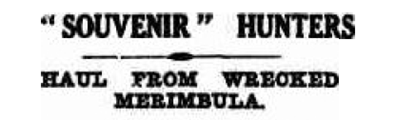
5th April - An article appeared in the newspapers telling of the sudden appearance of souveneer hunters entering the wreck via the gaping hole torn in her bows, clambering over the wreck "like crows round the carcus of a beast"
No one was left to protect the cargo and other valuables, men women, girls and boys entered the wreck and it was a case of the first there got the pick.
In the bush within a mile of the steamer were stacked piles of pilfered goods, rum, wisky, motor tyres, sewing-machines, prams, tables – everything that was not screwed down. Car loads of stuff have been removed. Men and women crawled into the heart of the ship and carried away toys, fruit, books, brooms, and even casks of beer. There was no one to stop them.

6th April - The remains were sold at auction for 300 pounds to Mr. A.W.Carey, of Melbourne, the cargo was not included in the sail.  The new owner gambled on the vessel being salvagable.
The new owner now had to advise the owners of the cargo that it must be salvaged within a week.

By the artice above it doesn't sound like much would be left.

After some time the battered remains  slid beneath the sea, The gamble didn't pay off as the ships back broke and slipped down the reef into deep water, now only the bow section remained visable on the rocks.
The loss of the Merimbula marked the termination of the Illawarra and South Coast Steam Navigation Company's passenger services, and subsequent to 1928, they confined their activities only to cargo services.


870-SS-Merimbula-A1579-SS-MerimbulaWRECKED-ON-SHORE

Passenger report.
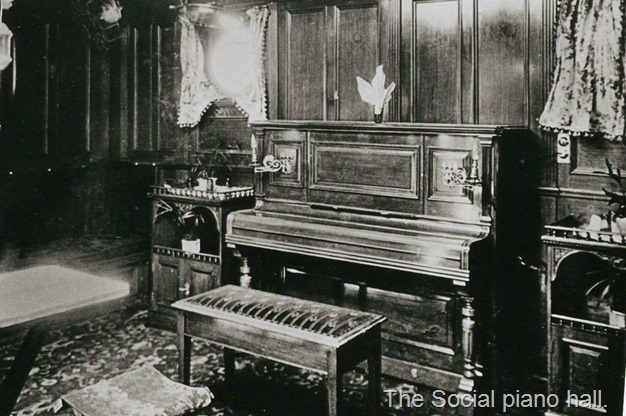
One woman said that after the mishap, “The first half hour's alarm and excitement, resembled a picnic more than a wreck. Immediately the captain gave the signal that there was no cause for worry, the passengers overcame their fears, and, after having a drink of coffee, played the piano and sang until morning then taken ashore, and put in the day in small huts, occasionally used by, fishermen. In order to maintain the cheery atmosphere, Mrs Sparks, the steamer's relieving stewardess, played records on the gramophone until the cars arrived from Nowra”.Lifeboat arriving with survivors
Lifeboat arriving with survivors.

landing-the-passengers
Ships description.

Having a length of 209' 6", (63.86m) breadth of 32' 2" (9.8m) and depth of 21' 1" (6.43m). A fast speed of 14 knots was achieved through twin triple expansion engines. At the time the Merimbula was described as the most beautiful vessel to steam Australia's waters.
She had state rooms, large dining areas and a social hall which could be enjoyed by 106 passengers, along with an exquisite body and superstructure (11,011 gross tonnage).The vessel, however, was found to be unstable in some sea conditions. To increase stability, a large number of cast iron blocks were placed in the hold.


On boarding a high degree of luxury awaited the passengers of the Merrimbula.

875-Merimbula-social-hall

871-Merimbula-saloon


873-Merimbula-deck


Today.
Not much can be seen of this once grand vessel, over the years the exposed remains of the bow have all but disappeared from the rocks.

947-SS-Merimbula-wreck 946-SS-Merimbula-wreck Wreck of Merimbula 23.2.10


Venture beneath the surface and you will discover another story.
Just off shore you will find the remains of the vessel on a sloping reef where it came to rest after slipping back into the sea.
The remains are located adjacent to the north side of the reef which extends from Whale Point. Wreckage can be located in 4 meters of water and extends out from the reef to a depth of approximately 13 meters.
You will find sections of the hull plating, an anchor, engines, as well as large winches, and most impressive are the boilers rising from the bottom.
Pictures showing what was left of the bow of the beautiful vessel, as it gradually disintegrates over time.

merimbulawinch One of the winches
photo courtesy of NSW Environment and Heritage.
http://www.environment.nsw.gov.au/MaritimeHeritage/researchcentre/wreckmerimbula.htm
 

I first dived this wreck around 1979, it was a fun easy and interesting dive, on one particular dive we had a large school of giant King Fish circling above and around one of the boilers, we collected a few lobsters amongst the strewn wreckage. If you intend to dive this location, check the weather, the area is exposed to nth and east swells and winds, and can be dangerous.

Historic Shipwreck
The Merimbula is a gazetted Historic Shipwreck, under Section 5 of the Commonwealth Historic Shipwrecks Act 1976. The listing applies to the shipwreck and all relics associated with the shipwreck.Currarong8aa

Lady Denman display
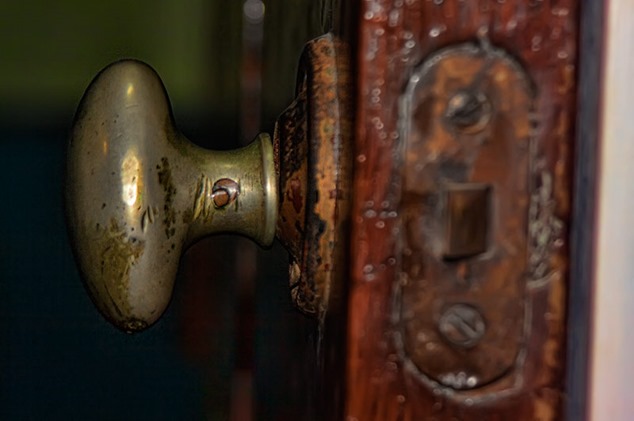
The museum has a collection of objects salvaged from the Merimbula, as well as historic photographs and information on display. Most notably a beautiful set of large timber doors from the kitchen.
The picture below is one of the door knobs off the door…you will have to visit the museum to see the rest…

 
DOOR-KNOB

Continue on to more images taken recently.


Ref”
.
http://www.environment.nsw.gov.au/MaritimeHeritage/researchcentre/wreckmerimbula.htm
. http://www.michaelmcfadyenscuba.info/viewpage.php?page_id=117
. http://trove.nla.gov.au/ndp/del/article/81115432
. http://www.southcoastregister.com.au/story/999653/wreck-that-ended-our-age-of-steamers/
. http://www.powerhousemuseum.com/collection/database/?irn=212159#ixzz2wfLIoz3r

3 April 2015

1928 S.S. Merimbula runs aground

1930

S.S. Merimbula shortly after running ashore and before she broke her back and slipped beneath the waves.

Yesterday IMG_5193I took a walk out to the remains of the S.S. Merimbula, 87 years after this beautiful coastal steamer ran aground on the reef adjacent to Bosom Beach Currarong , the elements have almost totally claimed what remains of the ship,  a few riveted, rusted pieces of steel, with a few small fragments of wood attached and a large piece of steel pipe with a rusted flange and bolts still in place,  is all that is left above the water to indicate the wreck site.

The few parts remaining have been moved over the years by the large waves that smash this exposed reef.   When I first saw this wreck in 1979, there was still a bow that you could recognise, and large pieces of timber decking attached,  it was in a different position to the pieces of wreckage remaining today.


Continue on to a previous post and photographs about the S.S. Merimbula.

  IMG_5186 IMG_5189 IMG_5192    
IMG_5197IMG_5201IMG_5208

16 October 2015

Camping De luxe


Illawarra Mercury - 1919
image

29 years before the S.S. Merimbula went ashore and drew the attention of Sydney people to the little known coastal resort of Currarong,   it was best known by Shoalhaven locals as a great camping and fishing spot,  the township was small and isolated,  the early roads were rough and took many hours to travel from Nowra.

1919 - Despite the Local Clive Shire Councils opposition, Henry Halloran a local land developer paid for and constructed a new road to Currarong and Culburra, the Shire Council then agreed it was a great thing for the area and tourism,  Mr Halloran wished they had made their minds up earlier and avoided the many delays.

Mr Halloran had grand visions for the area. He tried in vein for many years to see his dream of a new modern city, A city he would name “St Vincent's City, ” an area from Crookhaven River to the shores of Jervis Bay,  encompassing Lake Woollumboola.

St Vincent’s City.
Suburbs will extend from Crookhaven to the northern shores of Jervis Bay.  It will be traversed by a railway, having numerous stations for the convenience of the residents yet to settle there.   Provision has been made for industrial, commercial, educational, and residential areas, for a national park, racecourse, and recreation reserves, and due attention has been given to the details suggested by modern town-planning ideas.  Even Lake Wollumboola will be connected by a canal with Jervis Bay, and possibly ship-building on a huge scale will be conducted there in the sweet by and bye.

One group from Wollongong took advantage of the area, and often camped on the shores at Abraham’s Bosom,  they produced and published a paper called the “Abraham Bosom Times” and from reading one of their stories,   they certainly made the most of their stay.

During the Easter holidays a party of gentlemen from Wollongong camped at Abrahams Bosom, Jervis Bay, and camp life was evidently short of many discomforts,  judging by the accounts published in the "Abraham's Bosom Times," a daily record of the camp life which has been printed and published.

The dining tent was illuminated with acetylene light,  and two cooks served up the camp fare in most appetising form.  The days passed to hurriedly for the campers,  who wiled the time in fishing,  shooting,  and robbing wild bees nests,  from forest giants,  which had to be felled before honey could be procured.  In one instant the gad and drill was requisitioned in order to secure honey from the nests amongst the rocks,  but the venture did not prove a success.

Abraham’s Bosom is a beautiful area now part of the Jervis Bay National Park,  it has spectacular scenery, clear blue water, sea caves, clean beaches and hidden coves,  anyone who hasn’t been to the area should take the time to visit this beautiful part of our coast.

While your there visit the scattered remains of the S.S Merimbula now strewn across the rocks ,  and wonder what it must have been like for the passengers and crew to suddenly find themselves thrust unceremoniously upon the reef in the cold inky blackness.

1930
Continue reading about the S.S. Merimbula.
Meaning:  Gad - A pointed tool, such as a spike or chisel, used for breaking rock or ore.
BACK

22 September 2016

S.S.Eden.

These are some of the headlines that announced the narrow escape from disaster of the S.S. Eden in 1909.

700
eden-at-eden

S,S, Eden in Eden Harbour – no copyright restrictions.

Today with the aid of modern navigation equipment,  communication and radar,  it's hard to imagine a ship running into the imposing cliffs of Point Perpendicular,  but for the coasting vessels of the early 20th Century given the "right" or "wrong" set of circumstances Point Perpendicular could pose a serious problem.  Point Perpendicular headland is one of the most easterly projections into the Tasman Sea, coasting vessels often sailing and steaming close to shore and without due diligence,  could find themselves on a collision course with these imposing cliffs.

vessel at eden wharf


In this case it was a slightly strange combination of  circumstances that caused the mishap and near disaster of the Luxuriant Steam Ship Eden.

Saturday 18th 1909

Sailing on smooth seas  between Eden and Sydney, the S.S Eden carried  100 passengers including 40 to 50 women and children and around 30 crew, and cargo,  Captain S.Bishop who was temporarily relieving Captain G. Walker, was staying closer in to shore than would normally have been regarded as prudent or necessary.  

The first unusual circumstance.
At the time of the accident striking workers created  a shortage in the supply of coal for the steamers. To keep their ships operating  Captains were forced to burn timber and coal combined.  Staying close to the coast made the journey shorter and would burn less fuel, but with it came increased danger.

The second unusual circumstance.
6.30 a.m  - At the time the S.S Eden was plying the coast at half speed,  there were  bush fires burning around the south coast,  Jervis Bay area,  causing a heavy haze to drift off shore and hang low over the sea,  this combined with a dense fog  obscured the view of objects ahead.

7 - 8a.m  -  Ulladulla light had been shortly spotted,  the Eden cut straight across Wreck Bay and kept close in.

Breakers Ahead - The man on lookout saw the cliffs and rushed aft,  the captain in the wheel house ordered the the engines to be put into full speed astern,  but it was to late,  and the steamer crashing on,  was brought upon the rocks.
Most of the passengers were in their bunks when the impact took place,  others were knocked off their feet.   On feeling the shock which sent a violent shutter  from stem to stern, the passengers quickly rushed to the decks, many still in their night attire to learn what happened.  At first they were greatly alarmed, the 300ft towering cliff face loomed from the haze above their heads,  the impact was violent enough to dislodge large overhanging rocks which came crashing down around the ship,  one piece hit the ships bow plates with such force it became firmly embedded in the ship. Captain Bishop and his officers reassured the excited passengers,  telling them that there was absolutely no danger.  Captain Bishop and his crew acted with great coolness,  the stewards and stewardesses acting under Captain Bishops command served out the life belts, this caused more alarm amongst the passengers,  but the officers reassured the passengers this was done purely as a precaution,  the boats were swung out and lowered to the rail,  but they were never needed.

The Eden responded to her engines and was backed off straight away,  an examination showed that the fore-peak had become flooded,  the bulk head kept the remainder of the vessel perfectly tight. The ship was examined and found to be badly damaged below the water line Captain Bishop  judged the Eden to be sea worthy and without delay headed the Eden away for Sydney.   The wells were sounded periodically during the run up the coast,  and it was found that the water had not extended to the holds, the pumps were not required,  and consequently the cargo was not damaged.

The Eden was fitted with two bulkheads and therefore if the damage had been much greater than it proved to be she would have remained afloat.

Miraculous Escape.
One of the firemen was asleep in his bunk,  and the port anchor,  coming in contact with the rocks,  forced the hawsepipe within a few inches of his head,  he was thrown out of his bunk by the shock of the impact.

Damage Report.
The survey of the Eden in dock showed the damage forward is of a very extensive character,  and the opinion was expressed by experts that the vessel has a very narrow escape from disaster.  The whole forefoot was turned right to starboard,  thus exposing an irregular gap of great dimensions.  The whole of the plates below the 10ft water mark at the stem were either broken or fractured,  and the frames and floors in the vicinity of the damaged stem are in a buckled and broken condition.

image

REF: http://www.photosau.com.au/cos/scripts/ExtSearch.asp?SearchTerm=089597

Description of vessel.
The Eden was a steel screw steamer of 693 tons gross,  purpose built in 1900,  by Russel and Co of Port Gladscow, for the Illawarra Steamship Company  she was 197 ft long, beam 26.6 ft,  depth 16.6ft, Propelled by two compound engines producing 750 HP.   Luxurious accommodation had been provided for 60 first class and 12 second class passengers,  and all the modern improvements, including elaborate refrigerating plant and a complete installation of electric light.  The main salon and state rooms are unusually large and handsome and tastefully decorated and furnished.

Captain S. Bishop one of the oldest and most careful of the coasting masters was temporarily relieving Captain G Walker at the time of the accident,  but it had been arranged that he should take over permanent command of the vessel.  Captain Walker having been selected to command the companies new luxuriant steamer Merimbula,  which in 1928 went ashore and sunk after running into Drum and Drumsticks near Jervis Bay. Continue reading about the Merimbula
The Eden at this time was laid up in dock,  but was immediately rushed back into service to replace the Merimbula.

Other reported incidents involving the Eden.

1905 - The Eden had previously survived a tremendous gale off the coast of Jervis Bay.  Seeking shelter in Jervis Bay, the Eden entering the bay with great difficulty,  she took four hours to pick up the lighthouse,  Sea after sea broke over the steamer,  smashing the fittings and saloon furniture.  The passenger of whom there were a large number had an exciting time,  and the women suffered severely, weeping and praying all night.   The weather was so tempestuous that the female passengers were not the only ones on board who thought the Eden would never survive the storm.
The Eden sheltered in the bay until the weather moderated and arrived in Tathra  three days late.

1910 - Tidal Wave.
A tidal wave was experienced at Ulladulla on the south coast.  The weather was rough outside,  but the steamer Eden was loading in comparative comfort.  Suddenly huge seas broke completely over the wharf,  carrying 400 sleepers and everything portable with them,  The mooring ropes were snapped and to save herself the Eden had to stand out to sea.  Such a thing has never before been know at Ulladulla.

1921 -- The Eden was used to carry cargo and passengers to relieve Tasmania which was cut off during a seaman’s strike.

1929 - Man Lost Overboard.
A passenger went missing and presumed to have fallen overboard somewhere between Bermagui and Sydney.  Aged between 50 and 60 years,  When the Eden left Sydney the man was on board,  but his bunk was found to be unoccupied and he was no where to be seen.

1933 - The Eden was scuttled at Tathra.


Meaning:
Hawsepipe - A ship’s hawsepipe is the pipe passing through the bow section of a ship that the anchor chain passes through.
Forefoot - The area of a ship’s hull where the keel and stem are joined.
Stem – The most forward part of a ships bow, referring to the timber between the forward end of the keel and the deck.

HAWSEPIPE

The red hawsepipe can be clearly seen in the bow of the Lady Denman Ferry.
In this case it’s very small,  but in a larger vessel the pipe can be quite substantial and weigh many kilo’s.


BACK


7 August 2018

The launch and loss of the steamer Currumbene.

28-Launch-of-Currumbene-1922a
The launch of the steamer Currumbene 1922

On a glorious Monday morning on the 13th February 1922, The normally quiet seaside village of Huskisson was a bustle with cars and people. Motor buses arrived from Nowra crowded with passengers, and cars kept arriving with visitors, all eager to see the launching of the fine vessel,
built by Joseph Dent.

18 months earlier the keel made from locally sourced timber was laid on the banks of Currumbene Creek at the Dents shipyards. Joe Dent's workmen set about to construct a fine cargo boat for E.D. Pike and Co., Timber Merchants of Sydney.

Like so many other vessels constructed by the Dent family, the launch was marked with a large celebration. Invitations were issued to the launch. On the Monday morning at 9.30am, a large crowd assembled from all over the district to see the launching.

At precisely 9.30am on the high tide, Mr. Dent gave the signal, and the sound of many heavy hammers on the dog-shores gave notice that the work of launching had commenced, within a few minutes the vessel glided "majestically" into the creek from which she was named. 

The vessel was built for the North Coast timber trade between Bellinger River and Sydney. Measuring 132ft in length, breadth 28ft and a depth of hold at 8ft, she was built of colonial hardwood mostly sourced from the local forests.

Mrs. Burroughs, the wife of managing director of the owner, broke a bottle of champagne across the bows as the boat commenced its first journey into the blue waters and named her "Currumbene."  the large gathering clapped and gave a mighty cheer as the vessel entered the water.

The vessel was hauled alongside the wharf, everyone partook of refreshment of every kind, liberally provided by Mr.Dent.

30-Launch-of-Currumbene-in-1922


"The jolliest time possible was spent, and there seemed no end to the good things provided."

The managing director of the company Mr. Burrows, in a speech, said he was very pleased with the outcome of their investment.

" It afforded him the greatest pleasure to propose 'The health of Mr. Dent and the men working on the job." He said they had not stinted Mr. Dent for money, but they had full value for the money spent, and he also wanted to compliment the men working on the job, they were the only men he had seen working that he would care to give another job too."

31-Currumbene-at-mouth-of-creeka-1922

Not everything went to plan during the launch, caught in the outgoing tide the Currumbene went aground for a short time, before being towed to the wharf.

33-Currumbene-run-ashore-after-launch-1922

The celebrations continued into the night finishing with a dance in the new hall of the School of Arts, present-day "Huskisson Pictures" and given to the public by Mr. Burroughs, and greatly appreciated by the young folk.


34-Currumbene-at-Huskisson-wharf-after-fit-out
Currambene after fit out.

Not much information has come to hand on the life of the Currambene after her launch

Currumbene ashore

1924 -  March, She was stuck on the bar entering the Bellinger River, later refloated on the high tide without damage.

1925 -  October, She had a lucky escape from disaster after going ashore at the Bellinger River, on inspection she was found to be badly damaged, she was refloated and repaired.

1926 - She was once more stuck on the bar at the entrance to Bellinger River, again refloated without damage.

No blame was ever laid on the Captain or his crew for any of the standings, it was the peculiarities of the channel and sand shifting with currents and tides.

image

1928 - She was moored in Sydney when one of the fiercest Cyclones ever recorded hit the NSW coast. During the storm, the steamer White Bay foundered near Morna Point with the loss of 16 men. The steamer Euralla went aground, her crew of 16 were rescued.  At the time the storm hit there was a seaman's strike in progress, so many of coastal steamers were moored in Sydney Harbour.
The tremendous storm hit Sydney causing steamers anchored in the harbour to drag their moorings, the Currumbene was one of those. She broke adrift and was in danger of fouling several other steamers before being removed by the tug Leveret.

1928 - She was chartered for salvage operations on the luxury coastal steamer Merimbula which had gone aground near Beecroft Head Currarong. The charter was
canceled when it was found the Merimbula had settled considerably by the stern and salvage operations were canceled.

No other information comes to hand until 1934.

image


By 1934 the once busy steamer had become a liability to her owners, E. D. Pike and Co., Her last contract was by the Newcastle  Stone Crushing Company Ltd., finished in July 1931, since then no further work could be obtained for the vessel. She remained moored at Newcastle.
Built at a cost of 19.500 pounds, valued by the company at 10.500 pounds, she was insured for 5000 pounds. The Currumbene  had been a losing proposition to the company.


image


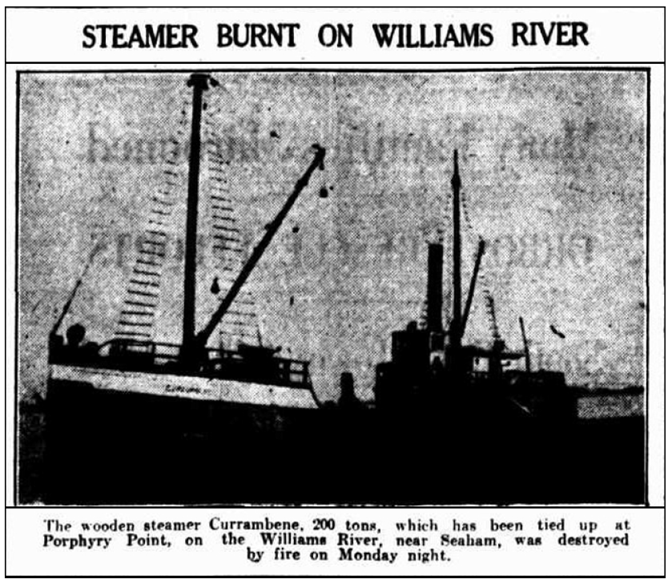
1934 - The once mighty steamer was lost in a mysterious, devastating fire on the banks of the William River Seaham.  The fiercely burning vessel lit up the countryside for half a mile or more.
The fire was watched by scores of residents from the verandas of their homes. Every now and then explosions like those of rockets could be heard."
She burnt for a few hours down to the waterline, she was still smoldering the following morning before sinking in 15 ft of water.  A large area of bush around the vessel was badly burnt as well.


image
Coroners inquiry.

The  Currumbene was moved to Clarencetown to remove the saltwater growth in 1932, but owing to bad weather she was moored at Seaham on the return journey, where she remained. Mr. Kelly was engaged as a caretaker. Kelly was instructed to light a fire in the boiler and take the vessel to
Clarence town for repairs. Mr. Edward Wilson of Seaham was on board the vessel on the night of the fire and left her at about 10.45 p.m., he
could see the vessel from his home.  The first he knew of the drama was when two rockets were fired by Mr. Kelly.

John Willam Kelly, the caretaker of the Currumbene, said he lit the boiler fire at Cullen's direction to shift the vessel to Clarencetown. He retired to bed at 11.p.m. and was awakened by smoke coming from the engine.  He did not know how the fire had started, He had inspected the ship before the fire.
The coroner returned an open finding.


Continue reading about the T.S.S Merimbula


image

31 January 2018

Young Endeavour–Currarong

1

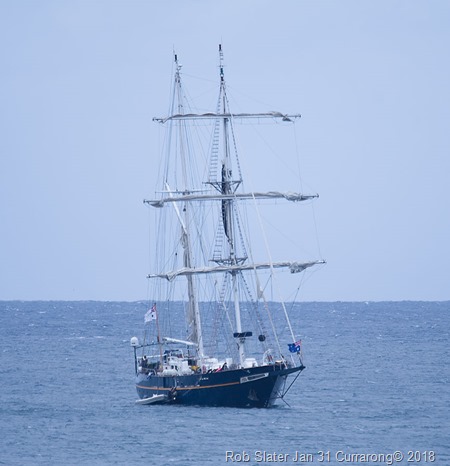
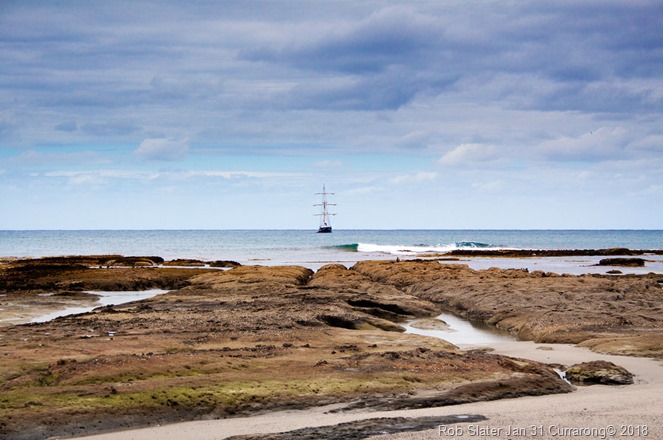
Today the Young Endeavour was anchored in the Bight at Currarong seeking shelter from the large swell pushed by a strong southerly gale.   Currarong offers protection to vessels in this situation.

currarong-jan-31-2018
Currarong township can be seen on the right.


IMG_8452

IMG_8527

Framed by part of what remains of the wreck of the luxury ship the S.S Merimbula, wrecked on Whale Point in 1928.

IMG_8441


Continue reading about the historic shipwreck...S.S.Merimbula.

Continue reading about the Young Endeavour from a previous trip to Jervis Bay including some beautiful night shots of the vessel.


image