.

.
HOME OF THE LADY DENMAN - Local history isn't always about the big story - the everyday story of life in the early development of the region can be a fascinating, entertaining and educational journey.
Showing posts sorted by date for query whales. Sort by relevance Show all posts

12 May 2019

Whale sinks boat in Jervis Bay - One man drowns. 1878


A tragic incident which illustrates the precarious nature of life on a whaling vessel.


The whaling barque Asia from Hobart Town was a regular visitor to the waters around Jervis Bay.  Asia had been at sea hunting whales for approximately 9 months before casting anchor in Jervis Bay in November 1878 to "try out" their most recently caught whale. The process involved the ships smaller boats fastening a whale to their gunnels before hauling the whale alongside the larger ship.  Once alongside the blubber would be stripped from the whale then drawn onboard by large hooks and rigging where the process of boiling down the blubber in large vats to render out the oil would take place. The remaining oil was poured into barrels, this process was called "trying."


Poor "Hyderabad."

First mate Thomas Graham and a small party of men were aboard one of the boats with a whale held fast to its side,  without warning,  another whale stove in their boat by biting it. The crew were consequently thrown into the water and submerged, one of them, named John Cannooard, known by the sobriquet "Hyderabad"  could not swim and was drowned immediately despite the efforts
of the first mate to save him.  In his attempt to save Cannooard, Graham almost drowned himself.  The remainder of the crew were rescued after being in the water for about half an hour.

Floundering in the water near a bleeding dead whale would have been a frightening ordeal. The possibility of being attacked by sharks attracted by the smell was very real. Once a whale was brought alongside a vessel, crews had to work quickly to strip the valuable blubber off the carcass before sharks could do to much damage.

No further information is has been found on this incident. It was quite common for sailors to be buried at sea, or taken to the nearest land for burial as ships didn't have the facility to store a body for any length of time.


image

1 April 2019

Whaling Jervis Bay

As can be seen from this short and not complete list of whaling ships which came into Jervis Bay,  the bay was at one time a very busy location for the whaling industry.


1870 - The Hobart Town Barque Alladin towed two sperm whales into Jervis Bay to secure the blubber and boil down.

1871 - The barque Othello cast anchor with 65 tons of sperm oil.  She took a 10 sperm whale off Jervis Bay two day before anchoring in the bay..

1871 - The whaling barque Metaris came into the bay to try out a large sperm whale.

1871 - The American whaling barque Eliza put in to Jervis Bay for water. She carried 1400 barrels of oil.

1872 - The Sydney whaling barque Metaris, had been at sea for 10 months before putting into Jervis Bay to recruit. She had sixteen tons of sperm oil.

1872 - The whaling barque Waterwitch put into the bay to recruit. She carried twenty tons of sperm oil.

1872 - The barque Alladin put into the bay, she carried twenty tons of sperm oil.

1872 - The American whaling barque Asmanby has put in to recruit. She has been twelve months out, and has 700 barrels of black oil and 300 of sperm oil.

1872 - The whaling brig Louissa, 5 months at sea put in to recruit with 5 tons of sperm oil.

1872 - The barque Sea Shell towed two sperm whale into the bay for processing, they had been caught thirty miles off the bay.

1872 - The American whaling barque Three Brothers put into the bay to recruit, with 1400 barrels of sperm oil aboard.

1872 - Melbourne whaling barque Mary Hamilton 3 months at sea put into Jervis Bay to repair a lost bowsprit, she carried no oil.

1872 - The brig Velocity, four months at sea put into the bay with 4 tons of sperm oil.

1873 - The brig Velocity put into the bay to recruit. She reported green water and drift wood eighty mile offshore.

1873 - The Whaling barque Runnymede, 9 months at sea, put into Jervis Bay to recurit. She carried nine tons of sperm oil.

1873 - The barque Waterwitch put into the bay, fourteen months at sea, she carried 14 tons of sperm oil. During the voyage crew member Joseph Williams from Hobart, he fell from aloft and was instantly killed.


Continue on to more information about the whaling industry in Jervis Bay.


image


17 December 2018

Perpendicular Smell–Jervis Bay

Daily Telegraph - March 1932

When one of the light-keepers at Point Perpendicular, at the entrance to Jervis Bay, came on duty one evening recently he sniffed the air, and observed, "Someone has been throwing dead fish out round here." No one could find the fish, but, whenever the wind blew from the northward the smell pervaded the air. As the days went on it grew stronger. But it was not fish, but a 50-feet whale, which had driven head on into a little opening in the cliffs near the lighthouse, and stuck there. Nothing could be done about it, and the light-keepers just had to hope that there would be an unusual prevalence of south winds for the next few months.


Continue Reading about whales and whaling in and around Jervis Bay.


image

5 July 2018

Whales and War ships.

Ships in the Bay
This morning the suns golden glow illuminated Hobart Class Guided Missile Destroyer, HMAS Hobart 111 as she headed to sea to conduct gun firing practice off shore from Jervis Bay.  In the foreground a pod of aproximately 12 Humpback whales were making their way north on their yearly migration.

IMG_7279


HMAS Hobart 111, was moored near HMAS Creswell during the night, I took the following pictures before the sun had breached the horizon.   The ship was illumated by bright red lights.


IMG_7187
IMG_7200
Untitled_Panorama1

HMAS Choules is also in the bay at the moment.
HMAS Choules is a Landing Ship Dock (LSD) which was originally commissioned into service with the Royal Navy in 2006.

IMG_7273

HMAS Hobart plowing through the small north swell as she leaves the bay.


IMG_7267


image

5 June 2018

The Barque Sapphire and the Barque Narramissic 1874

historyofwhaling2
The sea near Jervis Bay and the clear waters of the bay ran red with the blood of the whale industry.|


Whaling was a dangerous and unforgiving enterprise.

When a whale was spotted, ships would begin the chase, trying to draw near enough to lower their boats, manned with hard weather-beaten men, armed only with a hand-propelled harpoon, determination, and hopefully, luck. If they managed to catch and kill this great leviathan the men would now have to tow the whale by sheer back-breaking effort back to the waiting ship.

Death and injury was a common occurrence for the chasers, but the danger didn't stop there, when the whale was drawn on board, danger was ever present.

Sailors survived on limited rations in cramped quarters aboard creaking ships, as one sailor expressed, "we worked like horses and lived like pigs." Timber decks soaked in the fluid from processing whales were extremely slippery, men came down hard onto the deck, men slipped overboard to the waiting sharks drawn by water running with blood, men could be crushed by the weight of blubber being hauled into copper cauldrons in the try-works, they suffered deep lacerations from the sharp tools used for processing the whales.
Everything, including the men were covered in whale oil, all this aboard a ship pitching and rolling on an unsettled sea, hot oil from processing cauldrons could spill onto the fires, this could easily spread engulfing the ship and the crew, many ships left port and were never seen again.

When the processing was complete which could take 6 hours or more depending on the size of the whale, the crew would scrub and clean the ship as best they could,  despite their best effort, ships sailing downwind would always know when a whaling ship was approaching by the smell.

Collision at sea.

There were dozens of ships plying the coast chasing whales, collisions between ships occurred.


One such incident occurred 30 miles south of Cape St George between the whaling barque Saphire and the barque Narramissic.

10 September 1874 - The barque Narramissic left Newcastle bound for Melbourne and ran into heavy weather and was forced by leaks into Sydney Harbour.

20 - September 3am - The barque Narramissic left Sydney Harbour continuing her voyage to Melbourne, 30 miles south of Cape St George, in the pitch black the silence was shattered by the violent sound and vibration of two timber ships coming together.

The Hobart Town barque Sapphire,which was not displaying any side lights, struck the Narramissic with her flying jib-boom on her mizzen chains. The Sapphire lost one boat and her spritsail yard.  The Narramissic had her stanchions and gaff carried away, her covering board and spritsail were also damaged, five of her crew, thinking she was about to sink, jumped on board the Sapphire, leaving the master and three men to bring her into Jervis Bay, where repairs would have to be carried out before she could sail again.  The Sapphire came into Jervis Bay the following day.

The Narramissic stayed in the bay for 4 weeks wind bound because of terrible gales which had damaged other vessels caught at sea.

Once the repairs were finished the Narramissic sailed out of Jervis Bay continuing her journey to Melbourne.  She ran into more heavy weather, the second mate and a seaman named Christopher Tomkin went aloft to secure the yard-arm of the upper main topsail, which had got adrift from the gaskets. The sail caught Tomkins, who was 36 years of age and a native from Berwick, England, and knocked him overboard. A life-buoy was thrown to him, and the master hove a line to the drowning man, which he almost clutched but did not catch, the vessel drifted away from him, the weather being so bad as to preclude the possibility of rendering
him any assistance.

The Narramissic's voyage had been cursed with near disaster and tragedy.
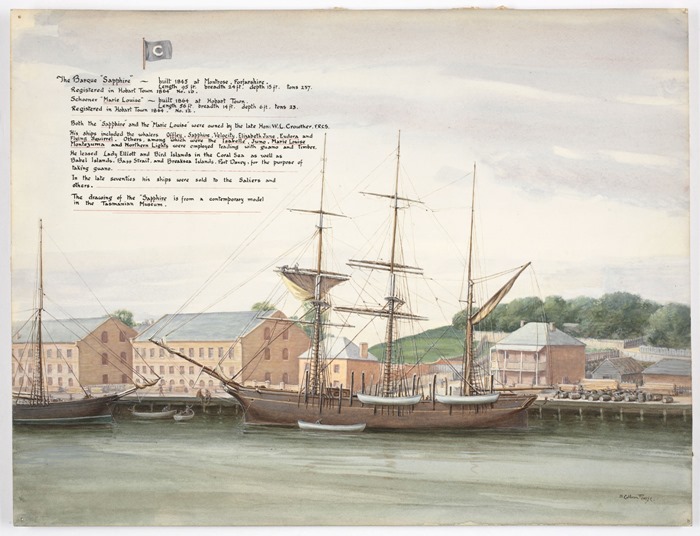
sapphire

The whaling barque Sapphire was a regular visitor to Jervis Bay,

1872 December - she put into Jervis Bay after a 10-month voyage from Hobart Town to recruit. She had taken 28 tons of sperm oil.

1875 February  - during a 14-month voyage she came into the bay to try-out 9 tons of oil,
the total take of oil for the trip was 21 tons.

By 1885 the romance of going to sea chasing whales was starting to decline, many whaling ship owners found it difficult to secure suitable crews and were forced into taking anyone that offered himself.  The Sapphire was involved in an incident when as was customary at the time, the owners would advance the willing a small sum in advance of the voyage.  Taking the advance these larrikins would often spend the money, then not join the ship as required when it was time to sail. The police would be called and these reluctant absconders would be arrested and taken aboard the ship.


image


13 February 2018

Drama at sea, two barques collide and make for Jervis Bay.

131820946


Most ships at this time used oil lamps to indicate their position at night to other ships who may be in close proximity, but not always, and in this case the lack of lights nearly ended in disaster.

Tuesday 20, 1874 - The barque Naramissia from Newcastle bound for Melbourne was sailing 40 miles south of Cape St George, it was 3 am in the morning when without warning she was struck by the whaling barque, Sapphire.   The Sapphire carried no side lights and struck her with her flying jib-boom on her mizzen chains.  Five of the Naramissia's crew, thinking she was about to sink jumped on board the Sapphire leaving the master and three men onboard.  Fortunately, the ship remained afloat, the master took her into Jervis Bay where the Sapphire joined her the next day. The Naramissia stayed in Jervis Bay for four weeks wind bound, during which time they carried out repairs

The Sapphire lost one boat and spritsail yard. The Naramissia had her stanchions and gaff carried away, and her covering board and spritsail damaged.

1872 - The Sapphire had been to Jervis Bay before, she often hunted whales along the coast near the bay. In 1872 she put into the bay to recruit, She had been at sea for 10 months and had taken 25 tons of sperm oil.
1875 -  She put into Jervis Bay to try out 9 tons of whale oil. The total take of oil for the voyage was 21 tons.

1885 image
1885 Long hard dangerous months at sea with small rewards meant finding experience crew was becoming harder,  ship captains and owners were forced to take anyone who was willing to come aboard, most were scoundrels with no experience of working aboard a ship, this led to conflicts. 
In 1885 some of the newly recruited crew of the Sapphire, as was customery were paid some of their wages in advance, absconded,  and after a merry chase for four days were caught and
forced back aboard the boat by the police. They mutinied and refused to go to sea throwing essential equipment overboard in an attempt to stop the ship leaving port.  The police were called again arresting the two ringleaders removing them from the ship.  New equipment was loaded and the ship finally sailed.

Ref: https://stors.tas.gov.au/AUTAS001131820946

Meaning - mizzen-chains: Plates of iron bolted to a ship's sides abreast the mizzen-mast for securing the shrouds and backstays of that mast.


image


12 May 2017

Fishing report for Jervis Bay 1912

"The bay at present is discoloured to a milky whiteness by the whale-oil factory operations."


image
Sun (Sydney, NSW : 1910 - 1954), Thursday 24 November 1912, page 12

This fishing report makes interesting reading, especially the part about the bay being covered with a white slick from the whaling operation.  The correspondent actually wrote the article aboard the whale processing factory ship the Loc Tay.  The Loch Tay and another factory ship the Polynesia were a permanent fixture in the bay at this time and were part of a larger whale hunting operation being carried out off the NSW coast using Jervis Bay as a base.
By December whale numberes had dropped,  catches were becoming harder to secure and many of the whales contained small amounts of oil, the small numbers of whales could not support the whaling operations.
This is the second reference to the discoloured water I have found,  and was also one of the reasons whale processing and hunting operations were eventually completely stopped inside Jervis Bay.
 You can read this disturbing story below.

The second interesting part of this story describes the Southerly winds arriving in  Sydney as the "JB wind".  I found a previous article that told a similar story and  mentions -  "Jervis Bay, where the weather comes from."


Writing aboard the Loch Tay In Jervls Bay, my angling horizon for the moment is naturally limited, but it has also been perceptibly broadened, for there is nothing the old fisherman likes better than to see new fishing grounds. Jervls Bay is the place where the southerlies branded J.B. in Sydney are first recorded, and there is no doubt the expansive inlet has more than its fair share of the breezes that are actually brewed on the fringe of the ice further south.  My last experience of Jervls Bay was aboard the Thetis, where the trawl swept across tho bottom for a couple of miles and the catch turned out to be chiefly red weed and skates. More intimate investigation during trip 3 to Captain's Point, where the Naval College is being built and to the little town of Huskisson, where the Dent clan predominates, revealed the fact that off Bowen Island and Captain's Point are good schnapper waters. On a new pier in front of the college site several workmen were fishing and catching large coloured leather-Jackets, slippery mackerel, yellowtail, and other fish, and a Dent party was wooing the red fish a mile further towards the strait between Bowen Island and the mainland. At Huskisson the little river is a first-class flathead, bream, and blackfish ground, and about 300 yards from its entrance a reef is the feeding ground for several varieties of marine fish. Around the bay are innumerable hauling grounds, where whiting, mullet, and bream were catchable, but there were no workers on them most of the time, although the Loch Tay folk would have been ready purchasers of a couple of baskets a day. At Huskisson no bait was procurable,  but no doubt a day's notice would suffice for the local haulers to bring some ashore. The bay at present is discoloured to a milky whiteness by the whale-oil factory operations.

Continue reading about the Loc Tay and Whaling in Jervis Bay.
Continue reading about - "Jervis Bay, where the weather comes from".
 

The S.S.Thetis mentioned in the article was a steam trawler which worked the coast from Sydney to Jervis Bay,  she was involved in the search for the S.S. Dandenong which sunk off Jervis Bay in 1876,  becoming one of the worst maritime disasters near our shores, 40 people went down with the ship including women and children.   The story of the disaster is about the amazing struggle for survival in impossible conditions,  involving great acts of bravery and sad loss - Continue reading about the S.S. Dandenong.


image
Sun (Sydney, NSW : 1910 - 1954), Thursday 28 November 1912, page 12

Serious complaints have been made at Jervis Bay respecting the discoloration of the water,  resulting from the work aboard the factory steamers on which the whales brought in by the gunboats have been treated.  A Nowra resident, Mr J. Miller, writes: -  The waters of Jervis  Bay are being polluted to such an extent that the fish are leaving tho bay instead of entering it,  as is their habitat this time of year.  The waters are of a milky appearance, and have a peculiar odour, while the shores are strewn with large pieces of blubber, intestines and the oysters to are turning white.   We have seen large schools of fish approaching the entrance, but as soon as they reach this discoloured water they immediately turn back. We attribute the above causes to the presence of two large factory ships, with their attendant gunboat whalers one, the Loch Tay, causing the greater pollution, we presume through the use of acids, chemicals, etc, in the treatment of the whales.  This boat has dealt with over 150 carcases, according to press reports.  This is ruining the fishing industry, and keeping tourists and amateur fishermen from patronising Jervis Bay.  We also understand that no revenue is being collected from these foreign ships. They carry all their own goods, butter, plumbers', materials, fitters, and coopers goods, in fact, they are fully equipped to do all their own work with their own men and materials.   This is no good to Australia.  I would also point out that in parts of Jervis Bay the deposited grease causes the sand to adhere to the feet when one walks on it.  - 

This complaint is true In the main, but during a recent visit to the Loch Tay,  the "Sun" representative found no evidence of the use of chemicals on the steamer.  The waters were certainly coloured milky white, but sharks were by no means deterred from entering them,  and off Captain's Point the fishing was good.  It is probably correct that shoals of fish outside, noting the discoloration, refrained from entering the bay,  but fish are curious creatures, and it Is quite likely that before long there will be a great rush of fish into the bay for the decomposing whale-meat.  At present they are puzzled by tho oil, which,  being on the. surface causes the water to lose Its pristine clearness. The oysters were certainly being spoiled in flavour by the oil.  A protest has been arranged at Huskisson and Nowra, but before it reaches dimensions sufficiently large to command attention the  Loch Tay will have followed her gunboats to New Zealand waters. The Polynesia and her two gunboats have gone, and the Loch Tay is expected to depart in a few days.


image

15 March 2017

Eden Whale Museum.

1

Old Tom

image

I had already been to the museum a  number of times, but couldn’t resist another visit last weekend,  the volunteer staff are friendly and welcoming and all too ready to give you insight into the history of Eden and the famous, association between the local whalers and the Killer Whales. If your down that way be sure to call in and be amazed.

 
http://killerwhalemuseum.com.au/


image

24 January 2017

Jervis Bay - ship movements.

Below are small snippets of information that appeared in different newspapers illustrating how Jervis Bay was being utilised by the ships working along the NSW south coast.

Of particular interest are the whaling boats . The Othello,  Metaris, Waterwitch, Asmanby, Alladin, Sea Shell and Runnymede are all mentioned below, all hunting whales during this period….It’s little wonder the whales migrating along the coast were quickly depleted.
 
1871
image
1871
image
1872

image

1872
image
1872
image
1872.
image
1872
image
1872
image
1873
image
1873
image
1875

image

1876
image


image

29 March 2016

Whaling Jervis Bay

historyofwhaling2

Jervis Bay has a thriving tourist industry based on whale and dolphin spotting.
These companies still hunt whales,  but in a completely different way.

Between June and August the magnificent Humpback Whales move north along the east coast of Australia, coming from the cold Antarctic where they have spent the summer feeding on krill, they head north to the sub tropical waters of north Australia to mate and give birth.

Then between September and November the whales travel south again, heading back to the Antarctic to feed.

Just like the whale hunters did in 19th century the tour operators today head out from Jervis Bay in large boats seeking whales, but now the boats are filled with tourists all hoping to capture a glimpse of these magnificent animals during the migration.

But,  it wasn't that long ago whales were being chased in the waters near and inside Jervis Bay for a totally different reason.    Between 1949 and 1962,  8300 whales were killed along the east coast of Australia.  mostly humpbacks as the more favoured blue whale and southern right whale had became scarce.

I came across this article from 1918,  about whalers lobbying the government to allow a whale station and processing operation to be built inside Jervis Bay.

Thankfully this operation was never allowed.


This small article is from the 

  • Albury Banner and Wodonga Express (NSW : 1896 – 1938.  Fri 19 Jul 1918
image
_MG_4485a

You can see this harpoon gun and much more on display inside the museum,  the display is a real eye opener into the role Jervis Bay played in the whaling industry on the south coast.

You can also see other posts about whaling and jervis bay by typing whales into the search box in the right column.


19 May 2015

Jervis Bay Whaling – Profit and Loss

1913 Reports of large pods of whales, ‘for as far as you can see”, drew whalers and their ships from as far away as Norway to the east coast of Australia in search of large profits.
  After a short time working the east coast of Australia, profits were as hard to find as the whales.

Below is a report from the Shoalhaven Telegraph 1913, it gives some insight into the costs of operating these large ships.


The Captain of the Norwegian Whaler now lying in Jervis Bay,  in a conversation with the writer on Saturday last,  gave the following information:-

It will be 16 months on the 8th of August since the whaler left for these waters.  The expedition is financed by a wealthy Norwegian company,  and was formed in the first place to operate principally in Tasmanian waters,  where,  it was said,  there were plenty of whales.

On arrival however,  Captain Egeness says they were found to be vary scarce.

Therefore the trip so far has been a financial failure,  the loss to date being something in the vicinity of 40,000 pounds.  Even with a run of good catches from now until the end of the trip,  the company would still sustain a slight loss.

The expenses of the factory ship alone run to 1500 ponds a month.  This includes insurance,  provisions, etc,  but not wages.

There are 113 men all told employed on the whalers.

The men on the factory ship work on wages,  with a percentage on the oil ( so much per cask).

The men in the whale boats get wages also so much per whale,  which varies according to the class of whale.

Captain Egeness and Dr. Kolflaath both consider if a factory could be established to treat whales it would be a paying concern.  They are of the opinion their own country men are best adapted for shooting and landing whales,  and Australian workmen for the work on shore.

The best results for the trip have been secured at Jervis Bay.


1913 the Norwegian whale boats Sorell and Campbell operated from the bay,  supporting two factory ships the Loch Tay and the Polynesia,  the Polynesia had spent the 1912 season working in New Zealand Waters.

From June through to October they took 379 whales, making a total of 537 whales for the two seasons yielding 2666 tons of oil. This operation was forced to close down after only two seasons as there were many complaints received due to the strong odour and offal floating in the Bay.

 Continue reading
TBG14219110220001 Loch Tay

The Norwegian  factory ship Loch Tay.

whale in the bay

A whale being readied for processing inside Jervis Bay.

     
_MG_4492p

IMG_9787

IMG_9788

You can see these medieval like tools on display inside the museum, along with whale bones, drawings, and photographs.


30 March 2015

Jervis Bay has a part to play

Kingsford Smith, from New Zealand to Australia.

cks_L96364_350 Commander Kingsford Smith while conducting one of his historic trans Tasman flights sought the help from the Department of Civil Aviation through ministerial sanction asking that lighting arrangements on the coast of New South Whales should be made at Newcastle, Sydney and Wollongong or Bulli.

Tentative arrangements were made for the military searchlights at Newcastle, Middle Head and the naval searchlights at Jervis Bay to be displayed from sunset until such time as the ‘OK’ was given that the fliers had landed at Richmond aerodrome.

It was decided that if the Southern Cross came into either of the three zones, Newcastle would send a succession of ‘N’s” from the shutter attached to the searchlight. Middle Head searchlight a succession of “S’s” by the same means and that Jervis Bay would switch over from a big search light to a 10in projector,  which was also fitted with a shutter signal a succession of “J’s”  If the pilot on picking up the coast,  saw any of these three lights,  discernable for a distance of 40 miles,  the watchers on the ground,  having heard him within their zones,  would send those signals,  and Flight-Commander Kingsford Smith would immediately know whether he had to turn north or south.

w1200_h678_fmax
 

Kingsford Smith’s plane the Southern Cross, surrounded by onlookers sits on Seven Mile Beach Gerringong,  before one of his historic Trans Tasman Flights.

18 March 2015

The bay full of whales

September 28th 1901.
image
 

Captain M’Veigh, of the Velocity states.
”Having put into Jervis Bay on the 12th instant from stress of weather, he found the bay full of whales,  so much so that they had scarcely room to swing;  large shoals were also seen along the coast”.


Amongst this collection of old articles, were a few lines of text that help paint a picture of the times around Jervis Bay in 1851.

17 March 2015

Whale stoves in boat – Jervis Bay

image

The greatest gamble on earth, with life as the stake, that is the industry of whaling.

Whaling meant many months at sea for the crews involved, long periods of boredom staring at the ocean looking for whales, the time was spent maintaining equipment and the ship. Once a whale was spotted, adrenaline charged excitement pulsed throughout the ship, men scurried to their positions and the chase began.
Dangers were ever present for the sailor, with many sailors loosing their lives in the pursuit of a meager living.

One such incident happened inside Jervis Bay in 1878 as reported by Captain Folder.


“ Mr. Thomas Graham, the first mate,  was fast to a whale in Jervis Bay, on November 8, another whale stove in the boat by biting it.   The crew were subsequently submerged, and one of them, named John Cannoord, known by the sobriquet of ‘Hydrabad,’  who could not swim was immediately drowned, notwithstanding the efforts of the first mate to save him.  In endeavouring to rescue Cannooard, Graham was also nearly drowned, Graham and the reminder of the crew, except the one alluded to, were rescued,  after being in the water for about half and hour.

 
.
This short incidental account, appeared in the Hobart Mercury, amongst other shipping and whaling news.
Old whale song.
 

Oh!  the rare old whale, mid storm and gale,
       In his ocean home will be,
A giant in might,  where might is right,
       A king of the boundless sea.


10 March 2015

Whalers – Jervis Bay

The Factory ship Loch Tay.
The history of the largest factory whaling ship to work from Jervis Bay.
TBG14219110220001 Loch Tay

Built 1893. and named the SS Loch Tay, Newcastle UK for the Dundee Loch Line Steam Ship Co. Ltd.
5,474 tons gross and 3,300 tons net. 410 ft long – 49ft. 3inches in breath and 30ft deep.
1911. Sold to the  Australia Whaling Company Norway and converted to a whale processing vessel.
The Loch Tay and three new whale catchers Campbell, Lionell and Sorrell began operations off Jervis Bay, but found the whales merely passed our coast at certain seasons.   After 3 months of operation only 150 whales had been caught, one of them measuring 90ft in length.
They up anchored and proceeded to test the New Zealand waters, after only a few months they found the same problem there, despite catching thirty three sperm whales, which are one of the best obtainable for oil,  the fleet returned to Jervis Bay.

image

 
  thick-heads  

After returning to Jervis Bay for a second season it proved to be a good season for whales and no fewer than 329 were caught and dealt with.
.

The Sydney Morning Herald (NSW : 1842 - 1954), Wednesday 6 August 1913,

   text  

1912. They moved the operation to Western Australia but ran into the same sort of problems with the authorities as they had with their Jervis Bay operation, and with the Freemantle Whaling Company.
1913 they closed their operation because of rising costs and the ongoing conflicts with authorities and trade unions.
1914. The company was liquidated, and the Loch Tay was converted to a cargo ship.
1918. She was Grounded and wrecked at Cap Ruby, Morocco with a cargo of wheat.

   scent  

Ambergris  is a solid, waxy, flammable substance of a dull grey or blackish colour produced in the digestive system of sperm whales.

Freshly produced Ambergris has a marine, faecal odour. However, as it ages, it acquires a sweet, earthy scent commonly likened to the fragrance of rubbing alcohol without the vaporous chemical astringency. Although ambergris was formerly highly valued by perfumers as a fixative (allowing the scent to last much longer), it has now largely been replaced by synthetics.


wikipedia

Ref: Loch Tay image.
http://skipshistorie.net/Tonsberg/TBG142AlfMonsen/tekster/TBG14219110200000LochTay.htm