.

.
HOME OF THE LADY DENMAN - Local history isn't always about the big story - the everyday story of life in the early development of the region can be a fascinating, entertaining and educational journey.
Showing posts sorted by date for query dent. Sort by relevance Show all posts

23 April 2019

The Dent investment.

1904 - George Dent senior was rapidly approaching his nineties but could still swing an axe that would put many a young man to shame. Described as the "grand old man" of Jervis Bay he was quoted as saying " the hull is sound as ever, but the spars are going."


1864 – Ideal for shipbuilding the plentiful supply of spotted gum near Huskisson attracted George Dent Snr to Jervis Bay.  Setting up his shipbuilding operation on the banks of Currambene Creek George rapidly gained a reputation for producing ships of all sizes to the highest standards.  By the 1890s the Dent family were well established in Huskisson.   George and his sons couldn't rely on shipbuilding alone to support their large and growing families.

The family realising early that tourism was a growth industry which could turn a handy profit, built and ran some of the earliest guest houses in Huskisson.  Members of the family were involved in the transport industry running passenger services to and from Nowra.   They ventured into the profitable Grass Tree gum collection industry which thrived in the area around 1885.  In 1896 the Dents operated a sawmill near Huskisson employing 35 men.
Tragically in 1910 James Dent 64, was killed while harvesting timber.  Members of the family served on the local Clyde Shire Council Board based at Tomerong, they were involved with many decisions which shaped Huskisson in the early years.


The Dents built the present day Huskisson Pictures as a community hall for the local people in 1913.  By the 1930's the large family, men, women and children were involved in all aspects of the Huskisson community.  Cricket, tennis, fundraising, peace day celebrations, community dances, school functions, market stalls, members of the family served on the local church committee helping to organise and run many fundraising events.  They operated fishing vessels taking tourists around the bay.  They helped build the first pedestrian crossing over Moona Moona Creek.    1902, They became involved in the newly formed Jervis Bay Railway Extension League, urging the government to have the railway extended from Bomaderry to Jervis Bay. The Lady Denman Ferry, the iconic centrepiece of the Jervis Bay Maritime Museum was built by the Dents in 1911. They were community spirited and risk takers, entrepreneur's, in the true sense of the word.


One of the more challenging business ventures the Dents invested time and money in was stranded ships.

When a vessel became stranded on the coast, efforts were made to recover anything of value before the remains were sold at auction by the underwriters. The Dents attended auctions and bought some of the stranded ships in an effort to turn a profit from the salvaged cargo, fittings and machinery.  It was a very risky business, many investors lost money because the ship would sink or be torn apart by storms before anything of value was saved.


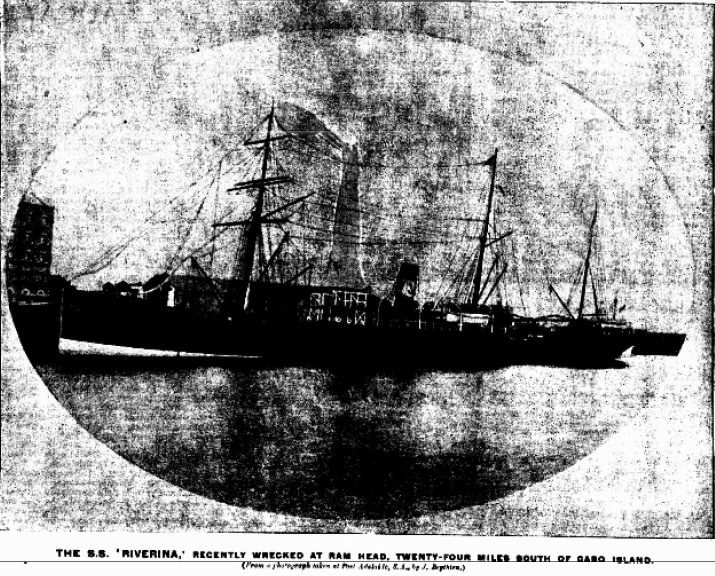
1890 -  S.S. Riverina.


One of the more profitable ships the Dents bought was the S.S.Riverina, a three-masted screw steamer of 2801.0 (imperial tons), 


27 January 1 am -  In hazy conditions bought about by bushfires in Gippsland, the Riverina was running at full speed when she ran ashore onto Island Point east of Cape Everard. The shock from the impact was terrific and came without warning for the passengers. The forward lookout screamed out a warning " breakers ahead" and despite the captain putting the steamer into full astern, she struck almost immediately. The captain tried in vain to reverse the steamer off the rocks by putting her into full astern but the steamer was stuck fast. The ships carpenter sounded the hold and found water rushing into the engine compartment and number two hold.  Captain Prehn ordered the boats to be lowered taking the passengers safely away from the ship which was found to be stranded 150 yards from shore. The crew set about making a makeshift camp with food and water for the frightened passengers. Signals of distress were fired and soundings were taken around the vessel, finding 12 feet aft. The ship's officer was dispatched in a boat to intercept any passing vessel and give them notice of the stranding.  The steamer Wendouree arrived at the scene at noon, some of the passengers were safely taken onboard and she set sail for Sydney.
Despite the ship resting in a very exposed position she was still stable and standing on an even keel.  This allowed salvage teams to recover much of her cargo. She weathered a storm during her time ashore and came through relatively unscathed, allowing the salvage work to continue.


The Auction.

14th February 1890 - There was a large attendance at the John Fraser and Co.'s rooms when the wrecked steamer was put up for auction. There was an estimated 400 tons of cargo still on board and the biddings commenced as 500 pounds and increased by 50-pound bids in rapid succession until the vessel was knocked down to Mr Dent for the sum of 1050 pounds.


Recovery. 

27  February - Mr Dent arranged for the steamers Trident and Sophia Ann to head to the Riverina which was still upright and intact despite the recent heavy weather. 


28th February - The steamer Sophia Ann arrived at the scene but due to very poor weather had to run for shelter back to Eden where she stayed for a few days. She was joined by the steamer Trident, and in calm weather arrived at the scene of the stranding together.

Dent and his team of workers quickly went about their business recovering a large quantity of cargo. He carried with him a powerful portable boiler and engine which was put on board the Riverina to facilitate the lifting of the heavy machinery which was submerged in 12 feet of water but could be seen at low water. Three divers had to feel their way in the discoloured water to secure the machinery and the cargo which was submerged in the vessels hold. 

The only cargo remaining dry were cases of currents and some vinegar.   With Sophia Ann alongside the men recovered valuable winches, anchors, chains, sails, and other furnishings.

The ship was badly damaged, immediately under the stokehold was a large hole through which Captain Laidman says " a Sydney tram could go through."

The weather co-operated allowing Dent and his men to make good progress. They had to work as quickly as possible to recover as much as they could, should a severe southerly storm develope,  the vessel could break up.  The decks of the ship had not sprung and she was still upright but moved about in an unnerving manner whenever a strong wind from the south blew.


The Dents investment was paying off. 

After everything of value was salvaged the vessel was abandoned becoming a total wreck.


18th March  - Marine Board Enquiry.

The board found the wreck was caused by the wrongful act of Captain Prehn. His certificate was suspended for six months.

The vessel had on board a cargo valued at £32,000, fully £20,000 of which is insured in Sydney offices, as follow: — Australian General £6000  -  Alliance Marino, £5000; Pacific Company, £1800; Sydney Lloyds, £3000 ; New South Wales, £600 ; China Traders, £400 ; South British, £200 ; North Queensland, £1200, and the remainder  in other offices


Continue reading about the Dents.


image

14 March 2019

Blog Comment

We received this interesting email, correcting one of our posts.


Dear Archivists,
Maybe I can help with some of your houses.  The photos below are of two different houses on Bowen St. which I remember from childhood. The top house was at 41 or 43 Bowen Street and the property at the rear included fruit trees and lawns going down to the creek.  It belonged to my grandmother, Mrs Amelia Jennings (d 1929)  who m2 William George Dent (d 1939) of Huskisson. The photo was taken at time of sale in 1950s by my mother and had been unoccupied for some years. The purchaser built a motel on the site. My mother’s grandparents were all original settlers to Nowra and the Shoalhaven .
Regards Dee Boys, Mrs
USA

Continue to the original post...Owen Street Huskisson 1916.


image

23 August 2018

S.S. Meteor 1881


image

Much regret was expressed in shipping circles when it became known that the well-known coastal steamer Meteor had foundered on the North-West Coast of Tasmania.


The 33-ton Meteor was a timber coasting steamer built at Jervis Bay in 1881, 65.8 ft x 14.2 ft x 5.4ft. driven by a 16hp engines, pushing her along at 71/2 knots.
.
Built by James Dent for George Dent Senior. She was purchased at Sydney by Mr. F.O. Henry. of Strahan, for the trade between Sydney and Trial Harbour.

Early days.
Under the command of Captain John Leask, she made several trips on the Launceston-West-Coast trade, and afterward under the command of Captain W .J. Taylor, who chartered her from the owner.
She was then leased by Mr. G. J. Haylett, and experienced engineer, who was in charge of the engine room at the time of the disaster, captain Richard Greene was in command, and two ordinary seamen made up the compliment. During her life, the Meteor was a busy vessel, doing a brisk trade on the North West Coast, each trip had full cargoes.

The first anyone knew of the disaster was when a notice was posted on the shipping board outside the Telegraph office.

:- Burnie. 8 a.m.   Meteor foundered about 7 miles from Burnie.

The owners of the vessel the Don Trading Co. received a similar notification from Mr. G. J. Havlett, who had rented the vessel. The wire being supplemented by the satisfactory news that no lives were lost.

Leading up to the loss.

She left the Mersey on her usual visit to coastal ports and arrived at Table Cape, she took in a full cargo of produce for Emu Bay for transshipment. Very severe easterly weather was encountered on the voyage. After arriving at the Bay and being unloaded it was found she was leaking badly.  Some of the cargo was found to be spoiled by water.

After discharging she was taken back to Table Cape and hauled onto the slips, shipwrights were employed to make the necessary repairs.  A new false keel was added, the rudder post was found to be damaged, the leak was caulked and iron works carried out, the work was completed with the application of a new coat of paint.  She was considered by those on board to be fit for sea.

Her last voyage – April 1893

8 a.m. Wednesday  - During the morning she was loaded with 301 bags of potatoes valued at 50 pounds.

9.30. p.m. Thursday - In fine order, she left port for the Mersey, Davenport, the weather was beautifully fine,  and the sea very smooth.

10 p.m. - The bar at the Cape was cleared, shortly after one of the crew Mr. Smart, went below for a piece of tobacco and heard a noise of water rushing in amidships.  He immediately informed Captain Greene.  Engineer Mr. Haylett, went to the engine-room and discovered the stoke holes making water freely.  The men were ordered to the pumps, the vessel carried three appliances on deck for pumping, these were quickly employed.
One seaman in the company of the captain started bailing out water with buckets, "in which task they all worked like trojans" feeling their lives depended on their efforts.

The captain turned the vessel believing she would make it back to the Bay, the men worked hard to save her, the pumps were kept going until the water reached the furnaces and extinguished the fires. The sails were hoisted, but not a breath of wind was stirring, and the vessel commenced drifting in a north-easterly direction at the mercy of the waves. The men hoisted distress signals in the form of torches fixed to battens in the hope of attracting the attention of passengers on a passing vessel, but in this, they were again unfortunate.

12.30pm - Orders were given for the pumping and bailing to cease and attention was directed to lessen the weight of cargo by throwing all the deck cargo overboard, hopefull giving the vessel a better chance of floating, this action also proved futile, she was filling fast.

In defiance of the perils that menaced him.

3.am - Some six or seven miles abreast of Emu Bay she had settled well into the sea which commenced to wash over her decks, she was rapidly sinking. The crew took to the lifeboat which had been lowered from her davits when it was discovered the vessel was making water.

The captain would not leave his ship, and though the crew implored of him to do so, he was determined to stick to his ship till her timbers disappeared, in defiance of the perils that menaced him.

The vessel rocked like a huge cradle on the breast of the waves, water washing clean over her. She listed to starboard and dipped back to port alternately, the ironwork shivering at every motion. The suction caused by the sinking vessel was imperiling the lives of the crew manning the lifeboat still clinging to the side of the vessel.  Captain Greene remained faithful to his post, and at times was half covered by the waves.

3.30 a.m - The end was reached when the vessels head was lifted high out of the water, and the Meteor suddenly disappeared below the waves stern first. Captain Greene was thoroughly exhausted and rescued just in time.

The men quickly hauled away from the sinking steamer.

The occupants of the boat then shaped for Emu Bay.  A heavy fog has settled low over the sea making it impossible to make out the shore.

6.30 a.m - After three hours of hard pulling, in bitterly cold, the sound of a steamer's whistle was a welcome sound, and though they couldn't discern any light, they were directed to the port of Burnie by the ship's whistle.  To compound their difficulties they were attacked by a huge shark off Blackmans Point, which was soon beaten off.

7.30 a.m - After a wearisome voyage in a boat leaking like a sieve, requiring constant bailing, the crew landed at Burnie in an exhausted state.  The seamen managed to save their clothes, but many other valuables were lost.


The vessel was insured in the New Zealand Insurance Company for 750 pounds. Those connected to the vessel said the amount will not cover the loss, the cargo was uninsured.

When constructed she was regarded as a finely built vessel, 8 years of hard continuous service with little trouble proved that to be the case.

"Rotten old Tub"

"At the time of the sinking men best qualified to venture an opinion described her as a "rotten old tub," absolutely unseaworthy: and had seen her best days. The fact of the vessel not having met her fate long ere this has been a matter of wonderment among those who had seen her recently."

Fortunately, the night was calm. Had it been otherwise it is doubtful any of those on board would have reached land.

The Meteor had escaped disaster on a number of occasions.

Feb 24 1991 – While negotiating the Pieman River if it had not been for the coolness and courage displayed by Captain Leask, the wreckage of the Meteor would have marked the graves of the whole crew.  While crossing the bar which was comparatively smooth the steamer was caught by one sea that carried her completely out of the very narrow channel. The ship would not answer her helm, was swept within 10 feet of the breakwater some 50 feet high, as the wave receded, a grinding noise was heard and the vessel heeled over to the railing, but fortunately slipped off the rock that had pierced a hole in the forward part of the hull. By great management and a certain amout of luck the Meteor fast filling with water, was brought back into the channel, entered the heads and was run aground in the river.
The cargo was brought ashore by the efforts of men running between the ship and shore, a distance of 200 yards, covered by about a foot of water, all trying to save as much of the cargo as possible. The work continued throughout the night till 2 a.m the next day, when the tide was at it's highest,  the steamer by this time was submerged to the top rail.
On the next low tide the steamer was temporarily repaired, pumped out and refloated.


For any seaman the most feared catastrophe which can happen to a vessel is to catch on fire.


image


October 1889 – While lying under Hunter Island disaster was averted by the quick action of Captain Leask and his crew. The captain and crew had gone below to dinner and noticed smoke coming into the cabin. They rushed on deck and found all in flames. Through quick action they got the fire under control. Captain Leask suffered burns to the arm while fighting the fire. The damage was confined to the deck, while fighting the fire a portion of the cargo, chaff, was thrown overboard while still burning.  She was returned to Formby for repairs.

Captain John Leask was born on the Shetland Islands before travelling to Australia in 1861 . He was a well repected seafaring captain and died at Port Adelaide in 1898


No image of the vessel has been found, if you can help or add to the story please contact me at
yourcontributions@gmail.com


image


7 August 2018

The launch and loss of the steamer Currumbene.

28-Launch-of-Currumbene-1922a
The launch of the steamer Currumbene 1922

On a glorious Monday morning on the 13th February 1922, The normally quiet seaside village of Huskisson was a bustle with cars and people. Motor buses arrived from Nowra crowded with passengers, and cars kept arriving with visitors, all eager to see the launching of the fine vessel,
built by Joseph Dent.

18 months earlier the keel made from locally sourced timber was laid on the banks of Currumbene Creek at the Dents shipyards. Joe Dent's workmen set about to construct a fine cargo boat for E.D. Pike and Co., Timber Merchants of Sydney.

Like so many other vessels constructed by the Dent family, the launch was marked with a large celebration. Invitations were issued to the launch. On the Monday morning at 9.30am, a large crowd assembled from all over the district to see the launching.

At precisely 9.30am on the high tide, Mr. Dent gave the signal, and the sound of many heavy hammers on the dog-shores gave notice that the work of launching had commenced, within a few minutes the vessel glided "majestically" into the creek from which she was named. 

The vessel was built for the North Coast timber trade between Bellinger River and Sydney. Measuring 132ft in length, breadth 28ft and a depth of hold at 8ft, she was built of colonial hardwood mostly sourced from the local forests.

Mrs. Burroughs, the wife of managing director of the owner, broke a bottle of champagne across the bows as the boat commenced its first journey into the blue waters and named her "Currumbene."  the large gathering clapped and gave a mighty cheer as the vessel entered the water.

The vessel was hauled alongside the wharf, everyone partook of refreshment of every kind, liberally provided by Mr.Dent.

30-Launch-of-Currumbene-in-1922


"The jolliest time possible was spent, and there seemed no end to the good things provided."

The managing director of the company Mr. Burrows, in a speech, said he was very pleased with the outcome of their investment.

" It afforded him the greatest pleasure to propose 'The health of Mr. Dent and the men working on the job." He said they had not stinted Mr. Dent for money, but they had full value for the money spent, and he also wanted to compliment the men working on the job, they were the only men he had seen working that he would care to give another job too."

31-Currumbene-at-mouth-of-creeka-1922

Not everything went to plan during the launch, caught in the outgoing tide the Currumbene went aground for a short time, before being towed to the wharf.

33-Currumbene-run-ashore-after-launch-1922

The celebrations continued into the night finishing with a dance in the new hall of the School of Arts, present-day "Huskisson Pictures" and given to the public by Mr. Burroughs, and greatly appreciated by the young folk.


34-Currumbene-at-Huskisson-wharf-after-fit-out
Currambene after fit out.

Not much information has come to hand on the life of the Currambene after her launch

Currumbene ashore

1924 -  March, She was stuck on the bar entering the Bellinger River, later refloated on the high tide without damage.

1925 -  October, She had a lucky escape from disaster after going ashore at the Bellinger River, on inspection she was found to be badly damaged, she was refloated and repaired.

1926 - She was once more stuck on the bar at the entrance to Bellinger River, again refloated without damage.

No blame was ever laid on the Captain or his crew for any of the standings, it was the peculiarities of the channel and sand shifting with currents and tides.

image

1928 - She was moored in Sydney when one of the fiercest Cyclones ever recorded hit the NSW coast. During the storm, the steamer White Bay foundered near Morna Point with the loss of 16 men. The steamer Euralla went aground, her crew of 16 were rescued.  At the time the storm hit there was a seaman's strike in progress, so many of coastal steamers were moored in Sydney Harbour.
The tremendous storm hit Sydney causing steamers anchored in the harbour to drag their moorings, the Currumbene was one of those. She broke adrift and was in danger of fouling several other steamers before being removed by the tug Leveret.

1928 - She was chartered for salvage operations on the luxury coastal steamer Merimbula which had gone aground near Beecroft Head Currarong. The charter was
canceled when it was found the Merimbula had settled considerably by the stern and salvage operations were canceled.

No other information comes to hand until 1934.

image


By 1934 the once busy steamer had become a liability to her owners, E. D. Pike and Co., Her last contract was by the Newcastle  Stone Crushing Company Ltd., finished in July 1931, since then no further work could be obtained for the vessel. She remained moored at Newcastle.
Built at a cost of 19.500 pounds, valued by the company at 10.500 pounds, she was insured for 5000 pounds. The Currumbene  had been a losing proposition to the company.


image


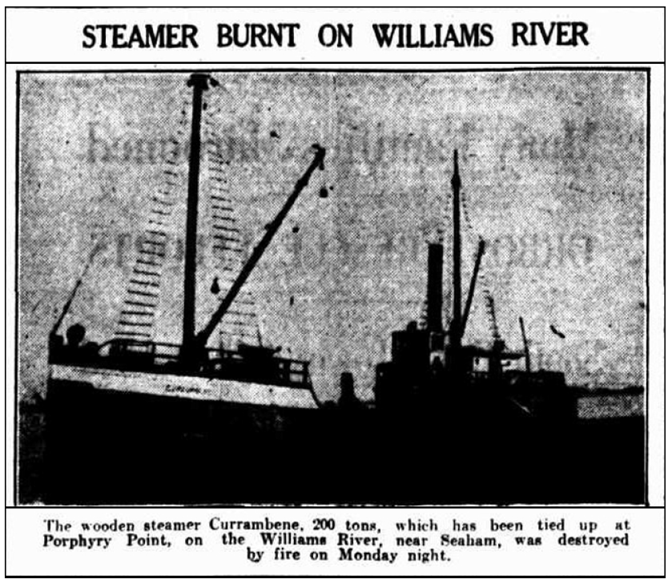
1934 - The once mighty steamer was lost in a mysterious, devastating fire on the banks of the William River Seaham.  The fiercely burning vessel lit up the countryside for half a mile or more.
The fire was watched by scores of residents from the verandas of their homes. Every now and then explosions like those of rockets could be heard."
She burnt for a few hours down to the waterline, she was still smoldering the following morning before sinking in 15 ft of water.  A large area of bush around the vessel was badly burnt as well.


image
Coroners inquiry.

The  Currumbene was moved to Clarencetown to remove the saltwater growth in 1932, but owing to bad weather she was moored at Seaham on the return journey, where she remained. Mr. Kelly was engaged as a caretaker. Kelly was instructed to light a fire in the boiler and take the vessel to
Clarence town for repairs. Mr. Edward Wilson of Seaham was on board the vessel on the night of the fire and left her at about 10.45 p.m., he
could see the vessel from his home.  The first he knew of the drama was when two rockets were fired by Mr. Kelly.

John Willam Kelly, the caretaker of the Currumbene, said he lit the boiler fire at Cullen's direction to shift the vessel to Clarencetown. He retired to bed at 11.p.m. and was awakened by smoke coming from the engine.  He did not know how the fire had started, He had inspected the ship before the fire.
The coroner returned an open finding.


Continue reading about the T.S.S Merimbula


image

29 June 2018

Huskisson Post Office.–1843 to 1938

2
Today we expect to be able to communicate over great distances almost instantly, we become annoyed if mail is delayed by a few days or our phone calls are interupted by bad reception or our internet is not working.  Take a moment to think about what it must have been like when mail was delivered by horseback and telephones were almost non existant.

Huskisson Post office approved.

1843 - The Post Master General (P.M.G) approved a post office for Huskisson, to commence operations on the 12th January 1843.

Mail would arrive at Nowra then be distributed to the surrounding districts by horseback.

1845 - Timothy Donovan was the first person I found any reference to, he delivered mail by horseback once a week from Nowra to Huskisson, Ulladulla, and Broulee a distance today of 140  miles, and was paid 85 pounds per week.

1848
- Timothy Donovan was still delivering mail to Huskisson, Ulladulla, and Broulee, payment was 140 pounds per week.

1849 - Henry Thomas took over the mail delivery, the payment was reduced to 100 pounds per week.

1851 - John Allen took over the delivery by horseback to the beforementioned destinations,  his payment for the service was reduced to 80 pounds per week.

1852 - The post office at Huskisson was discontinued and the letters were sent to the Shoalhaven. (Nowra PO).

1852 - John Allen was was still delivering mail to Huskisson, Ulladulla and Broulee by horseback once a week, his allowence had increased to 120 pounds.

1871 - The post office for the whole of Jervis Bay was located at Tomerong, at that time the centre for local governmant.  During wet weather the roads to the outer districts would become impassable making it impossible for mail to reach Huskisson for days at a time.

1886 –
An "official" post office to service Huskisson residents was established at Tomerong. Huskisson could now expect a mail delivery two days a week.


7

1904 - By this time the amount of mail being handled by Tomerong P.O had increased to such an extent the Shoalhaven Progress Association put forward a submission to the P.M.G. to have the mail service between Tomerong and Huskisson increased from two days a week to three days.
The Huskisson Post Office was still operated as a "non-official" post and telephone office with a revenue of about 40 pounds per annum. People who needed their mail urgently had to climb aboard tradesmen carts and travel the rough dirt road to Tomerong and back, which was regarded as an unsafe and dangerous pursuit.

post office 1913 husky


1913
- The Huskisson post office's normal mail routine could almost be overwhelmed when the Australian Fleet came to the bay. The post office would be inundated with incoming and outgoing mail.

The post office operated six and a half days a week.

1914 - A letter was sent to the Hon. Austin Chapman by the secretary of the Huskisson Progress Association, Mr. Les Dent, requesting the Saturday half-day holiday be moved to another day. The request was denied on the grounds the present arrangements "were the most suitable and in the interests of the majority of local residents and businesses."


8

1915 - Representations by the Hon. Austin Chapman to the Deputy Post Master General, (P.M.G) for increased payments to small post offices was denied. It was explained increases could only be paid to offices which can show increases in business. Huskisson Post Office had shown a fall-off in business and payments would be decreased.  Mr. Austin Chapman protested against any decrease in payments stating. " all of these offices are not fairly paid for services rendered."

Huskisson Post Office had a telephone at it's office.

1917 - A request to change the half-day holiday from a Saturday to a Wednesday was rejected on exactly the same grounds as in 1914. The Deputy P.M.G. went on the say, ' Residents can use the telephone in urgent cases on Saturday afternoon, and any time after ordinary business hours  by paying the usual opening fee."

4

1921  - The post office at Huskisson had not been recognised officially by the authorities.
In December a communication was sent by the Post Master General, (P.M.G.) of Huskisson to the Hon. Austin Chapman requesting that the local post office is raised to official status and that more privacy is provided for receipt and dispatch of telegrams. The matter was considered but it was found that the conditions at Huskisson did not justify the status of the office being raised. The matter of the privacy for handling telegrams was solved by placing a "silence cabinet"  inside the office to provide the necessary secrecy in dispatch and receipt of telegrams.

6

Huskisson Post Master General seriously injured.

1927
- The Huskisson Post Master General was Mr. Richard Dent, sen., a member of the well known Dent family who pioneered shipbuilding at Huskisson. Richard Dent was helping to launch a motorboat which had just been overhauled from the Dents slipways at Huskisson.  Attached to the launch was a wire rope which played out as the vessel slipped into the water. He noticed a twist in the rope, and put out his foot to clear the kink, but instead of doing that his foot was caught in the wire. The wire tightened with such force that the bone of the leg was snapped above the knee and the wire cut through the flesh almost completely severing his leg. He was taken to Berry Hospital and the leg was amputated a few inches above the knee.

1928 - Francis Riches wrote into the Nowra Leader complaining of the inconvenience she had experienced in trying to get a message out of Huskisson after post office hours. She was appalled at having to pay 3 shillings to use the telephone after hours. She also complained about the lack of electric lighting at Huskisson, stranding her son in the dark. The son had to ask a policeman to show him the way home.
5

1931 – Like almost every coastal community at that time Huskisson had very poor communication with the outside world, which is illustrated by a story which appeared in the Shoalhaven Telegraph August 1931 about a man named Sydney Thurstan, Haynes 65, who was enjoying a holiday with his wife at Huskisson. Mr. Haynes took a bad turn on Saturday night, attempts were made to get in touch with Dr. Rodway of Nowra. The Huskisson post office had the only telephone in Huskisson, but it was closed and the occupants were away. It was necessary to send a car to Falls Creek where the doctor was communicated with by telephone. By the time he arrived at Huskisson, Mr. Haynes had passed away from a suspected heart attack.

1931 - The sad affair above caused local papers to agitate for a better means of communication between the popular seaside resort of Huskisson and Nowra.

1938 - The popularity of Jervis Bay as a holiday destination was growing rapidly. The post office now had a staff of four and was finally recognised by the P.M.G Department  by consenting to a continuous telephone service.  During visits from the fleet the post office handled many thousands of letters each way, and many dozens of telegrams and phone calls.

1938 - 10 years after Francis Riches mentioned above,  complained about how dark Huskisson was, electric light poles connecting Tomerong and Huskisson were completed. The roads in the district were still in a shocking state and almost unusable in some areas.

1938 - Mr. and Mrs. Grant from the Huskisson Post office were highly praised in the Nowra Leader for their outstanding service to the community in the face of a rapidly growing population and the allocation of a continuous telephone .


image

19 June 2018

Wreck of the Barque Pacific - June 1864

June 1874 was a partricuarly tragic month,  Nowra and the district's farms were being devastated by floods and gales. Two ships were lost at the entrance to the Crookhaven River.  The ketch Sarah Jane was wrecked on the north spit with the loss of one seaman, while the Schooner Pacific went ashore on the south of Crookhaven Heads.

The Pacific.

21 May – The Pacific left Auckland bound for Newcastle for a load of coal. She enjoyed fine weather for the best part of the voyage until approaching the Australian coast.

12 June 10a.m – The Pacific drew near the land,  sighting the Shoalhaven coast,  the weather was dark and hazy, the wind from the E. and S. she hauled off the land and stood S.S.E. under close reefed topsails and foresail.  313 tons, American built, the Pacific was now in the grip of the "perfect hurricane", which carried with it every sail leaving her at the mercy of the wind and waves.

13 June 6 a.m. –  Nothing could be done to save the vessel and she came ashore on the flat rocks near the gap at the north-east end of the Pilot Station Hill Crookhaven.  At the time a crewman "James Grant" was on the foreyard of the ship helping to shorten sail when the ship struck, the sudden impact threw the unlucky sailor over the side of the ship onto the rocks below, killing him instantly.
The body was sewed in canvas and buried with the Union Jack wrapped around it, the crew knew he was an Englishman, he had been shanghaied on board at San Francisco under the name of "Jack".

Dead sailor burried.
James Grant was buried on the hill where the pilot station was later built.  Several local residents including William Armstrong, Mr Alex Munro, and Mr Tom Wellere were asked by the ship's captain, a Mr Chase, to witness the burial. The deceased man was described as being about 5 feet eight inches, blue eyes with five flags tattooed on his chest, an anchor on his right arm, and a bird with a leaf in its beak, over an axe, a saw and an auger on his left arm.

Superstitious pilot removes poor "Jacks" grave stones.

The grave used to be a landmark on the Station, and for many years was cared for by the wives of the pilot men; until in later years one of the Pilots, who was evidently superstitious removed the stones placed on the mound, he leveled out and used every effort to destroy the evidence of a grave being there, he said, "He did not want to live with a bloody cemetery.

The wreck was pushed above the high water mark and was stripped of everything of value. The beach below the Crookhaven Heads was strewed with candles. The vessel was uninsured.
The captain and crew later made the journey to Sydney by the steamer Illalong.


16 September - The vessel was later repaired and refloated by Mr George Dent of Jervis Bay.


image

7 June 2018

A rare look below the decks of the Lady Denman Ferry

Built in 1911 by shipbuilder Joseph Dent the Lady Denman now rests in a world class museum close to where she was built on the banks of Currambene Creek Huskisson.
The video gives you a rare look below the decks of the Lady Denman Ferry.  Constructed from locally felled timber one can only marvel at the skill and craftmanship of the builder and his crew.

The work by dedicated volunteers over many years to secure the Lady from deterioation can be seen amoungst the broken pipes, and rusting valves, she has seen better days.

The work continues.


For a larger viewing follow this link. https://www.youtube.com/watch?v=V3cXDUArqJ0


image

23 May 2018

The brigantine Adonis 1890.

Mystery still surrounds the sinking of another beautifully handcrafted timber ship built by the Dents on the shores of Currambene Creek Huskisson.

The brigantine Adonis was built at Jervis Bay by Mr. Dent in 1874.
She measured 108 tons, 92ft 4 inches in length, with a beam of 20ft 7 inches, and 8ft 3 inches depth of hold.

copyright free example of a brigantineExample of the fully rigged brigantine Leon from the era.

image

21 December 1890  - Captained by John Richards with a crew of 6, she was on a voyage from Wollongong to the Richmond River laden with coal, the vessel was making good and all was going well. She was placed around 10 miles distant from the shore, the night was dark, the weather was light with a north-east wind, and a strong easterly swell.

22 December 11 p.m.  - Able seaman Ludwick Myer was lying awake in his bunk, hearing the sounds of water on the floor he struck a light and saw that water was coming in freely, he quickly went aft reporting the ship was full of water to the captain. The pumps were immediately set to work, but they could not cope with the inflow, the captain ordered all crew to the deck and make the boats ready. At the captains order the man at the wheel put her hard aport, the water by then was over the forecastle deck.
The crew came on deck saying the water was rising fast, they sounded the pumps and found there was over 3ft of water below and rising fast. The crew tried to get her onto land but without avail.  Realising there was nothing they could do to save the ship the captain ordered his crew to abandon ship the crew launched the lifeboats and managed to leave the ship safely landing at Crowdy Head at daylight.

15 minutes after abandoning the ship the Adonis sank out of sight.
image
Official Enquiry.

1 January 1890 - during the official inquiry into the founding of the Adonis the captain and crew explained how they always looked upon the ship as a "thoroughly staunch and seaworthy craft".  The only explanation for the loss may have been if one of her planks was faulty.

Marine Board Findings.

7 January 1890 - The board deliberated on the abandonment of the Adonis, they found the abandonment was justifiable,  and there was no evidence on which to found a charge of default against the master, Captain Richards.

She was owned by Mr. Patrick Hogan and was insured.

A brigantine is a two-masted vessel with her foremast fully square rigged and her mainmast rigged with both a fore-and-aft mainsail (usually a gaff sail) and square topsails (and possibly topgallant sails).

An interesting fact about the Adonis.
Many ships were adorned with classical figure heads, but by the 1870's they went into decline and the last NSW made classical figure heads were a female bust for the schooner Venus of 1873 and a male bust for the brigantine Adonis of 1874.
REF: Ships figureheads in Australia.


image

1 May 2018

Schooner Zoe–Jervis Bay

T
1875 The launch of the Schooner Zoe.

The new topsail schooner Zoe was built by George Dent Junior at his shipbuilding yards on the banks of Currambene Creek Huskisson on October 30, 1875, to the order of Mr. George Hill, of Surrey Hills, Sydney. She was intended for the timber trade and was described as a "faithfully-built vessel" the whole of the timber used in her construction being well seasoned and the best that could be obtained.
She was 73 tons register. Her keel was 75 feet; beam 21 feet and depth of hold, 7 feet. She was described as having " fine lines".

87-George-Dent-IIIGeorge Dent Junior.

1888
A Dreadful voyage.
While on a voyage from Normanton to Port Jackson in November she fell into a series of heavy gales, with frequent spells of light airs and calm. The vessel frequently sought shelter under the different islands on the way down, putting into Cooktown, Mackay, Cape Moreton and Port Stephens through stress of weather. On one occasion whilst lying under Rocky Island, the vessel dragged her anchor and drifted within a few yards off the rocks.
Fearing she would go ashore the crew abandoned her and took shelter at the lighthouse keeper's residence for two days. The crew returned on board and in moderating weather managed to get the vessel clear of the danger.

If the crew thought this would be the last incident on this difficult journey they were mistaken.
While being forced to seek shelter from deteriorating conditions in the Pioneer River, the Zoe was driven ashore and remained hard and fast for several days. She was subsequently floated without damage and resumed her voyage only to be caught in bad weather which necessitated anchoring under Cape Morton.  The Zoe lost two anchors, with some chain in the bad weather and quite a number of sails were split or carried away.

1889 The tragic loss of the Zoe's cook.
Saturday 27, .
While anchored at Yamba the cook a Mr. W.Wells was reported missing. A fisherman named Sheather reported seeing attempting to swim to the schooner on a Monday morning. The swimmer was showing signs of distress and Sheather tried to rescue him, but the tide was too strong to render any assistance to the man, who afterward sank.

Tuesday 30.
The body of William Wells, the late cook of the schooner Zoe was found washed ashore on the North Beach of Iluka.

Zoe Foundered. 1895.
News arrived that the German Schooner Zoe had foundered, this was later disproven.


image

Loss of the Schooner Zoe. March 1896

The first news to arrive in Sydney of the loss of the German Schooner Zoe came from the captain of the steamer Kurrara.  The Zoe operated out of Sydney before being sold to Messrs. Hernsheim and Company and used for the inter-island trade.

The Zoe started her fateful voyage from New Britain for a cruise through the German Possessions. All went well until she made for Bouganville on January, 17 when she ran onto a reef on the south-east side of the island.  The crew managed to escape in the boats,  but vessel and cargo of copra and trade were a total loss.


Continue reading about the Dent's.


image


25 October 2017

Huskisson 1968 –1934 –1950's

image
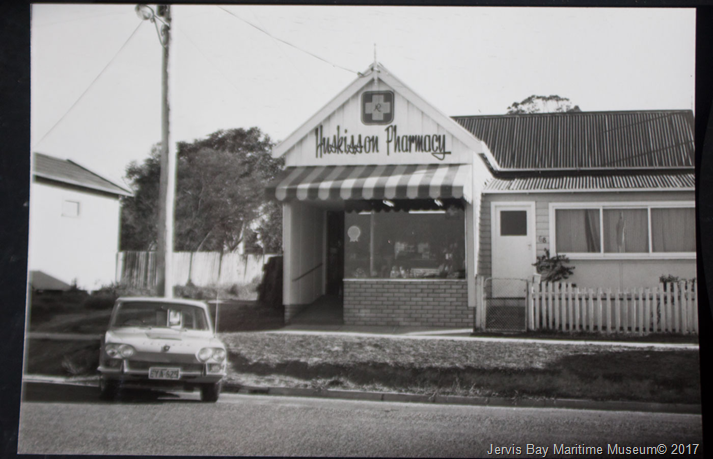
The first pharmacy in Owen Street Huskisson 1968/1969. Ray L. Coats was the chemist.

launching--of-phyllis-1934-built-frank-dent

Launch of the Phyllis, Currambene Creek 1934 – Built by Frank Dent.  Click to enlarge

arundel-guest-house-1950'

Aurundal Guest House 1950's – Click to enlarge

huskissons-first-mobile-fire-truch-outside-shed-owen-st-huskisson-1957---1959

Huskissons first mobile fire truck outside shed Owen St Huskisson 1957 – 1959


image


14 August 2017

old time notes

imageNorth Huskisson Wharf.


This small article which appeared in the Nowra Leader,  September 22, 1911  describes South Huskisson as a thriving small coastal town.  It mentions the large Dent family,   the shipbuilding and timber industry, as well as some of the people involved.


"It is now over 40 years or it may be 45 years since the late Mr James Dent, senr., started the ship building at North  Huskisson. That spot then was a busy centre. Combined with the shipbuilding carried on by Mr Dent, there was a large timber trade, logs in the round were shipped to Sydney.  This particular branch employed a great many men, and many bullock teams were used.  In connection with the various branches of this work, there were trusted men placed over each branch.  
As well as we can remember Mr Longfield was general manager.  Mr Peak took a part in supervising matters.


Mr Dent took an active part in all matters pertaining to the business.  Messrs.' James, since deceased, George and William who were then on the verge of manhood;  Fred, Harry, and Joe were boys.  Life then was all sunshine.  The traveller to Huskisson to-day cannot imagine it was such a busy centre at that period.

"Poor Old Ned Gather'em -up'' as he was generally called,  we suppose he was so called on account of gathering up the tools and other things of general use that caused the appropriate name to be given him.  'Old Ned" was in his glory when there was a launch on, he has long since been gathered to the land of his Fathers.   He with many others, roamed over that timbered locality which induced the
axeman and teamster to haul many of its enormous trees.   60 years ago or perhaps a little less than that there was not a habitation at the Currambene.  Mr Dent, the senior, was the first to build there.  The only house between Nowra and Jervis Bay, as the road wended then, was at Woollamia.  Mr Dawson had a home at Erowal, now the property of Mr P. Kean.  There were one or two houses at Jervis Bay,  but were on the decay.  Mr John Guihan, known then as "Kerry Jack," occupied one of those houses near the fresh water creek which empties into the Bay.

The Elyard family then had a cattle station at Jervis Bay, and "Jack"  was the stock-keeper; he went once a fortnight to Brundee for his rations.  It was he who first saw the wine laden ship "Juniper" wrecked south of the bay.


This part of the article describes South Huskisson (Present day Vinventia).
Prior to the time, we are writing about there were three hotels in Jervis Bay, also a blacksmith shop, wheelwright shop a wool store and wharf.  The old pine-tree is the only mark left today to remind of the long past and almost forgotten period.  The Bay now has its hotel and store, run by Messrs. Cambourne and Paul respectively.


imageTimber vessels at Huskisson Wharf, 1903


Advertising which appeared in the same newspaper.

image


image

27 July 2017

The Brigantine, Victory

young-endeavour4The Brigantine rigged Young Endeavour at anchor inside Jervis Bay March 31st 2017

The 142-ton wooden Brigantine Victory was built by George Dent in 1873 on the banks of Currambene Creek Huskisson.
Described as a fine ship built from iron bark and gum, copper fastened and sheathed with Munz metal. The style and draught of water qualified her for the intercolonial trade.  Her lines were described as "extremely fine, she shifts and stands without ballast, can go to sea with 25 tonnes, carries 225 tonnes of dead weight,  and is equal to 300 tonnes weight and measurement.   She measured 92 ft in length, breadth 24ft,  deep laden 8ft 6 inches, renders her one of the most eligible vessels that have been offered in this market for a considerable time."      She plied her trade all along the east coast between Queensland and South Australia, including many Trans Tasman voyages carrying all manner of cargo.    Like most ships of her era, she suffered arduous trips, sometimes resulting in a great deal of damage.

image


March 1883 her owners Messrs. Ghest and Jewett were informed that she had put into Keppel Bay in distress. While off the Queensland coast on a voyage between Dungeness and Auckland carrying a cargo of sugar, she ran into very heavy weather losing her sails.


image

September 1891 the Victory returned to Port Jackson after an absence of several months.  After leaving the Johnston River in August she met with strong south-east winds at the outset she sought shelter under High Peak Island.  Continuing her voyage,  on the 28th August she encountered a heavy southerly breeze, which lasted three days, after which the breeze abated until she was passing Seal Rocks.   The wind came from the west and north-west,  veering to the south-west and increased to the force of a gale, described as blowing  at times "in squalls of hurricane fury."  The gale was accompanied by a high confused sea, which broke on board the vessel from all quarters. She weathered the storm well with no serious damage,  the gale lasted 48 hours.

image

In September 1893 she arrived in Warrnambool from New Zealand carrying a cargo of timber. The voyage took 40 days, and was described as "exceptionally rough" she ran into heavy gales and a head wind was experienced almost from the day she set her sails and until she eventually dropped her anchor at Warrnambool.
Her sails were at several times  "blown to pieces" and on two occasions had to seek shelter under King Island. Her provisions and stores were nearly exhausted.  Even after the arduous journey and anchoring at Warrnambool her troubles weren't over.  The wind was still blowing half a gale from the south -west, with heavy seas tossing the Victory about.  At midday one of her anchor chains parted, and for a short time, she was in danger of going ashore,  fortunately, the other anchor held until the sea moderated.  The crew ran out a hawser from the vessel to the breakwater for additional security.

During the trying voyage, a disturbance erupted on board the Victory, on arriving at port two seamen were charged with disobedience and were brought before the Police Court, both men were discharged, with the Bench considering that they had already been sufficiently punished for any little faults, they had committed.

image
November 6, 1893, the Victory's luck ran out.
Under the command of Captain Roddy, she left Warrnambool bound for Newcastle, where she was to be loaded with coal and taken across to Gisborne (N.Z.),  the following day, she ran into heavy weather near Wilsons Promontory and sprang a leak.  The pumps were manned and kept going all day and night but all to no avail.  As the vessel passed through the straits the leak increased until there was 4ft of water in her hold.
At around 2 a.m the City of Adelaide was approaching Cape Everard, near Gabo Island about 25 miles off the land, when they saw rockets being fired. he bore down to the spot and discovered the Victory in distress.  When the City of Adelaide arrived the captain of the Victory reported that the vessel was sinking,  and wished Captain Mackay to stand by his vessel till daylight. 
The request was readily met by Captain Mackay,  and the two vessels remained in company until 6 a.m.   Trying valiantly to save the ship the crew of the Victory had been pumping and bailing, throughout the night,  but all to no avail, and as it became evident the vessel could not float for
much longer a hurried meeting of the crew was called, the decision was made to abandon her.  The City of Adelaide came to their assistance and with a strong easterly gale blowing at the time it wasn't without rick.   Once safely on board the City Of Adelaide the crew were made as comfortable as could be,  it was quite apparent by the worn out state of the crew they could not have stood by the vessel much longer.  The Victory sunk soon after the men left the ship.

image 


The board found the abandonment was justified, and there was no evidence upon which to find a charge of default against the master. The board wished to place on record its appreciation of the conduct of the captain of the City of Adelaide, which sighted the Victory,  and after standing by her for some time,  conveyed her crew to port.


Meaning: The brigantine was a two-masted sailing vessel with a fully square rigged foremast and at least two sails on the main mast: a square topsail and a gaff sail mainsail. The main mast is the second and taller of the two masts.


image