.

.
HOME OF THE LADY DENMAN - Local history isn't always about the big story - the everyday story of life in the early development of the region can be a fascinating, entertaining and educational journey.
Showing posts sorted by relevance for query dent. Sort by date Show all posts

13 January 2014

The Dent family

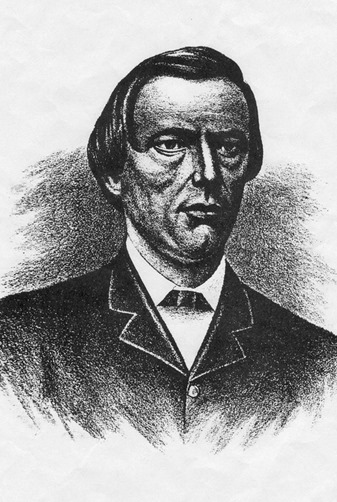
 1861. Tall, straight timber and the deep harbour attracted George Dent to Jervis Bay.


86-George-Dent-Senior

George Dent senior.

Huskisson once had a thriving shipbuilding industry, ships of all sizes were launched at the ship building operation on the banks of Currambene Creek operated by George Dent.

The museum has a fantastic display of tools and photographs from the era.
The floor of the display is made in the same fashion and materials as the decks of the ships built at Huskisson.


top-view hammer plane

672-George-Dent

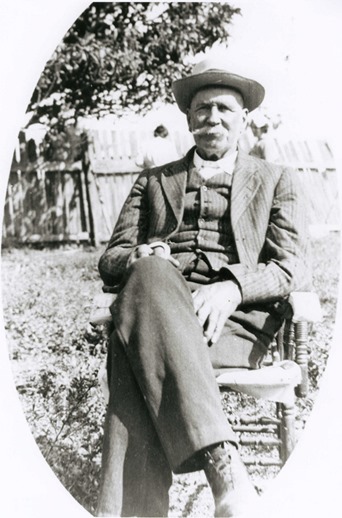
George Dent Junior.

George Dent moved his family from the Georges River area to Huskisson in 1861. George had been a timber-getter for the boat-builders on the Georges River in Sydney. Two of his sons, George Junior and Joseph became boat builders while his other two sons, James and William worked in the bush finding and felling the right timber for the boatbuilding.
William Wood joined George Dent Senior in the first shipyard, and later set up his own yard with other shipwrights joining them over the years. In the 1880s, George Dent Junior set up a new yard, and at the turn of the century, Joseph Dent did likewise. It was in his shipyard that the Lady Denman was built.


113-Joe-Dent-and-Crew-2a 
Joseph Dent on the left and his shipbuilding crew.


image


4 January 2016

Another steamer built at Jervis Bay.

The Lady Scott

Sydney Mail (NSW : 1912 - 1938), Wednesday 9 July 1913


image

1913 - The Lady Scott being built on the slips at Currambene Creek Jervis Bay.
The vessel has been built by Mr Joseph Dent of Huskisson, from designs by Mr. Walter Reeks of Sydney, and is for the Balmain New Ferry Company, Ltd.


The tall sailing vessels and ocean crossing steamers had long since left the bay.  The promised prosperity which was to come from building the wool road,  by which weiry, hard working bullocky’s,  driving large teams of bullocks, carrying huge loads of wool from the highlands to the bay to be loaded onto waiting sailing ships and ocean going steamers had long since passed by.

The bay had fallen silent for many years
,  Fishing was popular but industry was virtually non existant, the only local industry to employ people were the shipbuilding yards and the  few timber mills supplying lumber.

One of those yards run by the Dent family, had been skillfully hand crafting timber boats from locally sourced timber,  vessels of all kinds slid from the slip-ways located along Currambene Creek destined for locations all over the south pacific.

At a time when Huskisson,  had a population under 200,  two beautifully hand crafted timber Ferries were built by Joseph Dent, during the construction he employed around 10 men.


113-Joe-Dent-and-Crew-2a

Joe Dent and his shipbilding crew.

455-Joseph-Dent-at-sawmill-1857-1945-a

Joseph Dent at the timber mill.

The centre piece of the JB Maritime Museum,  the Lady Denman built in 1911 - 1979,  and her sister ferry, the Lady Scott  built in 1913 - 1969, were destined for Sydney Harbour.

Both vessels survive,  but the Lady Denman is the only one to have stayed in her original condition, and operate as a double ender until her withdrawal from service.

image
The Sydney Morning Herald - Thursday 6 November 1913

Like all ferries operating on Sydney Harbour she had her fair share of incidents.

DODGED  COLLISION, 1915
FERRY STEAMER'S ESCAPE. BRIGHT WINGS AND LADY SCOTT.
It is not often that a ferry steamer leaves a wharf as quickly as the Lady Scott got away from Greenwich this morning:  but a few seconds after, the vessel had shifted the big steamer Bright Wings crashed Into the wharf.
The Lady Scott tied up at the Greenwich Wharf about 8.10.  Just as the Bright Wings came out of Woolwich dock a short distance away.  The latter vessel swung round as she left the dock, and headed direct for the ferry steamer, which was crowded with passengers.  A large number of people were streamlng ashore, when the master, seeing the danger, ordered the lines to be thrown off,  and at the same time telegraphed to the engineer for full speed. The deck hands had no tlme to get the lines off the wharf-piles, and they merely freed them from the ship, and let them drop Into the water. The two gangways barely escaped a similar fate, being secured just as they were toppling overboard. The Lady Scott got away from the wharf like a startled bird, with her engines going at top pressure.  There was one anxious moment, as the bows of the Brlght Wings towered astern, but the ferry steamer just escaped.  A few seconds later, and the big steamer had struck the wharf.  She did little damage,  however,  had the Lady Scott not moved she would have undoubtedly suffered.

FERRY STEAMER ' DISABLED' 1925 - As a result of the sudden breakage of her propellar shaft the ferry steamer Lady Scott was disabled off Balls Head last night,  and drifted half an hour before assistance was forth-coming.  There was a good deal of excitement among the women passengers.

MISHAP TO FERRY STEAMER. 1931  - While the ferry Lady Scott, with a number of workmen on board, was berthing at Longnose Point early this morning, she crashed into the timbers and developed a leak. The inrush of water was not discovered until the ferry was on her way to the next wharf, which, however, she reached in safety. She was then tahon to Balmain dock, for repair.
image

FERRY STEAMERS COLLIDE. 1943  - The ferry steamers. Lady Scott and Lady Fergurson, collided at Circular Quay today and considerable damage was done to the latter. The passengers, however, realised that a collision was imminent and rushed from that side of the vessel, none being injured.

FERRY AGROUND. 1952,  — The Sydney ferry, Lady Scott, overshot Cremorne wharf and ran aground this afternoon. There were about 40 people on board, mostly children, at the time of the accident, but no one was hurt. The ferry broke a propeller shaft when she hit the rocks.  

The Lady Scott has undergone many changes.  She was one of the surviving ferries that saw the opening of the Sydney Harbour Bridge in the 1930's,  she was converted to diesel in 1937 and remained in service until 1969.

Burnt to the water line. After being withdrawn from service she was moored at Road Island until 1972.  In November of 1972 she caught fire and burnt to the water line.

John-Ward-Sydney-Ferries-ferry-Lady-Scott-on-fire-in-Iron-Cove-off-shore-at-Drummoyne,-Sydney,-New-South-Wales,-AustraliaPhoto, John Ward  - Lady Scott on fire in Iron Cove, off shore at Drummoyne, Sydney, New South Wales

418 John Cadman

John Cadman cruises bought her hull and rebuilt her as the John Cadman I.

1992 she was renamed the “Harbour Queen”, and still operates on Sydney Harbour under that name today, but only as a single ended vessel.

http://www.ferriesofsydney.com/index.php?PHPSESSID=q9chs4bgp6m1i0celcmgfq9ak7&action=dlattach;topic=1297.0;attach=3065;image

She can be recognised by her distinctive hull.
I wonder how many people who travel on her today realise just how much history her old hull has seen.?


 BACK


19 December 2014

Launch of the General Garfield 1882

As the ringing cheers of the visitors went forth, the top mast steamer unfurled the name “General Garfield”.
 1894photo-Morrissey


Example of a fore-and-aft rigged steamer.


The firm of Messrs. James Dent, shipbuilders of Jervis Bay, have added another to their large fleet of schooners and crafts, built at Jervis Bay.
On Saturday last as previously notified, the launch of the latest triumph in the shipbuilding craft too place, At an early hour there were a large number of visitors congregated from far and near. The vessel about to be launched was handsomely and liberally decked with bunting, the “Star and Stripes” occupying a conspicuous place, at the top of the main mast was furled the streamer, bearing the name which was to distinguish the vessel; and many an eye was turned towards the vessel as the time for the christening ceremony approached.

9.30 the “trigger” was struck.

And as the handsome craft began to glide smoothly down the ways, Miss Bessie Longfield, of Sydney, gracefully performed the christening ceremony, by breaking a bottle of cognac over here bow; as the ringing cheers of the visitors went forth, the top mast streamer unfurled the name General Garfield.
The launch was most successful, the vessel gliding smoothly into the water, without the slightest lurch from the perpendicular. The vessel having been moored the visitors were liberally treated to refreshments and success to the vessel and her builders was pledged in many a bumper.

On many occasions launches were often celebrated with a local dance, games, even shooting contests near the beach have occurred.
In this case, at noon, the visitors were invited to Mr. George Dent’s, where an excellent lunch was partaken of. The newly launched vessel is 100tons burthen, and was all ready for sailing as regarded rigging, etc.
In the afternoon a handicap pigeon match for a silver cup, value 8 pounds, came off, the winners being Mr James Dent, who was closely pursued for first place by his youngest brother, Master R.Dent.

Garfield dimensions.
Length over all 78ft: Keel 72ft: hold 8ft: beam 20ft 6in: The General Garfield is rigged as a fore-and-aft schooner, and is intended for the Sydney to Jervis Bay trade.
This vessel brings the aggregate tonnage of vessels launched by Messrs, Dent at Jervis bay, during the last 18 years to upwards of 3000 tons.
1417-Construction


The Dents yard was not a place for idle hands.

Besides the one just mentioned the Brothers Dent have the hull of a pleasure boat – a steam launch of considerable dimensions, well advanced which they are building, to the order of Mr. Dent, son of Sydney.

Meaning of:
A
Fore-and-aft schooner is rigged solely with fore-and-aft sails. Two masted fore-and-aft schooners are small, fast and handy vessels, often used as fishing vessels in the 19th century.
A fore-and-aft sail is a sail that can take the wind from either side of the sail, depending on the direction of the wind, as opposed to the square sail that is always turned so that it takes the wind on the same side of the sail.
629-Currumbene-Foreshore
Currambene creek
Huskisson.


The Garfield’s story doesn’t stop there. for many years she plied the N.S.W coast, being well known and highly regarded as a fine ship.
 

Lucky escape 1989.
Seven years after being launched, the Garfield, almost became a total wreck on the Manning Bar, where incidentally, she had almost been wrecked some time earlier, both incidents had her sitting on the bottom half full of water but was able to be refloated and repaired. “A lucky escape.”

Garfield’s luck ran out in 1998.
Her luck ran out in December 1898 after leaving Duck River,Tasmania and sailed thence on the 1st November to Adelaide. Contrary winds and rough weather caused him twice to seek shelter; leaving Hunters Island on the 11th. Shortly before midnight the alarming discovery was made that the land was only 5 miles to leeward. The master who was steering attempted to tack ship. Owing to the strong squally winds and heavy seas the vessel missed stays, and set rapidly towards land.
Nearing the shore the anchors were thrown out, but would not hold, and the Garfield struck on a sandy bottom sixty fathoms from the shore, on which a heavy surf was beating.


The crew had great difficulty in preventing themselves from being washed overboard by the sea which was continuously dashing over the vessel.
When daylight appeared all hands numbering five, landed in the boat, thankful for their escape.
It was found the vessel has struck on Lavinia Point, 12 miles from Wickham lighthouse, they camped there three days, and went to Wickham where they were received with great kindness.
The Garfield was launched in Jervis Bay in 1882 and till recently was in the New South Wales coastal trade.

January 18th 1899. 
Mr. Lyall arrived at the wreck site in January  18. He found the vessel lying with her bows to the beach, with a list of 7ft to starboard. For several succeeding days the 5 men employed were busy discharging the blackwood logs and effecting what repairs were necessary. the hull was comparatively uninjured..
A kedge anchor was run out and all was in readiness for launching the schooner.
 ketch anchor

Ketch Anchor.


February 12th 1899.
A strong easterly gale sprang up. A heavy sea was raised and the breakers carried away the decks of the wrecked vessel right from the stern to the middle of the main hatch, the masts disappeared over the side, the vessel “bilged.” and her owner was reluctantly compelled to abandon her.
He left the scene of operations and the Garfield became a total wreck.

What caused the Garfield to stray off course and become a total wreck.
Official findings and judgment.

At Carrie harbour and inquiry was held into the cause of the wreck.. The captain in his examination, attributed the wreck to the strong currents prevailing in the straights, which had been setting him ashore. After hearing the evidence of the crew the court acquitted Captain Peterson of all blame.

map-1 King_island_map


Meaning:
Missed Stays – An unsuccessful attempt to tac.
Fathom - A unit of length equal to 6 feet (1.8 m), roughly measured as the distance between a man's outstretched hands. Particularly used to measure depth.
Bilged - To spring a leak in the bilge.
Bilge - Is the lowest compartment on a ship, below the waterline, where the two sides meet at the keel.


7 August 2018

The launch and loss of the steamer Currumbene.

28-Launch-of-Currumbene-1922a
The launch of the steamer Currumbene 1922

On a glorious Monday morning on the 13th February 1922, The normally quiet seaside village of Huskisson was a bustle with cars and people. Motor buses arrived from Nowra crowded with passengers, and cars kept arriving with visitors, all eager to see the launching of the fine vessel,
built by Joseph Dent.

18 months earlier the keel made from locally sourced timber was laid on the banks of Currumbene Creek at the Dents shipyards. Joe Dent's workmen set about to construct a fine cargo boat for E.D. Pike and Co., Timber Merchants of Sydney.

Like so many other vessels constructed by the Dent family, the launch was marked with a large celebration. Invitations were issued to the launch. On the Monday morning at 9.30am, a large crowd assembled from all over the district to see the launching.

At precisely 9.30am on the high tide, Mr. Dent gave the signal, and the sound of many heavy hammers on the dog-shores gave notice that the work of launching had commenced, within a few minutes the vessel glided "majestically" into the creek from which she was named. 

The vessel was built for the North Coast timber trade between Bellinger River and Sydney. Measuring 132ft in length, breadth 28ft and a depth of hold at 8ft, she was built of colonial hardwood mostly sourced from the local forests.

Mrs. Burroughs, the wife of managing director of the owner, broke a bottle of champagne across the bows as the boat commenced its first journey into the blue waters and named her "Currumbene."  the large gathering clapped and gave a mighty cheer as the vessel entered the water.

The vessel was hauled alongside the wharf, everyone partook of refreshment of every kind, liberally provided by Mr.Dent.

30-Launch-of-Currumbene-in-1922


"The jolliest time possible was spent, and there seemed no end to the good things provided."

The managing director of the company Mr. Burrows, in a speech, said he was very pleased with the outcome of their investment.

" It afforded him the greatest pleasure to propose 'The health of Mr. Dent and the men working on the job." He said they had not stinted Mr. Dent for money, but they had full value for the money spent, and he also wanted to compliment the men working on the job, they were the only men he had seen working that he would care to give another job too."

31-Currumbene-at-mouth-of-creeka-1922

Not everything went to plan during the launch, caught in the outgoing tide the Currumbene went aground for a short time, before being towed to the wharf.

33-Currumbene-run-ashore-after-launch-1922

The celebrations continued into the night finishing with a dance in the new hall of the School of Arts, present-day "Huskisson Pictures" and given to the public by Mr. Burroughs, and greatly appreciated by the young folk.


34-Currumbene-at-Huskisson-wharf-after-fit-out
Currambene after fit out.

Not much information has come to hand on the life of the Currambene after her launch

Currumbene ashore

1924 -  March, She was stuck on the bar entering the Bellinger River, later refloated on the high tide without damage.

1925 -  October, She had a lucky escape from disaster after going ashore at the Bellinger River, on inspection she was found to be badly damaged, she was refloated and repaired.

1926 - She was once more stuck on the bar at the entrance to Bellinger River, again refloated without damage.

No blame was ever laid on the Captain or his crew for any of the standings, it was the peculiarities of the channel and sand shifting with currents and tides.

image

1928 - She was moored in Sydney when one of the fiercest Cyclones ever recorded hit the NSW coast. During the storm, the steamer White Bay foundered near Morna Point with the loss of 16 men. The steamer Euralla went aground, her crew of 16 were rescued.  At the time the storm hit there was a seaman's strike in progress, so many of coastal steamers were moored in Sydney Harbour.
The tremendous storm hit Sydney causing steamers anchored in the harbour to drag their moorings, the Currumbene was one of those. She broke adrift and was in danger of fouling several other steamers before being removed by the tug Leveret.

1928 - She was chartered for salvage operations on the luxury coastal steamer Merimbula which had gone aground near Beecroft Head Currarong. The charter was
canceled when it was found the Merimbula had settled considerably by the stern and salvage operations were canceled.

No other information comes to hand until 1934.

image


By 1934 the once busy steamer had become a liability to her owners, E. D. Pike and Co., Her last contract was by the Newcastle  Stone Crushing Company Ltd., finished in July 1931, since then no further work could be obtained for the vessel. She remained moored at Newcastle.
Built at a cost of 19.500 pounds, valued by the company at 10.500 pounds, she was insured for 5000 pounds. The Currumbene  had been a losing proposition to the company.


image


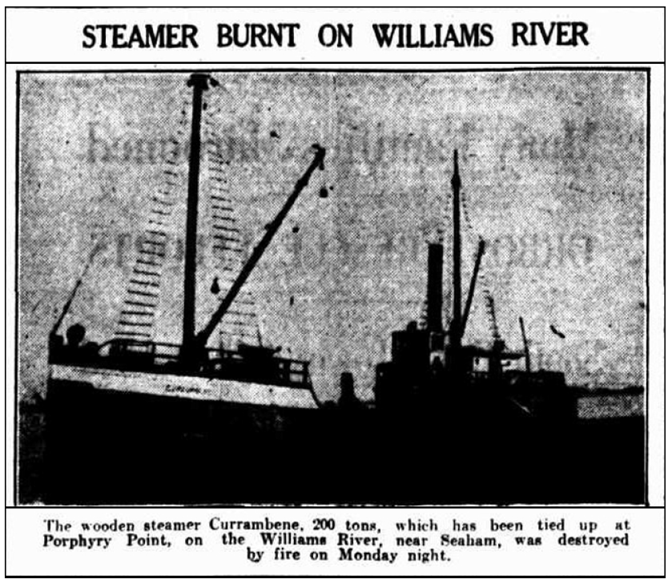
1934 - The once mighty steamer was lost in a mysterious, devastating fire on the banks of the William River Seaham.  The fiercely burning vessel lit up the countryside for half a mile or more.
The fire was watched by scores of residents from the verandas of their homes. Every now and then explosions like those of rockets could be heard."
She burnt for a few hours down to the waterline, she was still smoldering the following morning before sinking in 15 ft of water.  A large area of bush around the vessel was badly burnt as well.

image
Coroners inquiry.

The  Currumbene was moved to Clarencetown to remove the saltwater growth in 1932, but owing to bad weather she was moored at Seaham on the return journey, where she remained. Mr. Kelly was engaged as a caretaker. Kelly was instructed to light a fire in the boiler and take the vessel to
Clarence town for repairs. Mr. Edward Wilson of Seaham was on board the vessel on the night of the fire and left her at about 10.45 p.m., he
could see the vessel from his home.  The first he knew of the drama was when two rockets were fired by Mr. Kelly.

John Willam Kelly, the caretaker of the Currumbene, said he lit the boiler fire at Cullen's direction to shift the vessel to Clarencetown. He retired to bed at 11.p.m. and was awakened by smoke coming from the engine.  He did not know how the fire had started, He had inspected the ship before the fire.
The coroner returned an open finding.


Continue reading about the T.S.S Merimbula


image

23 April 2019

The Dent investment.

1904 - George Dent senior was rapidly approaching his nineties but could still swing an axe that would put many a young man to shame. Described as the "grand old man" of Jervis Bay he was quoted as saying " the hull is sound as ever, but the spars are going."


1864 – Ideal for shipbuilding the plentiful supply of spotted gum near Huskisson attracted George Dent Snr to Jervis Bay.  Setting up his shipbuilding operation on the banks of Currambene Creek George rapidly gained a reputation for producing ships of all sizes to the highest standards.  By the 1890s the Dent family were well established in Huskisson.   George and his sons couldn't rely on shipbuilding alone to support their large and growing families.

The family realising early that tourism was a growth industry which could turn a handy profit, built and ran some of the earliest guest houses in Huskisson.  Members of the family were involved in the transport industry running passenger services to and from Nowra.   They ventured into the profitable Grass Tree gum collection industry which thrived in the area around 1885.  In 1896 the Dents operated a sawmill near Huskisson employing 35 men.
Tragically in 1910 James Dent 64, was killed while harvesting timber.  Members of the family served on the local Clyde Shire Council Board based at Tomerong, they were involved with many decisions which shaped Huskisson in the early years.


The Dents built the present day Huskisson Pictures as a community hall for the local people in 1913.  By the 1930's the large family, men, women and children were involved in all aspects of the Huskisson community.  Cricket, tennis, fundraising, peace day celebrations, community dances, school functions, market stalls, members of the family served on the local church committee helping to organise and run many fundraising events.  They operated fishing vessels taking tourists around the bay.  They helped build the first pedestrian crossing over Moona Moona Creek.    1902, They became involved in the newly formed Jervis Bay Railway Extension League, urging the government to have the railway extended from Bomaderry to Jervis Bay. The Lady Denman Ferry, the iconic centrepiece of the Jervis Bay Maritime Museum was built by the Dents in 1911. They were community spirited and risk takers, entrepreneur's, in the true sense of the word.


One of the more challenging business ventures the Dents invested time and money in was stranded ships.

When a vessel became stranded on the coast, efforts were made to recover anything of value before the remains were sold at auction by the underwriters. The Dents attended auctions and bought some of the stranded ships in an effort to turn a profit from the salvaged cargo, fittings and machinery.  It was a very risky business, many investors lost money because the ship would sink or be torn apart by storms before anything of value was saved.


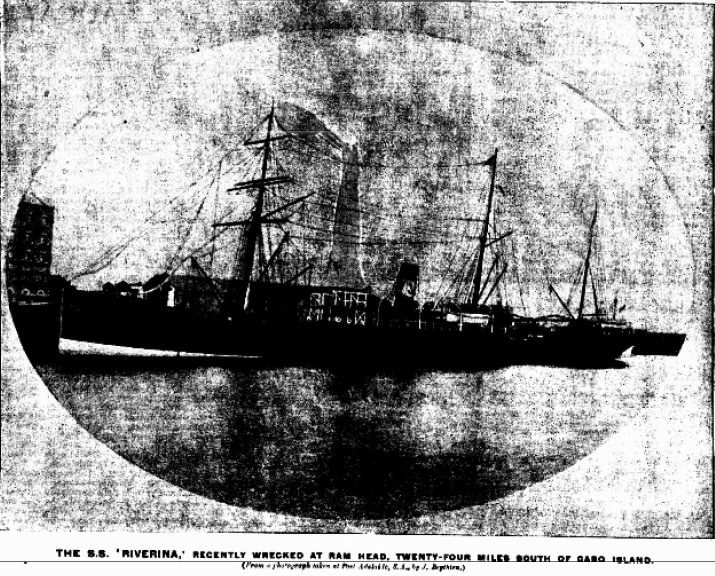
1890 -  S.S. Riverina.


One of the more profitable ships the Dents bought was the S.S.Riverina, a three-masted screw steamer of 2801.0 (imperial tons), 


27 January 1 am -  In hazy conditions bought about by bushfires in Gippsland, the Riverina was running at full speed when she ran ashore onto Island Point east of Cape Everard. The shock from the impact was terrific and came without warning for the passengers. The forward lookout screamed out a warning " breakers ahead" and despite the captain putting the steamer into full astern, she struck almost immediately. The captain tried in vain to reverse the steamer off the rocks by putting her into full astern but the steamer was stuck fast. The ships carpenter sounded the hold and found water rushing into the engine compartment and number two hold.  Captain Prehn ordered the boats to be lowered taking the passengers safely away from the ship which was found to be stranded 150 yards from shore. The crew set about making a makeshift camp with food and water for the frightened passengers. Signals of distress were fired and soundings were taken around the vessel, finding 12 feet aft. The ship's officer was dispatched in a boat to intercept any passing vessel and give them notice of the stranding.  The steamer Wendouree arrived at the scene at noon, some of the passengers were safely taken onboard and she set sail for Sydney.
Despite the ship resting in a very exposed position she was still stable and standing on an even keel.  This allowed salvage teams to recover much of her cargo. She weathered a storm during her time ashore and came through relatively unscathed, allowing the salvage work to continue.


The Auction.

14th February 1890 - There was a large attendance at the John Fraser and Co.'s rooms when the wrecked steamer was put up for auction. There was an estimated 400 tons of cargo still on board and the biddings commenced as 500 pounds and increased by 50-pound bids in rapid succession until the vessel was knocked down to Mr Dent for the sum of 1050 pounds.


Recovery. 

27  February - Mr Dent arranged for the steamers Trident and Sophia Ann to head to the Riverina which was still upright and intact despite the recent heavy weather. 


28th February - The steamer Sophia Ann arrived at the scene but due to very poor weather had to run for shelter back to Eden where she stayed for a few days. She was joined by the steamer Trident, and in calm weather arrived at the scene of the stranding together.

Dent and his team of workers quickly went about their business recovering a large quantity of cargo. He carried with him a powerful portable boiler and engine which was put on board the Riverina to facilitate the lifting of the heavy machinery which was submerged in 12 feet of water but could be seen at low water. Three divers had to feel their way in the discoloured water to secure the machinery and the cargo which was submerged in the vessels hold. 

The only cargo remaining dry were cases of currents and some vinegar.   With Sophia Ann alongside the men recovered valuable winches, anchors, chains, sails, and other furnishings.

The ship was badly damaged, immediately under the stokehold was a large hole through which Captain Laidman says " a Sydney tram could go through."

The weather co-operated allowing Dent and his men to make good progress. They had to work as quickly as possible to recover as much as they could, should a severe southerly storm develope,  the vessel could break up.  The decks of the ship had not sprung and she was still upright but moved about in an unnerving manner whenever a strong wind from the south blew.


The Dents investment was paying off. 

After everything of value was salvaged the vessel was abandoned becoming a total wreck.


18th March  - Marine Board Enquiry.

The board found the wreck was caused by the wrongful act of Captain Prehn. His certificate was suspended for six months.

The vessel had on board a cargo valued at £32,000, fully £20,000 of which is insured in Sydney offices, as follow: — Australian General £6000  -  Alliance Marino, £5000; Pacific Company, £1800; Sydney Lloyds, £3000 ; New South Wales, £600 ; China Traders, £400 ; South British, £200 ; North Queensland, £1200, and the remainder  in other offices


Continue reading about the Dents.


image

19 August 2015

The Steam Ship Dorrigo

The Launch of the S.S Dorrigo 1901

Huskisson in 1901 was a peaceful little community on the shores of Jervis Bay,  perched adjacent to the cool, clear running waters of Currambene Creek.
The community largely survived because of the fishing, timber and shipbuilding industry, tourism was starting to become popular as the bay was slowly being discovered by well healed Sydney people.

On Wednesday 7th of August the peace was interrupted by a great celebration..
Boat-Frame-a An example of one of the many vessels under construction on the banks of Currambene Creek near the time.

After months of work the S.S. Dorrigo was ready to slip into the cool wet element she was made for.
For many months she had been the centre of activity,  workmen toiled long hours,  local hardwood was felled, milled and dressed, and transported to the ship-building yards.  workers assembled her many individual parts,  and she slowly took shape.  Many locals were employed and families supported by the ship building industry,  when a ship was launched  it was a time for celebration and excitement for the whole community.

image


Launch of the S.S Dorrigo, snapped by Dr. Stoney as she entered the water.

9 a.m was the fixed time for the launch from Mr Hardiman’s ship-building yards.
 
The whole of the residents of the bay,  together with some from Tomerong and adjoining localities and a coach-load from Nowra,  were present to witness the interesting ceremony.    

The launch took place about a quarter to 9 a.m, it being necessary to take advantage of the full tide.

When everything was in readiness the workmen removed the chocks holding the vessel in her cradle,  a few turns were given to the screw jack at her stem,  the ship was given away,  and she slid gracefully and rapidly from the stocks into the waters of Currambene Creek,  where she proudly floated,  a tribute to the workmanship of the Bay shipwrights and to the enterprise of her owner,  Mr G. W Nicoll,  of Sydney.

A Time honoured custom.
Just as the vessel began to move,  Mrs Nicoll,  wife of the owner, following the time honoured custom,  broke a bottle of Champaign across her bows,  and christened her the Dorrigo,  and wishing her a long and successful career.  The launching was greeted with the hearty cheering from the assembled company.

Built by H. Hardiman.
The S.S Dorrigo is 132ft, long,  24ft, beam and 11ft, depth of hold, and a capacity of 400 tons with machinery and engines.  It has a raised quarter-deck,  80 ft long by 20ft high and a forecastle 2ft high by 20 ft long. She will be provided with accommodation for 20 salon and six steerage passengers.  Well known local ship-building identity George Dent was foreman,  the workmanship reflects the highest credit upon those gentlemen. She is well and faithfully built,  of district hardwood,  decking of Oregon Pine.  While graceful in all her lines.  The Dorrigo’s hull is strongly put together,  and she should be capable of withstanding more than ordinary heavy weathers.  She is intended for the Byron Bay and Northern Rivers trade.

Towed to Sydney.
After some final fitting at Huskisson, she will be towed to Sydney and be fitted up with her steam engines,  machinery and all the prerequisites for modern passenger traffic,, including the installation of electric light.

Substantial investment.
Building a modern steamer out of timber was a substantial investment for the owners,  The Dorrigo had cost somewhere around 2000 ponds already,  once she was  totally fitted out for her trading purposes, the investment was estimated at to be around 9000 ponds.

Largest Vessel built at Huskisson.
The Dorrigo at the time of launch, was the largest vessel built at Huskisson, and the forth vessel built by Mr Hardiman, and it is hopped many more such craft would be turned out at Huskisson,

Dent Family.
It is worthy of note that the Dent Family,  who have been identified with Ship-building at the Bay for 40 years,  have turned out no less than 78 vessels there be of one kind and another.  In his yard,  close by where the Dorrigo was launched,  Mr James Dent now has a decent sized craft on the stocks.  She will be 80ft long and 20ft beam,  and will probably be used in the timber trade,  which is very brisk at Jervis Bay right now.
 
Celebrations.
After the launch at the cost of Mr Nicoll,  his guests were entertained with refreshments.  At 1 o’clock luncheon was spread in an adjoining shed,  temporarily converted into a banqueting hall.   There about 50 persons sat down to an excellent repast. 
The guests wants were attended to by, Mrs Hardiman,  Mrs F. Dent, Miss Woods and Miss E. Elmoos,  who were assisted to by several other young ladies.

Mr Hardiman then called on the company to charge their glasses and drink to the health of Mr Nicholl,  the owner of the steamer. Mr George Dent proposed the health of Mr and Mrs Hardiman,  expressing the hope that the gentleman named would be entrusted with building many more ships on the Currambene.

Mr Hardiman,  in responding thanked everyone and especially his staff who worked beside him in their endeavour to produce such a fine craft.

He called on the company to give three cheers for the staff,  this was heartily responded to.


As  can be seen from the details above,  there was a lot of hope for the future prosperity of the local region in connection with ship-building and the timber trade.  Jervis Bay had been purposely neglected by previous governments in favour of the centralisation policy in order to aggrandize Sydney.  But locals believed the time must come when Jervis Bay would become an important commercial industrial port.

If you would like to find out more about some of the proposals that were put forward in regard to industry around the bay,  then come along and look at some of the information on display.  They clearly and graphically illustrate what might have been,  if even one of the proposals ever saw the light of day.

 
And what became of the S.S Dorrigo?.
1905 – Explosion on board.
On a trip from Coffs Harbour to Sydney and explosion occurred, described as and ‘everyday incident” by the captain to a reporter,  it appears from the article and the evasive manner in which the crew and the Captain tried to avoid questions about the incident,  they didn’t want news of the accident to get out,  but one of the passengers gave the reporter and account of what happened.

He described how around 6.30p.m just off Sydney Heads there was a loud explosion that made the ship shake.  Nearly all hands rushed out on deck to see what happened, and discovered there had been a burst up in the engine room. The captain immediately hoisted his head sail and the vessel kept off the land.
”We were very close to the rocks at one time and the vessel was rolling very much indeed”.

Onlookers on land reported seeing rockets and signals from the Dorrigo at the time the incident happened.

The Dorrigo entered the heads on Saturday morning at 9. 30 p.m. in tow of the Captain Cook.

When the Dorrigo docked bystanders noticed there were broken pieces of a cylinder head laying on the main deck and  many fragments down below there had been an explosion of some kind.
1906 – December 24th – 6 p.m Seal Rocks
The Dorrigo had a lucky escape from disaster when the shaft broke leaving the vessel at the mercy of the wind and the sea,  fortunately she was well off land,  and shortly after the steamer Noorebar responding to the Dorrigo’s distress rockets and lights took her in tow,  the operation was carried out at great risk in a heavy southerly blow. Hawsers were repeatedly broken during the tow until a wire hawser was secured,  Passengers and crew were glad to reach safety, especially at the prospect of spending Christmas night aboard the stricken craft.  The captain was praised at how he handled the stricken vessel.
1910  - Steamer Sold.
The North Coast Steam Navigation Company sold the Dorrigo to Burns, Philip and Co., Ltd’  to be used in Inter-Island work.
1912 February 12th – Fiji.

The S.S Dorrigo was a well known vessel in Australia  during her time with the North Coast Steam Ship Company.  In 1912 the Dorrigo was acquired by the Fijian Government for the inter-island trade. 
On February a cable from Auckland stated that the Dorrigo had been driven ashore on one of the Lan Groups,  Near Fiji.  Little information was know at the time the cable was sent other than the vessel was not in a dangerous position,  but had suffered severe damage.

imageFurther details emerged.
The vessel had been caught up in a fierce hurricane.  The hurricane devastated the islands and the Dorrigo was swept onto the rocks during the height of the storm.  When the ship struck the whole of the front of the bridge superstructure were swept away, and the main top mast snapped off. Captain Mahy was thrown from the bridge to the main deck,  and received injuries to his head,  ribs,  and neck,  as well as a badly lacerated hand.  The ships standard compass was lost,  and the steering compass smashed.

Renamed the Misima.
February 1st 1917 – East Cape Papua - Daily Commercial News and Shipping List.

The vessel went on the reef at Mia Island off East Cape, Papua at 7.30 a.m on February 1st.  Captain Ewen,  who was in command of the vessel,  tried all means to get the Misima afloat.  Anchors and kedges were put out,  but owning to the depth of water these would not hold,  and strong winds  drove her further on to the reef,  the vessels hull was badly pierced by the rocks.

The vessel struck at high water,  and as the tide went down she settled very firmly on the reef.  The Misima is in a bad way,  and will probably be a total wreck.   The passengers were transhipped to the Morinda,  while the crew were landed on the shore to await instructions.  At the time of the disaster the Misima was on her way from the North-east of Papua to Samarai.

She was only recently overhauled in Sydney and was insured by the Queensland Insurance Company and Captain Ewen was making his first trip in her.

map
map 2So far from where she was built.
February 7th – Brisbane Courier

By the 7th February 1917 it was confirmed by the Marine Department that the Misima was a total wreck on East Cape Papua.  Owned by Burns Phillip and Co., Ltd., and contracted to the Government for the Territory in the Papuan coastal service,  she was a regular visitor to Thursday Island.

Marine Enquiry findings.
After investigation the court found that no blame could be attached to anybody,  and that the master and crew took all proper precautions,  and made every effort to save the vessel.
 
BACK

14 August 2017

old time notes

imageNorth Huskisson Wharf.


This small article which appeared in the Nowra Leader,  September 22, 1911  describes South Huskisson as a thriving small coastal town.  It mentions the large Dent family,   the shipbuilding and timber industry, as well as some of the people involved.


"It is now over 40 years or it may be 45 years since the late Mr James Dent, senr., started the ship building at North  Huskisson. That spot then was a busy centre. Combined with the shipbuilding carried on by Mr Dent, there was a large timber trade, logs in the round were shipped to Sydney.  This particular branch employed a great many men, and many bullock teams were used.  In connection with the various branches of this work, there were trusted men placed over each branch.  
As well as we can remember Mr Longfield was general manager.  Mr Peak took a part in supervising matters.


Mr Dent took an active part in all matters pertaining to the business.  Messrs.' James, since deceased, George and William who were then on the verge of manhood;  Fred, Harry, and Joe were boys.  Life then was all sunshine.  The traveller to Huskisson to-day cannot imagine it was such a busy centre at that period.

"Poor Old Ned Gather'em -up'' as he was generally called,  we suppose he was so called on account of gathering up the tools and other things of general use that caused the appropriate name to be given him.  'Old Ned" was in his glory when there was a launch on, he has long since been gathered to the land of his Fathers.   He with many others, roamed over that timbered locality which induced the
axeman and teamster to haul many of its enormous trees.   60 years ago or perhaps a little less than that there was not a habitation at the Currambene.  Mr Dent, the senior, was the first to build there.  The only house between Nowra and Jervis Bay, as the road wended then, was at Woollamia.  Mr Dawson had a home at Erowal, now the property of Mr P. Kean.  There were one or two houses at Jervis Bay,  but were on the decay.  Mr John Guihan, known then as "Kerry Jack," occupied one of those houses near the fresh water creek which empties into the Bay.

The Elyard family then had a cattle station at Jervis Bay, and "Jack"  was the stock-keeper; he went once a fortnight to Brundee for his rations.  It was he who first saw the wine laden ship "Juniper" wrecked south of the bay.


This part of the article describes South Huskisson (Present day Vinventia).
Prior to the time, we are writing about there were three hotels in Jervis Bay, also a blacksmith shop, wheelwright shop a wool store and wharf.  The old pine-tree is the only mark left today to remind of the long past and almost forgotten period.  The Bay now has its hotel and store, run by Messrs. Cambourne and Paul respectively.


imageTimber vessels at Huskisson Wharf, 1903


Advertising which appeared in the same newspaper.

image


image

18 February 2015

Appreciation of the simple life – Huskisson 1891


Huskisson Public School a brief history.
Huskisson Public School first opened as a half-time school in 1871, On April 21st that year an application for a provisional school was lodged with the Council of Education and it was signed by the following: C.Murray, farmer; Messrs Isaac Lee, light-keeper; E.Honner, fisherman; W.Dent shipwright; G.Dent, sen., timber merchant; Les Dent; Jacob Peak, carter; and John Matthews, shipwright.
    This application was later altered to one for a half-time school, to be worked with New Bristol, 12 miles distant. 
    The road between Huskisson and New Bristol was not negotiable in very wet weather, and the residents promised that, at such times arrangements would be made to convey the teacher from one school to the other on alternate days by boat.  They also agreed to erect a suitable slab building at each village for school purposes.  The nearest post office at the time was Tomerong, about 6 miles distant, and this served the needs of all residents of Jervis Bay.
     The application was sanctioned and the school officially  came into operation in September, 1871.  Mr R.S Mackenzie being appointed as teacher.
     Mr Mackenzie was popular in the district, and had conducted school at two places concerned for three months without remuneration prior to his appointment by the Council of Education.  The school was converted to public in 1882.
    The enrolment for the first year of the schools existence was 15, and the average attendance 12.

image

image


The Shoalhaven News and South Coast Districts Advertiser 1891.

On Tuesday last, 6th inst., the teacher, Mr J.J.Emery, assisted by the residents, united in giving a school treat to the pupils of the public schools at New Bristol and North Huskisson (Jervis Bay).
Notwithstanding, the excessive heat of the previous week and the numerous counter attractions of the surrounding district to the picturesque rendezvous of Jervis Bay, the day passed off most successfully to both young and old.   Ere noon arrived, vehicles from Tomerong, Nowra wended their way to the school grounds until not less than 100 persons had assembled.
The site could not be excelled, owing to suitableness of shed and awning, lovely grounds, and plenty of cool water.
Luncheon was provided by Mr James Dent (3), Newman, and Deutschbein, and ably assisted by the Misses Wood (3), Dent and Emery.   After ample justice had been done to the many good things provided,  the adults united in several amusing games, the principal of them being ‘rounder's,” “drop handkerchief,” “jolly miller,” “disappointment,” and “bachelor in search of a wife,”   These over the children were amused with several races for pocket knives, rounder balls, lollies and cricketing gear, one of the most pleasing being a race by the adult ladies.  The last, but most exciting was the race for the bachelors cake, which was won by a Tomerong lad.  The lady providers were each presented with a duple piece of glassware.   Tea was again supplied in order to allow those from a distance to reach their homes in good time.
Sports were then resumed by those who had not dispersed, and kept up with great vim till darkness ended the day’s enjoy.  The people of Jervis Bay are to be complimented upon the manner in which they originated this their first school treat, and the unanimous way they carried it out, as was manifested by the cheerful countenances of those who assisted and by the presence of those who came from long distances.   It is hoped the same unanimity may always prevail, living in hopes of witnessing the same pleasing assembly in time to come.

What I find interesting in this story,  they were giving away pen knives as prizes to the children, as you know if your found with one in you possession now, it will be confiscated and you could be fined, how times have changed in many small ways.
.
Below is an add from the same newspaper – talk about being diversified…
image