5 March 2019
Cape St George Lighthouse - The building had to be taken down to ground level.
1859 - 5th July
The Department of Land and Public Works advertised for tenders for builders willing to contract for the erection of a Light House at Cape St. George. Tenders had to state the time within which it was
proposed to complete the work. A bond to Her Majesty of £500 was required to secure the tender, otherwise, the tender would not be taken into consideration.
Just 40 years later the controversially located lighthouse was decommissioned and was ready to be demolished.
1899 - 9th October
The Department of Public Works advertised for the sale of Building materials from the dismantling of Cape St George Lighthouse. Disposal of all materials included within the lighthouse and residences, together with all outbuildings and fences. Anyone sending in their application had to include the sum of 2 pounds as a guarantee of good faith. which would be forfeited by the successful tenderer if he failed to complete the purchase in fourteen days of notification of the acceptance of his tender.
The building had to be taken down to ground level.
Continue reading about Cape St George Lighthouse.
4 March 2019
The mystery of the disabled steamer.
The installation of a telegraph line went someway to end the isolation of Cape St George Lighthouse. Before the telegraph line was connected it could take days before news from the lighthouse would reach authorities by horseback. The line owned and controlled by the government was used almost exclusively by the lighthouse keepers to report the passage and status of passing ships as well as the weather in the vicinity of Jervis Bay. The line ran its path through rugged terrain suspended on poles. Adverse weather and falling trees could break the line at any time, the lack of communication would cause great concern for the shipping agents and owners in Sydney.
1915 - A report in the Daily Telegraph in Sydney described Jervis Bay "as one of the most important signal stations on the South Coast."
The mystery of the disabled steamer.
13 January 1898 - A telegraph reached Sydney from Jervis Bay stating that a three-masted schooner-rigged steamer, with a yellow funnel, was towed into the bay at 8.15 on the same morning. The steamer signalled, "machinery disabled". When these sort of incidents happened, it was important for owners and agents to know the name of the vessel, where it came from and where it was going. If a name wasn't easily discernable, ships could usually be identified by shape, the number of masts, funnels and colours.
And that's where this mystery begins.
What was the name of the vessel, where did she come from and where was she going?
Konigin Luise - Arrival of 'Königin Luise' in Fremantle, W.A. - 3 August 1919
It was then thought she may have been an Adelaide Co,'s steamer as they are denoted by yellow funnels, but there were no three masted steamers in the current fleet.
The mystery caused a good deal of interest in shipping circles, but because the telegraph line was only for the purposes before-mentioned and controlled by the government, investigation by paper correspondents was met with frustration, finding out which vessel was in distress was made almost impossible. The journalist in his efforts approached "official circles" but was met with what he described as a "remarkable ignorance of the fact."
The mystery ship remained that, a mystery, much to the frustration to all those with an interest in shipping matters, and to the newspaper correspondent and its readers.
No further details are known.
22 February 2019
James Craig – Cape St George Lighthouse
20Feb 2019.
I was recently standing atop the cliff in front of the ruins of the Cape St George Lighthouse and was lucky enough to get a photograph of the 19th Century square rigger James Craig passing by on her voyage from Hobart to Sydney. This sort of scene would have been common to the original lighthouse keepers manning the lighthouse from 1860 until it's decommissioning in 1899. Besides maintaining the lighthouse the keepers had the responsibility of monitoring all passing ships. Communication between the ships and the lighthouse before wireless was via flags of different designs and colours hoisted high on the ships rigging and displayed on the flagstaff which stood in clear view beside the lighthouse near the cliff edge. When the telegraph was connected they reported all ship movements to Greenwell Point Pilot Station, from there the information was passed on to Sydney. Many of the ship movements were posted in the Sydney newspapers.
Continue reading about Cape St George.
2 February 2019
Samuel Elyard.
Susan Capel, art dealer and restorer from Sydney, sent us two images by Samuel Elyard depicting scenes of the Shoalhaven. One is a beautiful image of the Cape St George Lighthouse located in the Booderie National Park on the south side of Jervis Bay. The lighthouse was a favourite subject for Elyard, he made the long rough journey by horseback and buggy to the lighthouse on many occasions. The museum has several in its collection. The other is an unidentified homestead in the Shoalhaven.
watercolour & bodycolour
37.5 x 50.5cm
unsigned
"Country Homestead, Shoalhaven, N.S.W." (1883)
watercolour & bodycolour
39 x 39cm
signed lower right
Continue reading about Samuel Elyard, a prolific painter and photographer who lived in the Shoalhaven in the 19th century. You will also find some interesting comparison photograph I have done of his original paintings compared to the actual scene today...
http://jervisbaymaritimemuseum.blogspot.com/search?q=samuel+elyard
Both of these images are for sale from Belle Epoque Fine Art and Antiques.
https://www.belleepoqueantiques.com/samuel-elyard
https://www.belleepoqueantiques.com/
25 July 2018
Samuel Elyard
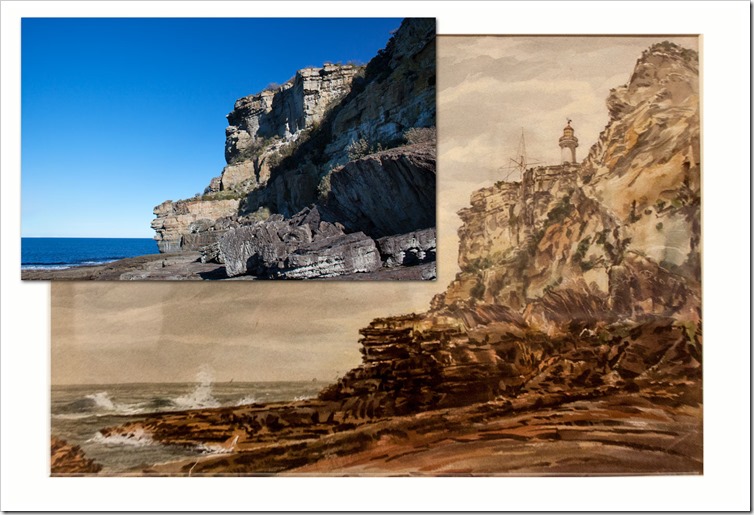
An Australian artist who painted and later photographed Cape St George Lighthouse near Jervis Bay. Some of his works are on display at the museum at this time.
You can see from the picture below he faithfully painted what he saw. I took the photograph a few days ago, Elyard's painting dates back to the late 1870's.
Click here to read about and see more photographic comparisons of Samuel Elyard's artwork.
5 June 2018
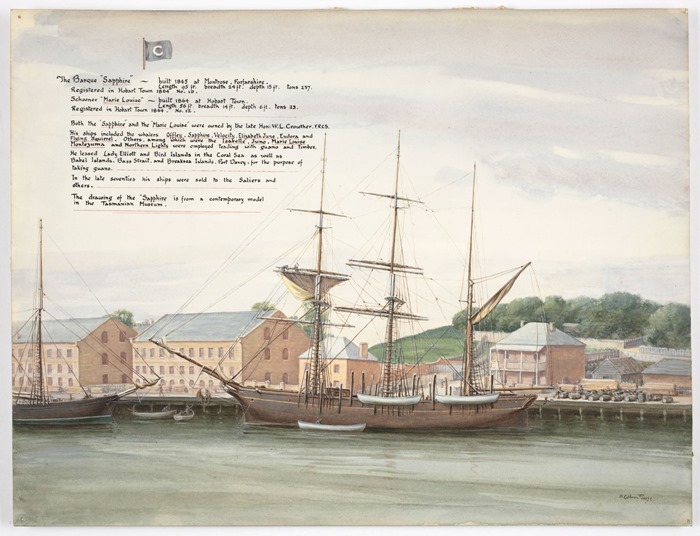
The Barque Sapphire and the Barque Narramissic 1874
The sea near Jervis Bay and the clear waters of the bay ran red with the blood of the whale industry.|
Whaling was a dangerous and unforgiving enterprise.
When a whale was spotted, ships would begin the chase, trying to draw near enough to lower their boats, manned with hard weather-beaten men, armed only with a hand-propelled harpoon, determination, and hopefully, luck. If they managed to catch and kill this great leviathan the men would now have to tow the whale by sheer back-breaking effort back to the waiting ship.
Death and injury was a common occurrence for the chasers, but the danger didn't stop there, when the whale was drawn on board, danger was ever present.
Sailors survived on limited rations in cramped quarters aboard creaking ships, as one sailor expressed, "we worked like horses and lived like pigs." Timber decks soaked in the fluid from processing whales were extremely slippery, men came down hard onto the deck, men slipped overboard to the waiting sharks drawn by water running with blood, men could be crushed by the weight of blubber being hauled into copper cauldrons in the try-works, they suffered deep lacerations from the sharp tools used for processing the whales.
Everything, including the men were covered in whale oil, all this aboard a ship pitching and rolling on an unsettled sea, hot oil from processing cauldrons could spill onto the fires, this could easily spread engulfing the ship and the crew, many ships left port and were never seen again.
When the processing was complete which could take 6 hours or more depending on the size of the whale, the crew would scrub and clean the ship as best they could, despite their best effort, ships sailing downwind would always know when a whaling ship was approaching by the smell.
Collision at sea.
There were dozens of ships plying the coast chasing whales, collisions between ships occurred.
One such incident occurred 30 miles south of Cape St George between the whaling barque Saphire and the barque Narramissic.
10 September 1874 - The barque Narramissic left Newcastle bound for Melbourne and ran into heavy weather and was forced by leaks into Sydney Harbour.
20 - September 3am - The barque Narramissic left Sydney Harbour continuing her voyage to Melbourne, 30 miles
south of Cape St George, in the pitch black the silence was shattered by the violent sound and vibration of two timber ships coming together.
The Hobart Town barque Sapphire,which was not displaying any side lights, struck the Narramissic with her flying jib-boom on her mizzen chains.
The Sapphire lost one boat and her spritsail yard. The Narramissic had her stanchions and gaff carried away, her covering board and spritsail were also damaged, five of her crew, thinking she was about to sink, jumped on board the Sapphire, leaving the master and three men to bring her into Jervis Bay, where repairs would have to be carried out before she could sail again. The Sapphire came into Jervis Bay the following day.
The Narramissic stayed in the bay for 4 weeks wind bound because of terrible gales which had damaged other vessels caught at sea.
Once the repairs were finished the Narramissic sailed out of Jervis Bay continuing her journey to Melbourne. She ran into more heavy weather, the second mate and a seaman
named Christopher Tomkin went aloft to secure the yard-arm of the upper main topsail, which
had got adrift from the gaskets. The sail caught Tomkins, who was 36 years of age and a native from Berwick, England, and knocked
him overboard. A life-buoy was thrown to him, and the master hove a line to the drowning man, which he almost clutched
but did not catch, the vessel drifted away from him, the weather being so bad as to preclude the possibility of rendering
him any assistance.
The Narramissic's voyage had been cursed with near disaster and tragedy.
The whaling barque Sapphire was a regular visitor to Jervis Bay,
1872 December - she put into Jervis Bay after a 10-month voyage from Hobart Town to recruit. She had taken 28 tons of sperm oil.
1875 February - during a 14-month voyage she came into the bay to try-out 9 tons of oil,
the total take of oil for the trip was 21 tons.
By 1885 the romance of going to sea chasing whales was starting to decline, many whaling ship owners found
it difficult to secure suitable crews and were forced into taking anyone that offered himself. The Sapphire was involved in an incident when as was customary
at the time, the owners would advance the willing a small sum in advance of the voyage. Taking the advance these larrikins would often spend the money,
then not join the ship as required when it was time to sail. The police would be called and these reluctant absconders would be arrested and taken aboard the ship.
13 April 2018
Cape St George Lighthouse - William Markham –
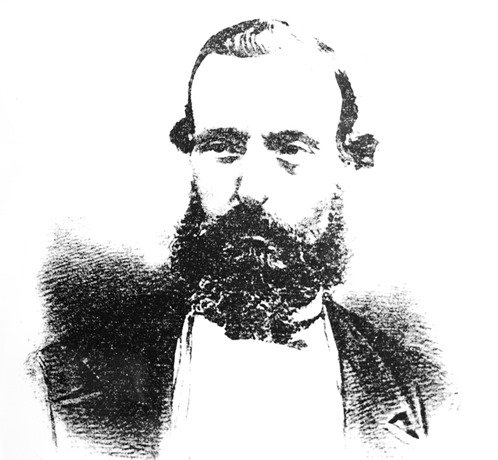
William Markham was the assistant lighthouse keeper at the Cape St George lighthouse from about 1878 to 1883. He was kicked in the head by a horse and died before he reached Nowra Hospital.
Living and working in such an isolated and unforgiving location was full of risk. William Markham was the sixth death at the lighthouse since it's construction in 1860, shrouding the lighthouse in misery once again.
Travelling along the dirt road to the lighthouse now is a relatively easy journey, but one can easily imagine how ardueous it would have been by horse and buggy.
Continue reading about the Cape St George Lighthouse.
7 April 2018
Cape St George Rescue
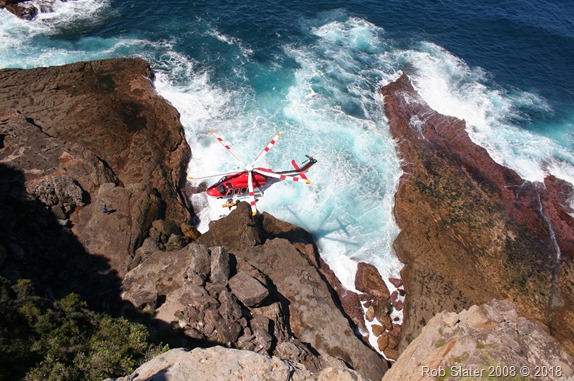
In 2008 I was near the old Cape St George Lighthouse when a young man broke his femur, being at the base of the cliff and in extreme pain, we called 000 and within 30 minutes the Air Ambulance from Albion park was hovering over the scene.
The young man was lifted off the rocks and flown to Wollongong Hospital. The rescue was an amazing thing to watch.
This area has been the scene of many sad and tragic stories since the old lighthouse was built. Fortunately this one ended with a successful rescue.
Continue reading about Cape St George Lighthouse.
13 February 2018
Drama at sea, two barques collide and make for Jervis Bay.
Most ships at this time used oil lamps to indicate their position at night to other ships who may be in close proximity, but not always, and in this case the lack of lights
nearly ended in disaster.
Tuesday 20, 1874 - The barque Naramissia from Newcastle bound for Melbourne was sailing 40 miles south of Cape St George, it was 3 am in the morning when without warning she was struck by the whaling barque, Sapphire. The Sapphire carried no side lights and struck her with her flying jib-boom on her mizzen chains. Five of the Naramissia's crew, thinking she was about to sink jumped on board the Sapphire leaving the master and three men onboard. Fortunately, the ship remained afloat, the master took her into Jervis Bay where the Sapphire joined her the next day. The Naramissia stayed in Jervis Bay for four weeks wind bound, during which time they carried out repairs
The Sapphire lost one boat and spritsail yard. The Naramissia had her stanchions and gaff carried away, and her covering board and spritsail damaged.
1872 - The Sapphire had been to Jervis Bay before, she often hunted whales along the coast near the bay. In 1872 she put into the bay to recruit, She had been at sea for 10 months and had taken 25 tons of sperm oil.
1875 - She put into Jervis Bay to try out 9 tons of whale oil. The total take of oil for the voyage was 21 tons.
1885
1885 Long hard dangerous months at sea with small rewards meant finding experience crew was becoming harder, ship captains and owners were forced to take anyone who
was willing to come aboard, most were scoundrels with no experience of working aboard a ship, this led to conflicts.
In 1885 some of the newly recruited crew of the Sapphire, as was customery were paid some of their wages
in advance, absconded, and after a merry chase for four days were caught and forced back aboard the boat by the police. They mutinied and refused to go to sea throwing essential equipment overboard in an attempt to stop the ship leaving port. The police were called again arresting the two ringleaders removing them from the ship. New equipment was loaded and the ship finally sailed.
Ref: https://stors.tas.gov.au/AUTAS001131820946
Meaning - mizzen-chains: Plates of iron bolted to a ship's sides abreast the mizzen-mast for securing the shrouds and backstays of that mast.
25 January 2018
Loss of the Julia Heyne 1865
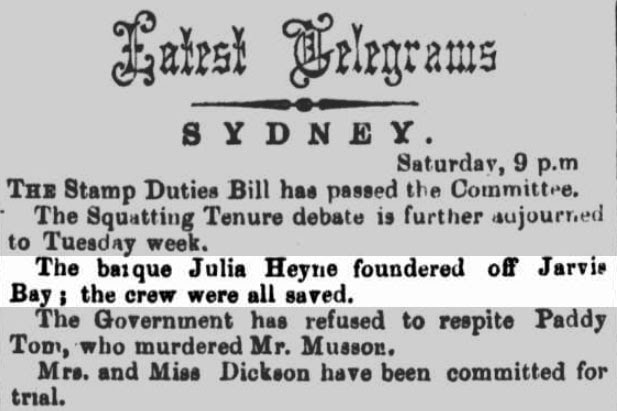
A small notification burried within the shipping news would often be the only indication of a ships disaster. So many ships foundered it was often only the ones with loss of life which would make the news.
Wednesday 18 May 1865
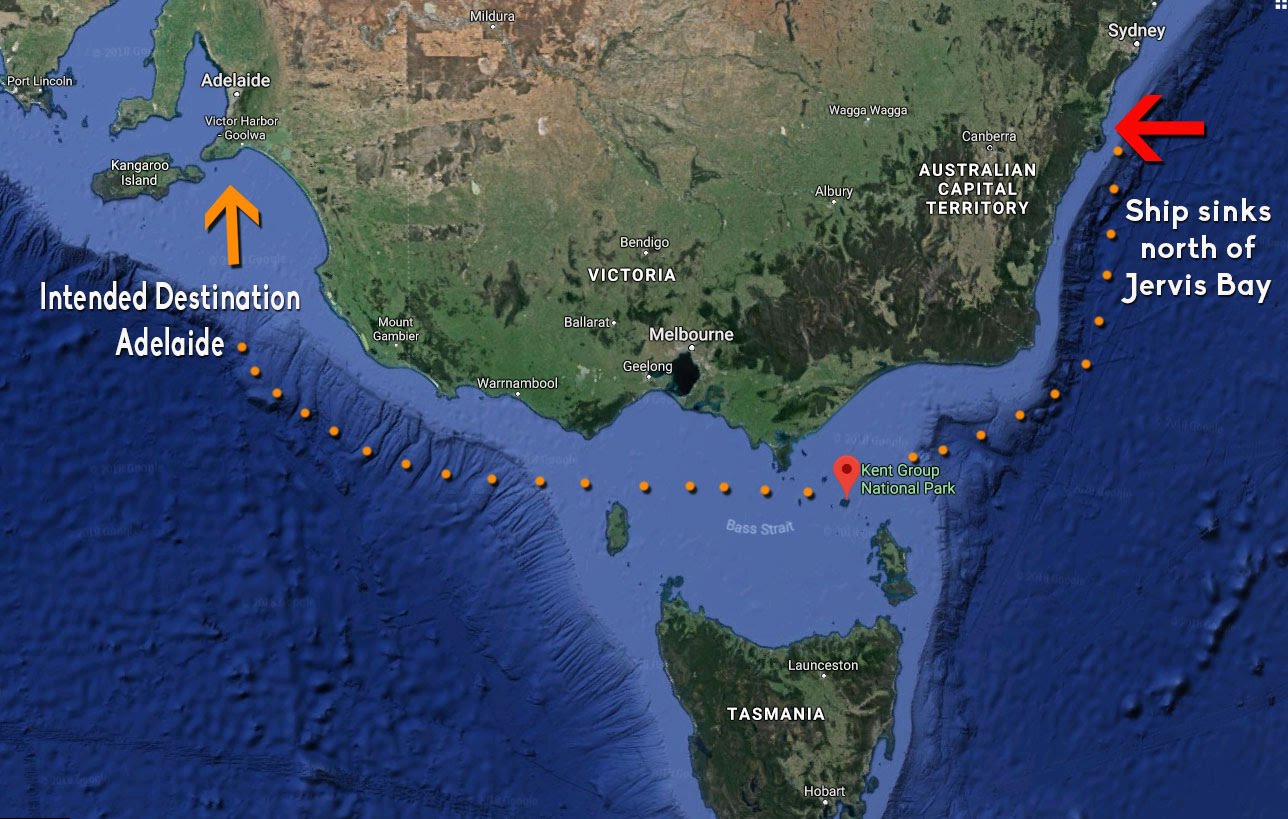
The 318-ton barque Julia Heyne was on a voyage to Adelaide carrying 519 tons of coal.
During fearful weather the vessel started taking water, for six days and nights the crew were continually pumping. By this time they were 15 miles north of Cape St George and were 30 miles from land when the decision was made to leave the ship. By this time despite continued pumping, there was 8ft 10 inches of water in the hold. In treacherous conditions, the crew climbed aboard the open life boat., one hour later the Julia Heyne slipped beneath the waves.
Thursday 19th May.
Battling gale force conditions the crew landed at Gerringong in a heavy surf, narrowly escaping with their lives.
Amazingly, the vessel had been in sight of the Kent's Group, ( a grouping of six granite islands located in Bass Strait ) and meeting a continuation of fearful gales, bore up on the 15th in a vain attempt to save the ship from going down.
The Julia Heyne was a well-known coasting vessel, sailing between Newcastle and Adelaide on a regular basis.
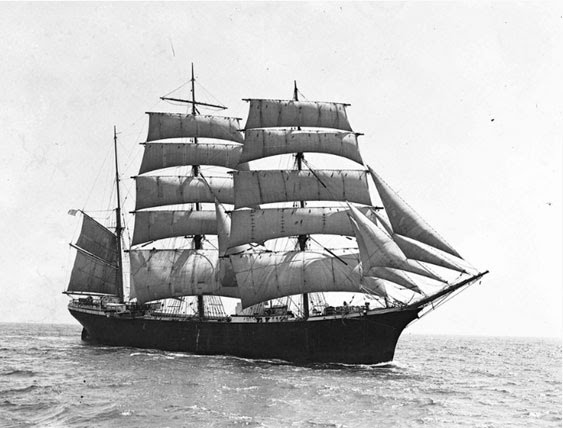
Examble of a barque from the time – Winterhud – copyright free.
Barque - a sailing ship, typically with three masts, in which the foremast and mainmast are square-rigged and the mizzenmast is rigged fore and aft.
12 December 2017
Crookhaven Heads Lighthouse
As it appeared in 1908.The Crookhaven Headland where after a short walk you will find the remains of the lighthouse.
As it appeared in 1905. This shows the headland almost cleared of trees and scrub.
Early today I took a walk out to the Crookhaven Heads Lighthouse, It has been quite a few years since I last visited the historic lighthouse and I didn't know what to expect considering the state it was in on my last visit.
History.
During the age of sail and coastal steamers, Crookhaven Heads was a busy waterway, being the only access to Shoalhaven River vessels would cross the shifting sandbars in all sorts of weather taking their cargo and passengers to and from Nowra. The lighthouse played a vital roll in providing safe navigation through these sometime treacherous waters.
1872 - A red light made from a ship's masthead light supported on two poles was exhibited by boatmen at the river entrance.
1882 - The first aid to navigation was a timber light, constructed on the beach 200 meters to the west of the current lighthouse consisting of a brass lantern.
1904 – The current brick structure was built on the headland overlooking the entrance to the river. The lantern was from the former Cape St George Lighthouse which was replaced by Point Perpendicular Lighthouse in 1899. The name of the station was then changed to Crookhaven Heads.
The lighthouse today is in a very sorry condition.
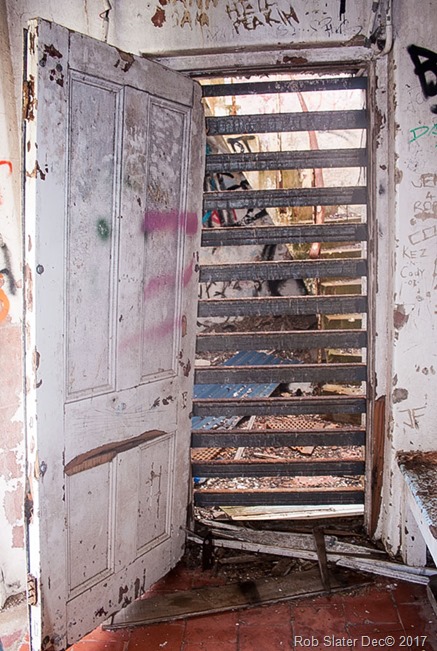
Today the headland is covered in well grown trees and scrup hiding the lighthouse from view, it's isolation has seen continuous vandalism over many years with all the windows smashed, doors ripped off, graffiti scribbled from top to bottom over the inside of the building and rubbish strewn about. Attempts to secure the building have seen the main windows fitted with steel panels inside and out, a steel slat door stops vandals from accessing the old stairwell.
1909 - The lighthouse was completely renovated but due to its isolated and overgrown location, this community work was quickly undone and we find the old light as it is today. A recent repaint of the outside has what remains looking clean and tidy, I wonder how long this will last.
Photo from my last visit in 2010.
2010 – Because of continued vandalisation the historic lantern was carefully disassembled in December 2011 and removed from the location by a navy helicopter from HMAS Albatross for restoration.Permanently fixed heavy steel bars across the doorway blocking entry to the tower stairs.
Vandalism 2017.
What will become of this historic monument?
The headland still dominates the entrance to Crookhaven River and now has a sinle automated light on top of a steel pole.
The waterway is still busy, with trawlers and pleasure boats coming and going on a daily basis. The Pilot station still monitors all boating in and out of the river and plays a vital roll in the safety of sea farers today.
I have done a few posts on Crookhaven Heads which include many of the ships that came to grief in and around the entrance to the river. It's quite a fascinating tale and well worth reading.
Continue reading.
8 October 2017
On this day
Wreck of the Summercloud – 10th October 1870
When you visit Booderie National Park you could find yourself in an area called Summercloud Bay
The area nestles on the northern reaches of what is known as Wreck Bay. Summercloud is a small south facing bay with crystal clear blue water fringed with a white sandy beach. When a northerly
offshore wind blows you will find the area calm and peaceful. This calm belies its past history. The Wreck Bay area is a graveyard for ships, hence the name. The topography which affords protection in northerly winds is the very reason so many ships have met with disaster withing Wreck Bay, following is the story of one of those ships.
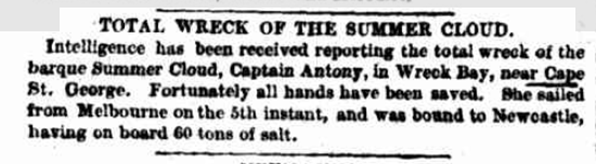
5th October 1870 - The Barque Summer Cloud, with 60 tons of salt on board, left Melbourne, and experienced fine weather on her journey north,
7th - The wind freshened from the E.N.E, with thick dirty weather setting in..
8th - During the evening the wind veered to the N.W.
9th - The wind turned back to the N.E., and blew in strong gusts, the weather still being very thick, no land having been sighted since clearing the Kent Group.
10th - The wind turned to the S.S.E., They sighted land on the weather bow, which afterwards proved to be the east side of Wreck Bay, the vessel at the time was steering N by E., and being unable to get an offing, Captain Anthony at once squared away, and ran her ashore on the beach, about 5 miles to the northward of where the ill-fated ship Walter Hood was wrecked, but before she took the beach she grazed on a reef; the fore and mainmasts were afterwards cut away to prevent her rolling, and it being the top of high water, the crew, with the Captain's wife and owners, soon managed to reach the shore after a deal of difficulty.
13th - Mr Parnell junior discovered the wreck and conveyed the crew and passengers to the Cape St George Lighthouse where they were kindly treated by the lighthouse keeper Mr Lee, from there the sad news was telegraphed to the owners.
Captain Anthony states that when he left her on the 21st she was lying high and dry at low water, apparently uninjured, with about two feet of water in her. She is the property of Mr Thomas Trelevean of Newcastle and is insured in the National Marine Insurance Company, of Adelaide, for the sum of £1500.
She became a total wreck and today the vessel's ballast and anchor chain cable can be observed northeast of the Summer Cloud Cove boat ramp
A wooden barquentine of 336 tons gross, 39.28m, built in Miramichi, New Brunswick, Canada in 1855.
The wreck was purchased by Craig Brothers, of Sydney for 301 pounds.
Meaning: Barque - a sailing ship, typically with three masts, in which the foremast and mainmast are square-rigged and the mizzenmast is rigged fore and aft.Example of a wooden barquentine
Continue reading about the Walter Hood which became a total wreck in Wreck Bay.
Continue reading about the Barque Italy which ran aground in Wreck Bay.
Continue reading about the Corangamite which became a total wreck in Wreck Bay.
Continue reading about the Hive and the Blackbird which became total wrecks in Wreck bay.
Continue reading about the Mokau which became a total wreck in Wreck Bay.
28 September 2017
Wreck of the Martha and Elizabeth May 1855.
There are many shipwrecks in the Shoalhaven area, some have a story to tell while others leave us in wonder as to the fate of the ship, crew and passengers. The people involved in this story found themselves in a rapidly deteriorating life-threatening situation where small decisions and quick actions made the difference between life and death.
The story of the Schooner Martha and Elizabeth is one of heroism, and a great deal of luck.
The fact that there were no casualties in such dire circumstances is amazing.
As you read the story try to put yourself in their situation. It's pitch black, you trying to stay upright on a twisting, pitching, rolling ship, all around you the noise of the ship smashing and grinding against the cliffs down both sides of the ship, timbers are splintering and coming apart around you, the rigging is hanging everywhere, the ship is quickly breaking apart. The fearful shouts and screams from the passengers trying to be heard over the sound of crashing waves engulfing the ship, the captain shouting orders to his crew, the wind-driven rain against your exposed wet and cold skin. These people were in a desperate struggle for survival.
The schooner Martha and Elizabeth under the command of Captain Anderson was on a voyage between Melbourne and Newcastle when she ran into difficult weather and currents
close to Jervis Bay.
April 26th - At 5.30pm. nearing Jervis Bay they sighted Cape St George, the wind at this time was variable from the S.S.E, with rain and thick weather,
Captain Anderson steered the vessel N.E by N.
7.30pm - The wind was variable, with heavy showers and the current setting was very strong to the southward.
8.pm - Captain Anderson found the current setting put the vessel down upon Point Perpendicular, he immediately tacked to the southward.
8.40pm - Finding the schooner would not fetch the south-head of Jervis Bay, on the port tack, the captain tacked to the N.E.
8.50pm - At this time all was calm, but, the vessel was setting in fast to the breakers with a heavy swell from the eastward.
9.pm - Finding the vessel close to the cliff, with no possibility of saving her, they cleared away, and launched the boat but owing to the heavy ground swell the boat filled and parted from the ship with one hand, Robert Jellicar in her, but he, fortunately, caught a rope and was saved by hauling him over the stern of the schooner.
9.30pm - the vessel came stern on, the main boom struck the cliff and she parted amidships. the vessel payed around to starboard
and was driven into a gully in the cliff just large enough to admit her lengthways. Upon entering the vessel struck instantly abaft, the sea breaking furiously over her.
Finding she could not last many minutes they endeavoured to get a line ashore by means of a small grappling. Finding the grappling would not hook the rocks one of the hands R. Jelliear, got footing by swimming from the stern, while another, John Rogers, jumped from the bowsprit, which instantly afterwards parted from the vessel. The remaining hands, with the captain's wife and sister, had robes slung around their bodies and hauled ashore by those ashore, the captain was the last to leave the vessel.
The crew and the captain's wife and sister had scarcely any clothing, and not a shoe to their feet. They had scarcely secured a footing on the slippery rocks when the vessel broke up.
11.pm. - The vessel had broken into small pieces. After some searching in the dark, they found a small ledge in the rocks where they all assembled for the night. It was intensely cold, with a strong easterly wind and incessant rain throughout the night.
April 27th.
First light revealed a desperate scene. - The survivors could see nothing of the Martha and Elizabeth other than some small pieces of wreckage, nothing could be saved.
Assending the cliff. They found themselves at the base of steep cliffs, they now had to find a way to the top, which they did with great difficulty. The area they were in was isolated with no help close by, to make their way to the Shoalhaven they had to contend with thick high scrub trees and in some places wade through waist-high swamps. Having no shoes and scarcely any clothes made the task more painful. After walking about 18 miles they had the good fortune to come across Mr Kinghorn's whaling station. Captain William Kinghorn set up a land based operation on the northern side of the bay near Montague Point on the Mount Jervis property belonging to his father Alexander Kinghorn. How long the station remained in operation is unknown
They remained with Captain Kinghorn for the night and were kindly treated.
Captain Kinghorn.
28th April - The party proceeded to the Shoalhaven where they were heartily made welcome by Captain Noel, of the steamer Nora Creina, and received from him a passage to Sydney.
30th April - After an uneventful trip, the party arrived in Sydney at about midnight, they were most grateful for their lives and to those from whom they received so much kindness.
An amazing story!.
Specifications: Martha & Elizabeth. Schooner, 81 tons. Built Clarence River, 1843; reg. Melbourne, 277/1854. Length 67 ft. Operated in the timber trade off Wilson's Promontory in the 1850s.
Nora Creina 142 gross tons, 93 net. Lbd: 133'7" x 18' x 7'7". Iron paddle steamship built at the Neptune Foundry Waterford Ireland for the Commercial S N Co., Waterford. 1853 owned by A G Robinson, Sydney. 1854 purchased by the Shoalhaven S N Co., Sydney and worked the Sydney - south coast ports of New South Wales as a passenger - cargo vessel. February 1857 of the unofficial Illawarra S N Co. (read - Kiama S N Co) Sold 1861-2 to Far East interests. Wrecked October 1849
Meaning: Abaft - in or behind the stern of a ship.
Ref: https://www.flotilla-australia.com/iscsnco.htm