.

.
HOME OF THE LADY DENMAN - Local history isn't always about the big story - the everyday story of life in the early development of the region can be a fascinating, entertaining and educational journey.
Showing posts sorted by relevance for query whales. Sort by date Show all posts

2 January 2014

Whale hunting – Jervis Bay

whale-harpoon-4
It doesn’t matter how many time you see a whale, it will always be an amazing experience and will be relived in your conversations over and over.

Between the months of May and July whales can be seen passing Jervis Bay during their annual migration north to their breeding grounds in the warmer waters of northeastern Australia.
There are many places to observe this annual migration and one of the local favourites is the lookout atop the cliffs near the old ruined lighthouse in Broderie National Park.
During September and November the whales will be seen heading south on their return journey, many with calves. During their return many call into the bay, sometimes they can be seen a short distance off the beaches.  In 2012 a southern right whale confounded the experts and attracted large crowds of onlookers by staying just outside the entrance to Currambene Creek, the experts had all sorts of theories, it was resting, it was sick, it might have been attacked by sharks or hit by a boat, we heard it all, but the whale surprised everyone because a few days later it gave birth to a beautiful calf before moving off with its new baby to finish their migration south.

Jervis Bay has a number of tour operators more than willing to give you a close encounter with these magnificent marine mammals. Detail of these can be found at the visitor's centre inside the museum.


Types of Whales Hunted. There were two main types of whales pursued in our waters, the
Humpback (Megaptera novaeangliae) and the Southern Right Whale. (Eubalaena australis)

Other whales were also caught along our coast, the much rarer giant of the sea the Blue Whale was also caught and processed inside Jervis Bay.


hb


srw


Haunting whale sounds here.

’Bend ya backs and row me lads and take me to me whale”
In the past this annual migration was exploited by whale hunting companies.  Whale oil and other parts of the whale were a valuable resourse.  All of which can be replaced with synthetic equivalents now.

I didn’t know they hunted whales from Jervis Bay?

Whalers visited the bay hunting whales as early as the 1790’s right up until 1913.
Large whaling ships called into the bays sheltered waters during whale operations along the southern coast and reprovisioned their ships at Bristol Point.

_MG_4483
1790’s
Whaling was a messy, smelly and dangerous low paid job and when gold was discovered in the hills behind Jervis bay many of the ship crews would desert the ship hoping to strike it rich in the gold fields around Nerriga and Yalwal. Calling into the bay became less desirable for ship owners and eventually stopped.


cpt-william-kinghorn 

1840
Captain William Kinghorn set up a land-based operation on the northern side of the bay near Montague Point on the Mount Jervis property belonging to his father Alexander Kinghorn. There is an area of land between Culburra and Currarong named after the family,  Kinghorn Point, and can be accessed from the road out to Currarong. There are two streets named after the family as well, Kinghorn Street in Nowra and Goulburn. Captain Kinghorn in his 80's died in his home at Goulburn in 1878.

1859
It is unknown how long his whaling operation existed in the bay, but the Caroline was wrecked at Point Perpendicular and the crew made their way through the bush and came upon the station of James Kinghorn, Esq., “who’s superintendent rendered them every assistance”. so it appears that the whaling station was possibly still operating in 1859.

Read more - Captain William Kinghorn

 whale-harpoon6
1912 
The Norwegian factory ship the Loch Tay, plus three chasers the Sorrell, Campbell and Lionel arrived in the Bay to hunt whales with the full support of the NSW government. During the opening season they harpooned 158 whales.
Their eventual take totalled 537 whales in two seasons, but they were forced to close because of the strong odour which drifted across the bay  during the summer northeasters, reaching the Royal Australian Naval College (HMAS Creswell) and Huskisson.  There were also complaints about the putrid offal floating in the bay which attracted large sharks and made the navy’s training operations dangerous.

ih


One of the beautiful paintings by Ian Hansen on display in the museum, depicting whale operations near Bristol Point.

1917

Records show there was also a small whale hunting operation running on the southern side of the bay, near Bristol Point and Greenpatch, this operation may have been used to supplement the fishing families income.

whale-harpoon5


1919
An investor Mr Moore, was willing to spend large sums of money to set up another large land-based operation in the bay. With the experience of the previous operation and after correspondence between the NSW Premier and the serving Prime Minister William Watt, the Prime Minister stated!
“it would be unwise to permit the establishment of a whaling station which is in close proximity to the Naval College  HMAS Creswell" and with that, all whaling from Jervis Bay ceased.

 whale-harpoon-2
Today: Fortunately for us all, most countries have ceased whaling operations. In the oceans close to Australia the Japanese are still conducting operations under the ridiculous facade of research.
Despite this the whale population around the world is slowly recovering, but sits on a knife edge, with more pressure being applied to the few remaining whale hunting countries to stop operations. Hopefully we will see some common sense and a return of large numbers of these amazingly beautiful creatures to our oceans.

The museum has a fine collection of equipment and information on display from the whaling industry, some can be seen on this page,  pay us a visit and take a walk back into an era long since past!

bone-ship
One of the museums finely detailed model of a ship made from whale bone.


Continue reading about whaling in and around Jervis Bay.

REF: Read more:


image

19 May 2015

Jervis Bay Whaling – Profit and Loss

1913 Reports of large pods of whales, ‘for as far as you can see”, drew whalers and their ships from as far away as Norway to the east coast of Australia in search of large profits.
  After a short time working the east coast of Australia, profits were as hard to find as the whales.

Below is a report from the Shoalhaven Telegraph 1913, it gives some insight into the costs of operating these large ships.


The Captain of the Norwegian Whaler now lying in Jervis Bay,  in a conversation with the writer on Saturday last,  gave the following information:-

It will be 16 months on the 8th of August since the whaler left for these waters.  The expedition is financed by a wealthy Norwegian company,  and was formed in the first place to operate principally in Tasmanian waters,  where,  it was said,  there were plenty of whales.

On arrival however,  Captain Egeness says they were found to be vary scarce.

Therefore the trip so far has been a financial failure,  the loss to date being something in the vicinity of 40,000 pounds.  Even with a run of good catches from now until the end of the trip,  the company would still sustain a slight loss.

The expenses of the factory ship alone run to 1500 ponds a month.  This includes insurance,  provisions, etc,  but not wages.

There are 113 men all told employed on the whalers.

The men on the factory ship work on wages,  with a percentage on the oil ( so much per cask).

The men in the whale boats get wages also so much per whale,  which varies according to the class of whale.

Captain Egeness and Dr. Kolflaath both consider if a factory could be established to treat whales it would be a paying concern.  They are of the opinion their own country men are best adapted for shooting and landing whales,  and Australian workmen for the work on shore.

The best results for the trip have been secured at Jervis Bay.


1913 the Norwegian whale boats Sorell and Campbell operated from the bay,  supporting two factory ships the Loch Tay and the Polynesia,  the Polynesia had spent the 1912 season working in New Zealand Waters.

From June through to October they took 379 whales, making a total of 537 whales for the two seasons yielding 2666 tons of oil. This operation was forced to close down after only two seasons as there were many complaints received due to the strong odour and offal floating in the Bay.

 Continue reading
TBG14219110220001 Loch Tay

The Norwegian  factory ship Loch Tay.

whale in the bay

A whale being readied for processing inside Jervis Bay.

     
_MG_4492p

IMG_9787

IMG_9788

You can see these medieval like tools on display inside the museum, along with whale bones, drawings, and photographs.


29 March 2016

Whaling Jervis Bay

historyofwhaling2

Jervis Bay has a thriving tourist industry based on whale and dolphin spotting.
These companies still hunt whales,  but in a completely different way.

Between June and August the magnificent Humpback Whales move north along the east coast of Australia, coming from the cold Antarctic where they have spent the summer feeding on krill, they head north to the sub tropical waters of north Australia to mate and give birth.

Then between September and November the whales travel south again, heading back to the Antarctic to feed.

Just like the whale hunters did in 19th century the tour operators today head out from Jervis Bay in large boats seeking whales, but now the boats are filled with tourists all hoping to capture a glimpse of these magnificent animals during the migration.

But,  it wasn't that long ago whales were being chased in the waters near and inside Jervis Bay for a totally different reason.    Between 1949 and 1962,  8300 whales were killed along the east coast of Australia.  mostly humpbacks as the more favoured blue whale and southern right whale had became scarce.

I came across this article from 1918,  about whalers lobbying the government to allow a whale station and processing operation to be built inside Jervis Bay.

Thankfully this operation was never allowed.


This small article is from the 

  • Albury Banner and Wodonga Express (NSW : 1896 – 1938.  Fri 19 Jul 1918
image
_MG_4485a

You can see this harpoon gun and much more on display inside the museum,  the display is a real eye opener into the role Jervis Bay played in the whaling industry on the south coast.

You can also see other posts about whaling and jervis bay by typing whales into the search box in the right column.


10 March 2015

Whalers – Jervis Bay

The Factory ship Loch Tay.
The history of the largest factory whaling ship to work from Jervis Bay.
TBG14219110220001 Loch Tay

Built 1893. and named the SS Loch Tay, Newcastle UK for the Dundee Loch Line Steam Ship Co. Ltd.
5,474 tons gross and 3,300 tons net. 410 ft long – 49ft. 3inches in breath and 30ft deep.
1911. Sold to the  Australia Whaling Company Norway and converted to a whale processing vessel.
The Loch Tay and three new whale catchers Campbell, Lionell and Sorrell began operations off Jervis Bay, but found the whales merely passed our coast at certain seasons.   After 3 months of operation only 150 whales had been caught, one of them measuring 90ft in length.
They up anchored and proceeded to test the New Zealand waters, after only a few months they found the same problem there, despite catching thirty three sperm whales, which are one of the best obtainable for oil,  the fleet returned to Jervis Bay.

image

 
  thick-heads  

After returning to Jervis Bay for a second season it proved to be a good season for whales and no fewer than 329 were caught and dealt with.
.

The Sydney Morning Herald (NSW : 1842 - 1954), Wednesday 6 August 1913,

   text  

1912. They moved the operation to Western Australia but ran into the same sort of problems with the authorities as they had with their Jervis Bay operation, and with the Freemantle Whaling Company.
1913 they closed their operation because of rising costs and the ongoing conflicts with authorities and trade unions.
1914. The company was liquidated, and the Loch Tay was converted to a cargo ship.
1918. She was Grounded and wrecked at Cap Ruby, Morocco with a cargo of wheat.

   scent  

Ambergris  is a solid, waxy, flammable substance of a dull grey or blackish colour produced in the digestive system of sperm whales.

Freshly produced Ambergris has a marine, faecal odour. However, as it ages, it acquires a sweet, earthy scent commonly likened to the fragrance of rubbing alcohol without the vaporous chemical astringency. Although ambergris was formerly highly valued by perfumers as a fixative (allowing the scent to last much longer), it has now largely been replaced by synthetics.


wikipedia

Ref: Loch Tay image.
http://skipshistorie.net/Tonsberg/TBG142AlfMonsen/tekster/TBG14219110200000LochTay.htm

5 June 2018

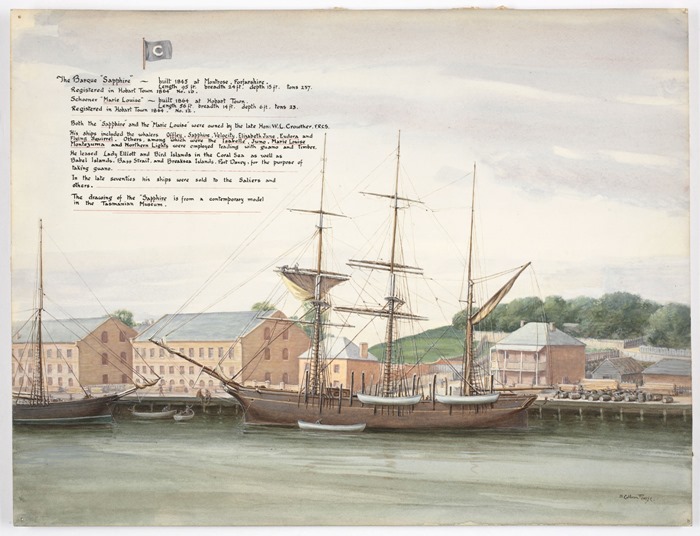
The Barque Sapphire and the Barque Narramissic 1874

historyofwhaling2
The sea near Jervis Bay and the clear waters of the bay ran red with the blood of the whale industry.|


Whaling was a dangerous and unforgiving enterprise.

When a whale was spotted, ships would begin the chase, trying to draw near enough to lower their boats, manned with hard weather-beaten men, armed only with a hand-propelled harpoon, determination, and hopefully, luck. If they managed to catch and kill this great leviathan the men would now have to tow the whale by sheer back-breaking effort back to the waiting ship.

Death and injury was a common occurrence for the chasers, but the danger didn't stop there, when the whale was drawn on board, danger was ever present.

Sailors survived on limited rations in cramped quarters aboard creaking ships, as one sailor expressed, "we worked like horses and lived like pigs." Timber decks soaked in the fluid from processing whales were extremely slippery, men came down hard onto the deck, men slipped overboard to the waiting sharks drawn by water running with blood, men could be crushed by the weight of blubber being hauled into copper cauldrons in the try-works, they suffered deep lacerations from the sharp tools used for processing the whales.
Everything, including the men were covered in whale oil, all this aboard a ship pitching and rolling on an unsettled sea, hot oil from processing cauldrons could spill onto the fires, this could easily spread engulfing the ship and the crew, many ships left port and were never seen again.

When the processing was complete which could take 6 hours or more depending on the size of the whale, the crew would scrub and clean the ship as best they could,  despite their best effort, ships sailing downwind would always know when a whaling ship was approaching by the smell.

Collision at sea.

There were dozens of ships plying the coast chasing whales, collisions between ships occurred.


One such incident occurred 30 miles south of Cape St George between the whaling barque Saphire and the barque Narramissic.

10 September 1874 - The barque Narramissic left Newcastle bound for Melbourne and ran into heavy weather and was forced by leaks into Sydney Harbour.

20 - September 3am - The barque Narramissic left Sydney Harbour continuing her voyage to Melbourne, 30 miles south of Cape St George, in the pitch black the silence was shattered by the violent sound and vibration of two timber ships coming together.

The Hobart Town barque Sapphire,which was not displaying any side lights, struck the Narramissic with her flying jib-boom on her mizzen chains. The Sapphire lost one boat and her spritsail yard.  The Narramissic had her stanchions and gaff carried away, her covering board and spritsail were also damaged, five of her crew, thinking she was about to sink, jumped on board the Sapphire, leaving the master and three men to bring her into Jervis Bay, where repairs would have to be carried out before she could sail again.  The Sapphire came into Jervis Bay the following day.

The Narramissic stayed in the bay for 4 weeks wind bound because of terrible gales which had damaged other vessels caught at sea.

Once the repairs were finished the Narramissic sailed out of Jervis Bay continuing her journey to Melbourne.  She ran into more heavy weather, the second mate and a seaman named Christopher Tomkin went aloft to secure the yard-arm of the upper main topsail, which had got adrift from the gaskets. The sail caught Tomkins, who was 36 years of age and a native from Berwick, England, and knocked him overboard. A life-buoy was thrown to him, and the master hove a line to the drowning man, which he almost clutched but did not catch, the vessel drifted away from him, the weather being so bad as to preclude the possibility of rendering
him any assistance.

The Narramissic's voyage had been cursed with near disaster and tragedy.

sapphire

The whaling barque Sapphire was a regular visitor to Jervis Bay,

1872 December - she put into Jervis Bay after a 10-month voyage from Hobart Town to recruit. She had taken 28 tons of sperm oil.

1875 February  - during a 14-month voyage she came into the bay to try-out 9 tons of oil,
the total take of oil for the trip was 21 tons.

By 1885 the romance of going to sea chasing whales was starting to decline, many whaling ship owners found it difficult to secure suitable crews and were forced into taking anyone that offered himself.  The Sapphire was involved in an incident when as was customary at the time, the owners would advance the willing a small sum in advance of the voyage.  Taking the advance these larrikins would often spend the money, then not join the ship as required when it was time to sail. The police would be called and these reluctant absconders would be arrested and taken aboard the ship.


image


12 May 2017

Fishing report for Jervis Bay 1912

"The bay at present is discoloured to a milky whiteness by the whale-oil factory operations."


image
Sun (Sydney, NSW : 1910 - 1954), Thursday 24 November 1912, page 12

This fishing report makes interesting reading, especially the part about the bay being covered with a white slick from the whaling operation.  The correspondent actually wrote the article aboard the whale processing factory ship the Loc Tay.  The Loch Tay and another factory ship the Polynesia were a permanent fixture in the bay at this time and were part of a larger whale hunting operation being carried out off the NSW coast using Jervis Bay as a base.
By December whale numberes had dropped,  catches were becoming harder to secure and many of the whales contained small amounts of oil, the small numbers of whales could not support the whaling operations.
This is the second reference to the discoloured water I have found,  and was also one of the reasons whale processing and hunting operations were eventually completely stopped inside Jervis Bay.
 You can read this disturbing story below.

The second interesting part of this story describes the Southerly winds arriving in  Sydney as the "JB wind".  I found a previous article that told a similar story and  mentions -  "Jervis Bay, where the weather comes from."


Writing aboard the Loch Tay In Jervls Bay, my angling horizon for the moment is naturally limited, but it has also been perceptibly broadened, for there is nothing the old fisherman likes better than to see new fishing grounds. Jervls Bay is the place where the southerlies branded J.B. in Sydney are first recorded, and there is no doubt the expansive inlet has more than its fair share of the breezes that are actually brewed on the fringe of the ice further south.  My last experience of Jervls Bay was aboard the Thetis, where the trawl swept across tho bottom for a couple of miles and the catch turned out to be chiefly red weed and skates. More intimate investigation during trip 3 to Captain's Point, where the Naval College is being built and to the little town of Huskisson, where the Dent clan predominates, revealed the fact that off Bowen Island and Captain's Point are good schnapper waters. On a new pier in front of the college site several workmen were fishing and catching large coloured leather-Jackets, slippery mackerel, yellowtail, and other fish, and a Dent party was wooing the red fish a mile further towards the strait between Bowen Island and the mainland. At Huskisson the little river is a first-class flathead, bream, and blackfish ground, and about 300 yards from its entrance a reef is the feeding ground for several varieties of marine fish. Around the bay are innumerable hauling grounds, where whiting, mullet, and bream were catchable, but there were no workers on them most of the time, although the Loch Tay folk would have been ready purchasers of a couple of baskets a day. At Huskisson no bait was procurable,  but no doubt a day's notice would suffice for the local haulers to bring some ashore. The bay at present is discoloured to a milky whiteness by the whale-oil factory operations.

Continue reading about the Loc Tay and Whaling in Jervis Bay.
Continue reading about - "Jervis Bay, where the weather comes from".
 

The S.S.Thetis mentioned in the article was a steam trawler which worked the coast from Sydney to Jervis Bay,  she was involved in the search for the S.S. Dandenong which sunk off Jervis Bay in 1876,  becoming one of the worst maritime disasters near our shores, 40 people went down with the ship including women and children.   The story of the disaster is about the amazing struggle for survival in impossible conditions,  involving great acts of bravery and sad loss - Continue reading about the S.S. Dandenong.


image
Sun (Sydney, NSW : 1910 - 1954), Thursday 28 November 1912, page 12

Serious complaints have been made at Jervis Bay respecting the discoloration of the water,  resulting from the work aboard the factory steamers on which the whales brought in by the gunboats have been treated.  A Nowra resident, Mr J. Miller, writes: -  The waters of Jervis  Bay are being polluted to such an extent that the fish are leaving tho bay instead of entering it,  as is their habitat this time of year.  The waters are of a milky appearance, and have a peculiar odour, while the shores are strewn with large pieces of blubber, intestines and the oysters to are turning white.   We have seen large schools of fish approaching the entrance, but as soon as they reach this discoloured water they immediately turn back. We attribute the above causes to the presence of two large factory ships, with their attendant gunboat whalers one, the Loch Tay, causing the greater pollution, we presume through the use of acids, chemicals, etc, in the treatment of the whales.  This boat has dealt with over 150 carcases, according to press reports.  This is ruining the fishing industry, and keeping tourists and amateur fishermen from patronising Jervis Bay.  We also understand that no revenue is being collected from these foreign ships. They carry all their own goods, butter, plumbers', materials, fitters, and coopers goods, in fact, they are fully equipped to do all their own work with their own men and materials.   This is no good to Australia.  I would also point out that in parts of Jervis Bay the deposited grease causes the sand to adhere to the feet when one walks on it.  - 

This complaint is true In the main, but during a recent visit to the Loch Tay,  the "Sun" representative found no evidence of the use of chemicals on the steamer.  The waters were certainly coloured milky white, but sharks were by no means deterred from entering them,  and off Captain's Point the fishing was good.  It is probably correct that shoals of fish outside, noting the discoloration, refrained from entering the bay,  but fish are curious creatures, and it Is quite likely that before long there will be a great rush of fish into the bay for the decomposing whale-meat.  At present they are puzzled by tho oil, which,  being on the. surface causes the water to lose Its pristine clearness. The oysters were certainly being spoiled in flavour by the oil.  A protest has been arranged at Huskisson and Nowra, but before it reaches dimensions sufficiently large to command attention the  Loch Tay will have followed her gunboats to New Zealand waters. The Polynesia and her two gunboats have gone, and the Loch Tay is expected to depart in a few days.


image

26 June 2014

Whale migration

whales-2 


Each year at this time we get to see a remarkable event.
Here is a picture of two Humpback Whales doing a bit of tail slapping with Pigeon House Mountain as a backdrop. These whales eventually made there way right into the Wreck Bay area right in front of the village and slowly cruised past only 20 meters from the rocks, giving a few lucky tourists a fantastic experience, and to make it even more exciting one was almost totally white.

white-whale white-whale2


If you get a chance head out to one of the headlands and do a bit of Whale watching. The lookout near Cape St George Lighthouse is a particularly good spot to see them heading north.
The museum has plenty of material available at the visitors centre to help you along.

18 March 2015

The bay full of whales

September 28th 1901.
image
 

Captain M’Veigh, of the Velocity states.
”Having put into Jervis Bay on the 12th instant from stress of weather, he found the bay full of whales,  so much so that they had scarcely room to swing;  large shoals were also seen along the coast”.


Amongst this collection of old articles, were a few lines of text that help paint a picture of the times around Jervis Bay in 1851.

5 July 2018

Whales and War ships.

Ships in the Bay
This morning the suns golden glow illuminated Hobart Class Guided Missile Destroyer, HMAS Hobart 111 as she headed to sea to conduct gun firing practice off shore from Jervis Bay.  In the foreground a pod of aproximately 12 Humpback whales were making their way north on their yearly migration.

IMG_7279


HMAS Hobart 111, was moored near HMAS Creswell during the night, I took the following pictures before the sun had breached the horizon.   The ship was illumated by bright red lights.


IMG_7187
IMG_7200
Untitled_Panorama1

HMAS Choules is also in the bay at the moment.
HMAS Choules is a Landing Ship Dock (LSD) which was originally commissioned into service with the Royal Navy in 2006.

IMG_7273

HMAS Hobart plowing through the small north swell as she leaves the bay.


IMG_7267


image

24 January 2017

Jervis Bay - ship movements.

Below are small snippets of information that appeared in different newspapers illustrating how Jervis Bay was being utilised by the ships working along the NSW south coast.

Of particular interest are the whaling boats . The Othello,  Metaris, Waterwitch, Asmanby, Alladin, Sea Shell and Runnymede are all mentioned below, all hunting whales during this period….It’s little wonder the whales migrating along the coast were quickly depleted.
 
1871
image
1871
image
1872

image

1872
image
1872
image
1872.
image
1872
image
1872
image
1873
image
1873
image
1875

image

1876
image


image