.

.
HOME OF THE LADY DENMAN - Local history isn't always about the big story - the everyday story of life in the early development of the region can be a fascinating, entertaining and educational journey.
Showing posts sorted by relevance for query moona. Sort by date Show all posts

26 December 2014

Jervis Bay – Moona Creek footbridge.

1903 Life around the bay hadn’t changed a great deal from the early 1800’s. The biggest change was the growth in tourism. The shipbuilding industry led by the Dent family was in decline. The Dents themselves started to diversify and cater to the growing tourists. The bay was becoming popular with holiday makers, encouraged by numerous newspaper articles written by traveling correspondents calling attention to the beauty of this untamed landscape.

”Where the weather came from”.
Before this media attention,  Jervis Bay to Sydney-siders was only known as ‘where the weather came from”

42-Footbridge-over-Moona-Moona-Creek

Today without much effort we can travel easily between Huskisson and Vincentia. In 1903, what we now find so simple, presented considerable challenges.

2015 - Moona Creek, is passed over every day by hundreds of travelers, in 1903 Moona Creek presented quite an obstacle, always flowing with water and surrounded by low lying wet land, the only way to get between Huskisson North and Huskisson South (now Vincentia), was to take a long and winding journey inland around the far reaches of the creek or wade across the creek at low tide.

”Looking with longing eyes”.
Below is from an article in the Shoalhaven Telegraph, Wednesday 7th January 1903.
A correspondent writing from Jervis Bay, wishes to draw attention, through the columns of the Telegraph, to the great need of a foot bridge across Moona Creek. Now that Jervis Bay is becoming a grand place for tourists, it would be a great boon, he points out, to many if they could extend their walk along the beach beyond the creek mentioned. He noticed, when at Moona Creek on New Years Day, numbers of ladies and gentlemen looking with longing eyes to the beach beyond, and, no doubt, wishing to get across. It would only take a few pounds to do all that is necessary.


Footbridge-over-Moona-Moona-Creek 
It took another 23 years before a foot bridge was erected in 1926. Remnants of the bridge can still be discovered projecting from the rocks. The bridge was eventually washed away in a flood.


Continue reading about Moona Moona Creek.


image


30 November 2017

Moona Moona before the bridge.

The photo shows the Moona Moona creek crossing before a timber bridge was built in the early 1940's. Before then you had to travel the long way around via Huskisson Road and the College road to reach Vincentia, or take a chance and ford the river.
The bridge that stands there now is a concrete single span, 8.2 m long x 9.7 m wide, built in 2003.

There are now plans before government to build a seperate shared predestrian/cyclist bridge over the creek.


Continue reading some other interesting history about Moona Moona Creek. Including information about the first timber constructed foot bridge built by locals.
 
moonee-creek


moona-moona-Ethel-Harrison
Ethel Harrison,   on the first pedestrian Moona Moona creek crossing. built in 1926. Continue reading.

image

1 February 2016

Moona Moona

A thunderstorm was building from the west, the clouds are starting to move low and slow.
The lights from the bridge illuminated the sky.
moona-moona-2
Continue reading the interesting story about Moona Moona Creek

BACK

7 May 2015

Shoalhaven Snippets

 
Small stories from local newspapers.
Shoalhaven Telegraph, January 7th 1903 _ The new Shoalhaven by-laws

“Any person who shall suffer any kind of swine or any ass,  horse, mule, sheep, goat, or any horned cattle belonging to him or her,  or under his or her charge, to stray or go aboard or to be tethered or de-pastured in any street or public place within that portion of the municipality beyond the town boundary shall,  on conviction,  forfeit and pay for such offence a sum not exceeding forty shillings and not less than five shillings”

Moona Creek 1903.
A correspondent,  writing from Jervis Bay,  draws attention to the need of a footbridge across Moona Creek.
Moona Creek Footbridge design - Shoalhaven Telegraph, July 1921.
The trustees of Deas-Thomson Estate, of 2500 acres,  submitted a design for a footbridge over Moona Creek 340 ft long. _ It was decided by council that the plan was not up to a standard design.
1106-Footbridge


walking-bridge-remnants-2walking-bridge-remnants

I took these this morning, 7th May 2015, there are still some remnants of the footbridge to be seen.

image

Daily coach to Captains Point – The Shoalhaven News and South Coast Districts Advertiser. 1913

Ben Loutit has started a daily coach to Captain’s Point, arriving here about seven o’clock each night,  and departing the next morning early for Nowra via Huskisson.
    It is also the intention of Mr Thomson to start a similar line for the convenience of Captain Point residence.

In 1913, Travellers were transported by horse and buggy with the journey from Nowra to Huskisson taking 2 hours or more,  depending on the weather and road conditions.

Ben-Louttit's-passenger-coach 
By 1916, vehicle’s had replaced the horse drawn passenger coaches.
The roads were still in a bad state, potholed, corrugated, and poorly maintained, the trip would often have been a very uncomfortable affair.

First-service-car-of-George-Dent

George Dent, always one of the first to see opportunity, quickly invested in transporting visitors and locals.
Above is George Dents first Service Car.

image

The above advertisement appeared in the Shoalhaven Telegraph 1916.

School of Arts Huskisson. 1913
The School of Arts is making headway just now.  Cards and Dominoes and Chess for the winter evenings,  with and occasional concert.

Meaning: Moona, Aboriginal for plenty.

BACK

31 July 2018

Moona Moona Bridge

Darrell Squires lives a short distance from the Moona Moona bridge, he has been recording the progress of the construction of the new pedestrian and cycle way crossing to the old bridge.  He put together these images which follow the construction from the beginning to the end.
Thanks Darrell,  there very much appreciated.


Click on the images to enlarge.

38030639_1913532765334488_5185961117708451840_n38084997_1913532418667856_3245643890086117376_n38085089_1913532525334512_8032684627116163072_n38040882_1913532665334498_3926548192509820928_n


Continue reading about this historic crossing, included are some amazing old photo's


image

9 January 2014

Holidaying at Moona, Moona Creek

1480-Huskisson-rs-processed Moona Moona was a popular holiday spot in the past, people camped right behind the inlet, these days camping’s not allowed, but you will always find a few travelers pulling up and using the park to rest in overnight.

12 January 2015

Early Moona, Moona Creek Camping.

moonee-creek-camping-ground
The shores of Moona Moona Creek, was once a very popular camping area for holidaymakers.
There are many stories about happenings around the shores of “Moonee Creek” as it was once known.
I will add some of those to this post at a later time.

6 May 2014

Huskisson, the early days

Following on with our series of early pictures from the Denman Archives we have two fantastic photo’s from the early days.
304-Early-days-of-Currumbene-Creek


A very early shot of Huskisson - Currambene Creek

Footbridge-over-moona-creek


The original bridge over Moona Moona creek.

3 June 2014

Moona Moona Creek

moona-creek Before the bridge was constructed.
Another picture in our series of historical photographs in the Denman’s Collection.

31 August 2018

Comments

Because of a difficult problem with the blog site I have been unable to see any comments being made about any of the posts. I only found these today, sitting in the spam folder instead of the inbox. It's good to know other people are interested and appreciate the history.

Jen Littlechild's - MV Desikoko.
Hello, my father was assigned to Desikoko for a time during WWII.
He used to tell stories of being incognito & scouting the islands for Japanese radio transmitters, but never mentioned the islands. We know from his army records he arrived in Milne Bay, but no mention of Desikoko. The story has always been a fascination, wanting to fill the gaps. So interesting to read about Desikoko's connection to Rabaul, as my husband & I visited Old Rabaul Town 4 years ago, the day after the last erruption, & the whole place was in clean up mode. We stay at the Rabaul Hotel with Suzie, & explored the history & area for a week. We also went to Milne Bay & the Trobriands. Even if I had no idea exactly which islands dad had sailed to I got a good feel for the people, geography & history.
I would love to know if you have any more details of Desikoko's activities during WWII, & we must come  & visit the museum ONE day

Thank you
Jen Littlechild
Continue reading about the Desikiko.


Pemupukan Kacang Tanah has left a new comment on your post "Wrecked Navy Yacht.":

You took amazing photos.
Continue reading about the wrecked yacht.


Wrecked on Bowen Island.
Pemupukan Kacang Tanah.
Good post! thanks for sharing.
Continue reading about being wrecked on Bowen Island


Warwick Donnelly coments on - Nerriga
Hi
We suspect that these photos are of the home and blacksmiths shop of Thomas Donnelly. He is recorded as being both a blacksmith and a carrier, running a coach and mail service between Braidwood and Nowra from around 1870 and thew 1890's. He lived in Nerriga and married Elizabeth Ann Hollands in 1871. The Hollands family lived in Nerriga at the time, having moved there from Sutton Forest.
We are researching the Donnelly family background back to James Donnelly who arrive as a convict in 1798. Thomas is our great grandfather and James was his grandfather.
We would like to make contact with the current owners of the property and get any further information about the Donnellys and the Hollands in the Nerriga area, if anyone can help.
Thanks. Warwick Donnelly.
Continue reading about Nerriga.

 
Julian Armstrong  - The sinking of the SS Dandenong off Jervis Bay.

Very interesting. I have just found out that my 3x Great Uncle was a survivor of this terrible wreck, and his account of the disaster was perhaps the first passenger account to be published. I have attached a transcript from The Evening News (Sydney), 15 Sep 1876 (TROVE online newspapers).

“NEWS OF THE DAY
Statement of Survivors

Mr. J.M. Hartley, a cabin passenger, tells us that there were three boats attached to the Dandenong, but that a considerable time elapsed before the first boat could be lowered— half-an-hour, he thinks — but the time very likely appeared to him longer than it really was. He also thinks the ship was not properly supplied with pumping apparatus, which was fitted to be worked
by steam. The passengers and crew worked hard to keep the water under, but finding the water was gaining on them rapidly, desisted, and the captain then gave orders to lighten the ship, and hoisted signals of distress.

Mr. Hartley is of opinion that Captain Irwin considered their only hope of safety lay in transhipping the passengers from the steamer to the barque; but nearly the whole of the passengers were afraid to trust themselves in the open boat. Mr. Winship, of Newcastle, was among those who refused to get into the boats. This reluctance is to be accounted for partly by the imminent danger of death in the boats, and partly from the hope that they could be saved in the captain's boat.

The first boat that left was smashed to pieces when near the vessel, but three or four managed to climb up the side by the aid of ropes. Mr. Hartley, like all the others, had a very narrow escape. He was almost unconscious in the water, but held on to a rope that was thrown him with that tenacity that can only spring from desperation. Somehow he managed to get the rope looped around his arm, and this enabled him to hold on a little longer. The last thing he remembers is being caught by the hair of the head and by the heels, and dragged on to the deck of the barque.

He speaks very highly of Captain Walker and the officers and crew of the barque Albert William, who showed the rescued passengers every possible kindness — gave up all their bunks, and remained without shelter themselves. Mr. Hartley has lost all he possessed. He was coming over to Sydney to start in the ironmongery trade. He was in business in the boot and shoe trade, opposite the Post Office in Melbourne.”

Thanks for your site, I will endeavour to visit your museum soon.

Julian Armstrong, Narooma NSW
Continue reading about the S.S. Dandenong


Jeff Laffite Jones  -  "The mystery of Scrimshaw":
This is the recently discovered secret of my family and ancestors. The secret was carved by my 7th great....great-grandfather on a scrimshaw Powder horn and passed down from father to son for 200 years. I am the first son to decode and decipher the secret and prove it (The Skeleton Horn)The scrimshaw powder horn was carved by my great....great-grandfather Chris Jones. The horn was carved with 309 masonic cryptic anagrams & picture puzzles that tell the secret of my family. My great...great- grandfather is George Washington's only son. Scott F. Wolter of the History Ch. paid for my DNA test to prove it's true. I am Viking descent Washington-Osborne, 72nd generation to Odin and Thor. Ref. ( The Pedigree And History Of The Washington Family: Derived From Odin, The Founder Of Scandinavia, B.C. 70 (1879) by Albert Welles) Kessinger Publishing's
https://plus.google.com/108482539820581852184/posts/Dw6MXJC1ti6
Continue reading about the Scrimshaw


Daniel Reilly – "The tragic death of Thomas Speechley.":
A moving story from yesteryear with time marching on. Thank goodness some of the details are being preserved by your work.
Thanks Danny

Continue reading about Thomas Speechley


Akhila - "HMAS Creswell":
informative post! I really like and appreciate your work, thank you for sharing such a useful facts and information about base bay management strategies, keep updating the blog.
Continue reading about HMAS Creswell.

Anonymous - "Southern Pencillings - By the Raven.":
I enjoy what you guys are usually up too. This kind of clever work and coverage!
Keep up the fantastic works guys I've included you guys to
our blogroll.
Continue reading about Southern+Pencillings


Prince Arora - "The S.S. Wollumbin":
The blogs are really appreciable and one can trust the knowledge and information provided in the writing. The article you do produce on a weekly base really the best.
 
Continue reading about the S.S. Wollumbin

Chew Bacca - "Reported in the Brisbane Courier Mail 9th June 1891":
To bad about Miss Moss.
Continue reading about miss+moss


Chew Bacca - They both admitted they had eaten the unfortunate wretch” 1801
Those were the days!
Continue reading about .They both admitted they had eaten the unfortunate wretch.

Chew Bacca - "Violent, unrelenting spectacle across the headland":
wow! great photo.. must of been great to witness that in person
Continue reading about the Violent Spectacle.

Chew Bacca - "Woollamia Church….1934":
Awesome! kind of looks like Henry Thoreau's cabin at Walden pond in Massachusetts
Continue reading about Woollamia Church 

Chew Bacca - "Super Moon":
We enjoyed the same moon over here in california for a few evenings! Didnt know about the reasons for the occurence thanks for the information. Great photos!
Continue reading about the Supermoon 

Chewbacca - "Moona Moona Creek":
So cool! good to see these images being digitized and saved for the future
great history
Continue reading about Moona Moona creek.


image


10 November 2015

A journey to Jervis Bay 1908

The Macleay Chronicle (Kempsey, NSW : 1899 - 1952), Thursday 30 July 1908
The following story from a visitor to the bay over 100 years ago paints a different picture to the one we now have of the bay.  Some thing haven’t changed, the beauty of the area is still a sight to behold.

The main change derived from this story are the regulations we are governed by now.   The regulations have taken away some of the freedom people had back then to roam about the bay pursuing their own interests, be it fishing,  hunting or sightseeing.   The rules and regulations are necessary to deal with technology and the rising population,  and the associated pressure this is putting on the bays environment.

Enjoy the story below,  it’s a fascinating journey, there are a couple of inaccurate references,  The “Chimbozaro” did smash into Point Perpendicular, but without any loss of life.

The area described as “Boat Harbour” we now know as “Honey Moon Bay” - there is another “Little Boat Harbour”  it featured in the previous story about the ‘Torpedo Tubes.”

The reference to a waterfall at the head of Moona Creek, there is no such waterfall – I think the story refers to Currambene creek and the waterfall at Falls Creek.


The route from Nowra for the first eight miles passes through dairying country,  and over the last 81/2 miles through dense hardwood forests,  which have, as yet, only been partly touched by the woodman’s axe.

Here and there are to be seen busy little saw mills with large quantities of logs waiting to be turned into girders, paving blocks, and other commercial sizes.

Emerging from the timber at the end of the road,  the sudden view of the bay is one of the grandest imaginable. 

Straight in front is the entrance with it's bold headlands - Perpendicular Head,  with Bowen Island in the centre,  and Governor Head at the south - standing like sentinels on guard.  At the blush the entrance might be taken for Sydney Harbour,  but is of greater width,  being 2 miles across,  while the headlands are much higher.

Point Perpendicular is a most imposing mass of rock,  raising abruptly from the ocean to a height of 250 feet.
It was against this rock the "Chimbarazo."  some years ago,  in a most unaccountable manner,  ran full tilt,  the impact being terribly disastrous and attended with considerable loss of life.
 
image

The bay is nearly circular in form,  and almost landlocked,  being 10 miles across as the widest part.  A distinct charm of the bay is the regular manner in which it is divided into beaches of beautiful white sand,  alternating with rocky points jutting into the waters,  which constitute excellent fishing grounds.

Jervis Bay is destined to become one of the favourite fishing resorts in Australasia,  as capital bream and schnapper fishing can be enjoyed in any weather close to the hotel or accommodation houses,  the later being most comfortable and moderate as regards tariffs.  The transparent waters of Currumbene Creek literally make the most lackadaisical fisherman's mouth water,  as he perceives immense quantities of bream, blackfish, mullet, garfish,  and many other members of the finny tribe looking vainly for a hook and line.

It is a common occurrence for 3 and 5 pound bream to be taken,  indeed the bay is the veritable paradise for the angler.

Shooting enthusiasts are also well catered for,  bird-life of all kinds being most prolific,  The marsupial also abounds,  and many stirring stories are told of immense bags,  by the oldest inhabitant,  who,  incidentally,  has been in and around the bay for fifty years.

There are many point of interest.  the principal being Moona Creek,  with a public oyster bed,  and a splendid waterfall at the creek head.

The salamander,  in search of ideal camping spots far from the maddening crowd,  would do well to select Lamb's,  Chinamen's,  New Bristol,  or Captain's points.  All are charming places, plentifully supplied with with clear fresh water,  tons of fire wood,  and beautiful beaches,  the acme of perfection for sun-hatching; But the spot which eclipses all the rest is Boat Harbour,  a beautifully secluded lagoon at the northern end of the bay. Oil launches,  with a draught of 31/2 feet, can pass through the narrow entrance,  which will only comfortably admit one boat at a time.  Once inside one gets a view of this lovely little place,  an acre of crystal water,  a beach which circles around the whole,  safe bathing,  immune to sharks,  grass trees growing right to the edge of the basin,  fresh water in plenty,  high beetling cliffs surrounding,  and brilliant sunshine,  and you have a view of campers paradise.

imageHoney Moon Bay. 

Visitors to the bay should not neglect to land on Bowen Island,  on which are to be seen large numbers of penguin.  The antics of this strange bird are indescribable,  and one gets great amusement in watching the beautiful creatures walking awkwardly about.   There are also numbers of rabbits,  hares and wallabies,  and snakes are in-numerable.
bowen-island

The fishermen of the bay,  especially the brothers Dent,  know the bay from end to end,  and,  being equipped with fast launches,  guarantee sport,  pleasure,  and comfort to any visitors who may desire to make a trip to this charming resort for a holiday.

5

 
BACK
 

3 July 2015

Jervis Bay Snippet

Another small article takes us back to a time when life around Jervis Bay moved at a much slower pace.

Funding cuts driven by the great depression in 1930 saw the government lease the beautiful buildings of the Royal Australian Naval College out as hotels and guesthouses., the publicity drew more and more people to the bay seeking it’s amazing beauty and quiet charm,  tourism became an important part of the local economy.
.
The Sydney Morning Herald March 1933.
.
“Set like a jewel on one of the low promontories of Jervis Bay stands the modern town of Huskisson.  Here hurry ceases,  for is there not fifteen miles of bush to break the disturbing influence of a railway connection to the hustling city of Sydney?

Nothing more exciting that the crack of a bullocky’s whip as a huge log is bought into the shipbuilding yard,  the arrival of the daily mail,  or the dispatch of a few cases of schnapper and blackfish,  mars the even tenor of life in this idyllic spot.

But it is known to motorists,  who comes with all his paraphernalia and a section of his family to camp beneath the great Bloodwoods and Blackbutts that crown the headland of Tapalla Point,  or the grass – grown banks of Moona Moona Creek.   There he stays for a day,  a week,  or a month – to vanish suddenly,  leaving no trace of his temporary home except a tent peg or a shallow channel that suggests a showery holiday.

By day the silver beaches that boarder the bay are alive with a colourful foreground of bathers;  by night the flash of the light at Point Perpendicular lends it’s charm to the nine-mile stretch of water that spans the spacious inlet eastward.”
 document(285)
image
Newspaper photograph and description from the same era.
BACK

12 November 2016

Old postcards of Jervis Bay.

The-Jervis-Bay-1
 
Moona Creek Footbridge built in 1926…swept away by floods a number of times. Continue reading about Moonee Creek or Moona as the locals call it. 
The-Jervis-Bay-2


If your walking around the foreshore on the northern side of the creek, keep an eye peeled for the remains of some of the old footbridge stumps that are still surviving 90 years later. They can still be seen poking out of the rocks at low tide. If you follow the link above you will see a couple of photograps that will give you a hint what to look out for…

BACK

14 December 2013

Moonee Creek Footbridge

Footbridge-over-Moona-Moona-Creek-a

Original Creek Crossing
It’s hard to imagine now but this was erected across the creek at this point probably because it’s was the shallowest and narrowest area to cross.
They must have thought it would be able to withstand floods and the ever changing entrance to Moonee Creek.

23 April 2019

The Dent investment.

1904 - George Dent senior was rapidly approaching his nineties but could still swing an axe that would put many a young man to shame. Described as the "grand old man" of Jervis Bay he was quoted as saying " the hull is sound as ever, but the spars are going."


1864 – Ideal for shipbuilding the plentiful supply of spotted gum near Huskisson attracted George Dent Snr to Jervis Bay.  Setting up his shipbuilding operation on the banks of Currambene Creek George rapidly gained a reputation for producing ships of all sizes to the highest standards.  By the 1890s the Dent family were well established in Huskisson.   George and his sons couldn't rely on shipbuilding alone to support their large and growing families.

The family realising early that tourism was a growth industry which could turn a handy profit, built and ran some of the earliest guest houses in Huskisson.  Members of the family were involved in the transport industry running passenger services to and from Nowra.   They ventured into the profitable Grass Tree gum collection industry which thrived in the area around 1885.  In 1896 the Dents operated a sawmill near Huskisson employing 35 men.
Tragically in 1910 James Dent 64, was killed while harvesting timber.  Members of the family served on the local Clyde Shire Council Board based at Tomerong, they were involved with many decisions which shaped Huskisson in the early years.


The Dents built the present day Huskisson Pictures as a community hall for the local people in 1913.  By the 1930's the large family, men, women and children were involved in all aspects of the Huskisson community.  Cricket, tennis, fundraising, peace day celebrations, community dances, school functions, market stalls, members of the family served on the local church committee helping to organise and run many fundraising events.  They operated fishing vessels taking tourists around the bay.  They helped build the first pedestrian crossing over Moona Moona Creek.    1902, They became involved in the newly formed Jervis Bay Railway Extension League, urging the government to have the railway extended from Bomaderry to Jervis Bay. The Lady Denman Ferry, the iconic centrepiece of the Jervis Bay Maritime Museum was built by the Dents in 1911. They were community spirited and risk takers, entrepreneur's, in the true sense of the word.


One of the more challenging business ventures the Dents invested time and money in was stranded ships.

When a vessel became stranded on the coast, efforts were made to recover anything of value before the remains were sold at auction by the underwriters. The Dents attended auctions and bought some of the stranded ships in an effort to turn a profit from the salvaged cargo, fittings and machinery.  It was a very risky business, many investors lost money because the ship would sink or be torn apart by storms before anything of value was saved.


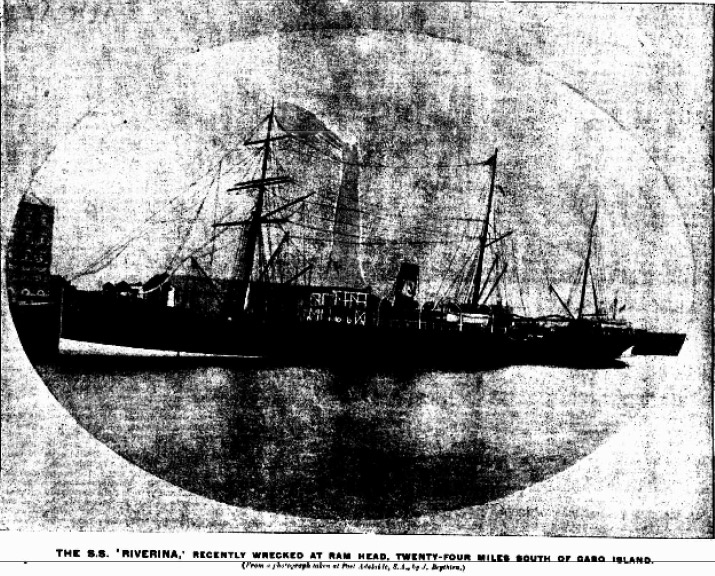
1890 -  S.S. Riverina.


One of the more profitable ships the Dents bought was the S.S.Riverina, a three-masted screw steamer of 2801.0 (imperial tons), 


27 January 1 am -  In hazy conditions bought about by bushfires in Gippsland, the Riverina was running at full speed when she ran ashore onto Island Point east of Cape Everard. The shock from the impact was terrific and came without warning for the passengers. The forward lookout screamed out a warning " breakers ahead" and despite the captain putting the steamer into full astern, she struck almost immediately. The captain tried in vain to reverse the steamer off the rocks by putting her into full astern but the steamer was stuck fast. The ships carpenter sounded the hold and found water rushing into the engine compartment and number two hold.  Captain Prehn ordered the boats to be lowered taking the passengers safely away from the ship which was found to be stranded 150 yards from shore. The crew set about making a makeshift camp with food and water for the frightened passengers. Signals of distress were fired and soundings were taken around the vessel, finding 12 feet aft. The ship's officer was dispatched in a boat to intercept any passing vessel and give them notice of the stranding.  The steamer Wendouree arrived at the scene at noon, some of the passengers were safely taken onboard and she set sail for Sydney.
Despite the ship resting in a very exposed position she was still stable and standing on an even keel.  This allowed salvage teams to recover much of her cargo. She weathered a storm during her time ashore and came through relatively unscathed, allowing the salvage work to continue.


The Auction.

14th February 1890 - There was a large attendance at the John Fraser and Co.'s rooms when the wrecked steamer was put up for auction. There was an estimated 400 tons of cargo still on board and the biddings commenced as 500 pounds and increased by 50-pound bids in rapid succession until the vessel was knocked down to Mr Dent for the sum of 1050 pounds.


Recovery. 

27  February - Mr Dent arranged for the steamers Trident and Sophia Ann to head to the Riverina which was still upright and intact despite the recent heavy weather. 


28th February - The steamer Sophia Ann arrived at the scene but due to very poor weather had to run for shelter back to Eden where she stayed for a few days. She was joined by the steamer Trident, and in calm weather arrived at the scene of the stranding together.

Dent and his team of workers quickly went about their business recovering a large quantity of cargo. He carried with him a powerful portable boiler and engine which was put on board the Riverina to facilitate the lifting of the heavy machinery which was submerged in 12 feet of water but could be seen at low water. Three divers had to feel their way in the discoloured water to secure the machinery and the cargo which was submerged in the vessels hold. 

The only cargo remaining dry were cases of currents and some vinegar.   With Sophia Ann alongside the men recovered valuable winches, anchors, chains, sails, and other furnishings.

The ship was badly damaged, immediately under the stokehold was a large hole through which Captain Laidman says " a Sydney tram could go through."

The weather co-operated allowing Dent and his men to make good progress. They had to work as quickly as possible to recover as much as they could, should a severe southerly storm develope,  the vessel could break up.  The decks of the ship had not sprung and she was still upright but moved about in an unnerving manner whenever a strong wind from the south blew.


The Dents investment was paying off. 

After everything of value was salvaged the vessel was abandoned becoming a total wreck.


18th March  - Marine Board Enquiry.

The board found the wreck was caused by the wrongful act of Captain Prehn. His certificate was suspended for six months.

The vessel had on board a cargo valued at £32,000, fully £20,000 of which is insured in Sydney offices, as follow: — Australian General £6000  -  Alliance Marino, £5000; Pacific Company, £1800; Sydney Lloyds, £3000 ; New South Wales, £600 ; China Traders, £400 ; South British, £200 ; North Queensland, £1200, and the remainder  in other offices


Continue reading about the Dents.


image