.

.
HOME OF THE LADY DENMAN - Local history isn't always about the big story - the everyday story of life in the early development of the region can be a fascinating, entertaining and educational journey.
Showing posts sorted by relevance for query thomas speechley. Sort by date Show all posts

14 November 2017

Young Thomas Speechley.

The tragic story of Thomas Speechley and the mystery of the lonely grave.

8-nov-2017b

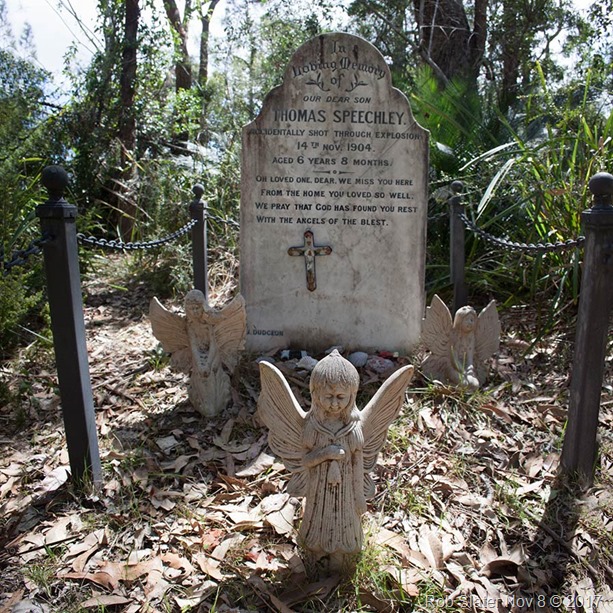
Standing alone at the end of a small dirt track nestled amongst the bush on the eastern bank of Currambeen creek is a small grave. I first discovered the grave by accident around 1980, riding through the bush on my bike I came across a small overgrown track leading to the river.  I had past this track many times before without noticing.  After ducking and weaving a short distance through thick scrub I was quite stunned to come across an old gravestone.  The grave still had a few dilapidated timber pickets sticking from the ground, with other termite eaten pieces scattered about.   The grave was marked with the words "Thomas Speechley accidentally shot through explosion 14th November 1904."  This sparked my curiosity to find out who and why he was buried here in this quiet, lonely place.

On previous rides in the area I had come across signs of old habitation scattered amongst the bush, rusted iron, drums and the body and chassis of an old Cadillac truck, windscreen surround, steering wheel and one free spinning timber spoked wheel still attached to the differential..

image
What grave?
I asked my relatives who had been in the Callala area since the 1950's but they knew nothing about the grave.  Over time I asked around and was always  met with the same response..."What Grave?,  When I moved from Callala across to Woollamia the grave slipped from my memory until I became involved in research at the Denman Museum.  I came across some old photo's of the grave in the museum archives. Since then I have spoken to one of the relatives of the young boy and after 37 years, recently re-visited the grave.

Walking along the rutted bush track from the Myola Boat Ramp car park for about 1200 meters I came across 4 timber posts sticking from the ground.  There the only indication of something different along the track.  Without those posts you could easily miss the grave site.  I pushed through the overgrown bush towards the river and came across a plaque attached to a large rock by the National Parks.  From there it's a very short walk to the gravestone...

8-nov-2017
The whole site is overgrown and easily missed if you didn't know it existed in the first place.

IMG_3907
Thomas Speechley was a young boy aged 6 years and 8 months living with his family on the banks of Currambene Creek on the north eastern side of present-day Myola.  The area was an aboriginal settlement from 1895 – 1920's and was known by the aboriginal people as Bilong.   At one time there were between 10 -15 cottages there.  There are many middens in the area and association with aboriginals is recorded as far back as the early 1800's, other signs show the aboriginals have been using the area for many thousands of years.    Thomas's father William Speechley  was an Englishman married to an Aboriginal woman, earning a living by collecting the gum from Grass Trees on the north side of the bay near Beecroft Peninsula.   He owned a small boat and would travel from the Currambene across the bay to collect gum.  His boy Thomas would sometime accompany him.

8-nov-2017a

14th November 1904.
The Speechley's and Christie Carpenter from Bilong, set off across the bay as they had done many times before.  While William and Christie were going about their business of collecting gum, Thomas played on the beach nearby.  

Thomas came across a 7lb shell casing, often found in the area. He showed his father who promptly threw it away and told Thomas to leave it alone before resuming his work of gathering gum.  Soon after a loud explosion occurred, when William arrived on the scene he found his son Thomas was already dead. Thomas had been fatally wounded by the exploding shell, ripping his hand off and doing extensive damage to his abdomen, killing him instantly.   Thomas was brought back to Huskisson and buried in the grave on the side of Currambene Creek not far from the families homestead.
As the years passed the grave and settlement were abandoned and slowly dissappeared into the bush.

Shell cases on the beach.
Why were there shell cases on the beach?.  The Navy had from the very beginning used Jervis Bay as a place for live shell practice and training.  The area where the incident took place was well known by locals for finding shell cases on the beach which they eagerly collected and sold back to the navy.  No one was aware that some of those shells could still be active,  all were thought to be "plugged" with no bursting charge.


image


The tragedy made news in papers all over the country including newspapers in England, many asking how this accident could have occured.


image


The Navy was puzzled by the death of the boy.

The authorities held an enquiry into the tragic accident and could not account for the shell being found on the beach in that location.   The navy explained, "when firing is carried on at Jervis Bay targets are moored out in the entrance of the bay and the guns are therefore, directed out to sea. Under no circumstances are the shells fired on to the mainland.  Occasionally targets are erected near Bowen Island, an uninhabited spot some distance from Jervis Bay. Those are fired at with both plugged and live shells, and it is thought that the fishermen of the neighbourhood have been in the habit of collecting the shells that have been thrown on to the island."

image
A target being redied for shell practice from the Quarterdeck of H.M.S Challenger in Jervis Bay one month before the fatal accident.

The shell that caused the death of young Speechley is believed to have been a 71b. shrapnel with an R.L. percussion cap. The slightest blow on the nose of the shell would cause the bursting charge of about 4oz. of powder to explode and shatter the shell, which Is composed of steel.
One explanation was that the shell could have come from a badly directed firing and could have landed on the beach after ricocheting, striking the ground sideways and not exploding. They also suggested the shell could have been from the time of the HMS Orlando which operated in the bay in the late 1890's. There was no way of knowing which ship the shell came from.

H.M.S Challenger. 
On the 3rd, 4th and 5th of January H.M.S. Challenger arrived in the bay and dispatched parties of about 80 men to conduct a  search of the beaches looking for live projectiles. It was reported that about 40 projectiles of 9.2in., 6in., 4in., 4.7in., and 4in., calibre were found, and collected together, but 11 were practice projectiles.  The existance of other live shells was a definate possibility.


HMS_Challenger_AllanGreen

HMS Challenger by Allan Green

Remarkably William Thomas was using shells for ballast and at the time of the accident carrying 18 shells weighing up to 80lb's in his boat.

Visiting Thomas.
The site is a beautiful, lonely place, sitting only metres from the rivers edge, disturbed only by passing boats and bird song.  There are known to be 4 other graves in the area,  these are unmarked,   suggesting the site was originally central to the small community which lived there.

8-nov-2017c
2
The beautiful Currambene Creek adjacent to Thomas's Grave.


Comment  - Unknown has left a new comment on your post "Young Thomas Speechley.":
Such a bittersweet story but how lovely to hear that little Thomas' memory lives on.


image

8 January 2019

Thomas Speechley.

IMG_3897

I recently uploaded the story of the tragic death of young Thomas Speechley and the whereabout of his lonely grave onto the Old NSW Album facebook page. The story had a huge response and evoked alot of emotion. Going by the feedback Thomas will be having quite a few visitors in the near future.


Comment  - Unknown has left a new comment on your post "Young Thomas Speechley.":
Such a bittersweet story but how lovely to hear that little Thomas' memory lives on.

LDMM - Thank you "Unknown" for your comment.


image

14 May 2018

The death of Thomas Speechley

image
Sydney Evening News Friday 18 Nov 1904.


Soon after the tragic death of young Thomas killed by an exploding Navy shell he was playing with many articles appeared in Sydney newspapers from correspondents covering the official enquiry.

The navy denied it shot live shells on to the shore, saying they set up floating targets at the entrance of the bay, and only occasionally towards Bowen Island, regarded by the navy  "as an uninhabited place." They also said the shells were full of sand and were nonexplosive,  Asked why sand ?, The officer explained they were once filled with water, but this was replaced with sand as the weight was closer to a live shell.
They could not explain how a live shell could have been found where it was.

The article below was written in response to the statements above.

With reference to statements published in Thursday's "Evening News" regarding the Jervis Bay explosions our Nowra correspondent writes:
_ "Where the shell exploded is on the opposite side of the bay from Bowen Island at Point Perpendicular, the site f the new lighthouse and hundreds of shells are to be found on that side.  Of course, the population on either side is sparse,  but a  good many pleasure seekers often visit the spot.

'In many places around the shores of the bay tracks of these shells can be found.   They often tear up the ground for yards cutting a deep trench,  and afterward rising higher, and striking further on.  It's all very well for officers of ships to say they never fire towards shore, excepting towards " an uninhabited spot known as Bowen Island." If they did fire towards the island they would as likely as not hit the main shore on the south side, or fire on to the high seas; but everyone in the vicinity of Jervis Bay  knows that it has been the custom of the men-o-war to steam backward and forwards at the 'hole-in-the-wall.' and fire at a target opposite, which means they must hit the northern shore.  In proof of this, shells are often picked up miles from the entrance to the harbour."


Continue reading about Thomas Speechley, his lonely grave and his association with Jervis Bay.


image


31 August 2018

Comments

Because of a difficult problem with the blog site I have been unable to see any comments being made about any of the posts. I only found these today, sitting in the spam folder instead of the inbox. It's good to know other people are interested and appreciate the history.

Jen Littlechild's - MV Desikoko.
Hello, my father was assigned to Desikoko for a time during WWII.
He used to tell stories of being incognito & scouting the islands for Japanese radio transmitters, but never mentioned the islands. We know from his army records he arrived in Milne Bay, but no mention of Desikoko. The story has always been a fascination, wanting to fill the gaps. So interesting to read about Desikoko's connection to Rabaul, as my husband & I visited Old Rabaul Town 4 years ago, the day after the last erruption, & the whole place was in clean up mode. We stay at the Rabaul Hotel with Suzie, & explored the history & area for a week. We also went to Milne Bay & the Trobriands. Even if I had no idea exactly which islands dad had sailed to I got a good feel for the people, geography & history.
I would love to know if you have any more details of Desikoko's activities during WWII, & we must come  & visit the museum ONE day

Thank you
Jen Littlechild
Continue reading about the Desikiko.


Pemupukan Kacang Tanah has left a new comment on your post "Wrecked Navy Yacht.":

You took amazing photos.
Continue reading about the wrecked yacht.


Wrecked on Bowen Island.
Pemupukan Kacang Tanah.
Good post! thanks for sharing.
Continue reading about being wrecked on Bowen Island


Warwick Donnelly coments on - Nerriga
Hi
We suspect that these photos are of the home and blacksmiths shop of Thomas Donnelly. He is recorded as being both a blacksmith and a carrier, running a coach and mail service between Braidwood and Nowra from around 1870 and thew 1890's. He lived in Nerriga and married Elizabeth Ann Hollands in 1871. The Hollands family lived in Nerriga at the time, having moved there from Sutton Forest.
We are researching the Donnelly family background back to James Donnelly who arrive as a convict in 1798. Thomas is our great grandfather and James was his grandfather.
We would like to make contact with the current owners of the property and get any further information about the Donnellys and the Hollands in the Nerriga area, if anyone can help.
Thanks. Warwick Donnelly.
Continue reading about Nerriga.

 
Julian Armstrong  - The sinking of the SS Dandenong off Jervis Bay.

Very interesting. I have just found out that my 3x Great Uncle was a survivor of this terrible wreck, and his account of the disaster was perhaps the first passenger account to be published. I have attached a transcript from The Evening News (Sydney), 15 Sep 1876 (TROVE online newspapers).

“NEWS OF THE DAY
Statement of Survivors

Mr. J.M. Hartley, a cabin passenger, tells us that there were three boats attached to the Dandenong, but that a considerable time elapsed before the first boat could be lowered— half-an-hour, he thinks — but the time very likely appeared to him longer than it really was. He also thinks the ship was not properly supplied with pumping apparatus, which was fitted to be worked
by steam. The passengers and crew worked hard to keep the water under, but finding the water was gaining on them rapidly, desisted, and the captain then gave orders to lighten the ship, and hoisted signals of distress.

Mr. Hartley is of opinion that Captain Irwin considered their only hope of safety lay in transhipping the passengers from the steamer to the barque; but nearly the whole of the passengers were afraid to trust themselves in the open boat. Mr. Winship, of Newcastle, was among those who refused to get into the boats. This reluctance is to be accounted for partly by the imminent danger of death in the boats, and partly from the hope that they could be saved in the captain's boat.

The first boat that left was smashed to pieces when near the vessel, but three or four managed to climb up the side by the aid of ropes. Mr. Hartley, like all the others, had a very narrow escape. He was almost unconscious in the water, but held on to a rope that was thrown him with that tenacity that can only spring from desperation. Somehow he managed to get the rope looped around his arm, and this enabled him to hold on a little longer. The last thing he remembers is being caught by the hair of the head and by the heels, and dragged on to the deck of the barque.

He speaks very highly of Captain Walker and the officers and crew of the barque Albert William, who showed the rescued passengers every possible kindness — gave up all their bunks, and remained without shelter themselves. Mr. Hartley has lost all he possessed. He was coming over to Sydney to start in the ironmongery trade. He was in business in the boot and shoe trade, opposite the Post Office in Melbourne.”

Thanks for your site, I will endeavour to visit your museum soon.

Julian Armstrong, Narooma NSW
Continue reading about the S.S. Dandenong


Jeff Laffite Jones  -  "The mystery of Scrimshaw":
This is the recently discovered secret of my family and ancestors. The secret was carved by my 7th great....great-grandfather on a scrimshaw Powder horn and passed down from father to son for 200 years. I am the first son to decode and decipher the secret and prove it (The Skeleton Horn)The scrimshaw powder horn was carved by my great....great-grandfather Chris Jones. The horn was carved with 309 masonic cryptic anagrams & picture puzzles that tell the secret of my family. My great...great- grandfather is George Washington's only son. Scott F. Wolter of the History Ch. paid for my DNA test to prove it's true. I am Viking descent Washington-Osborne, 72nd generation to Odin and Thor. Ref. ( The Pedigree And History Of The Washington Family: Derived From Odin, The Founder Of Scandinavia, B.C. 70 (1879) by Albert Welles) Kessinger Publishing's
https://plus.google.com/108482539820581852184/posts/Dw6MXJC1ti6
Continue reading about the Scrimshaw


Daniel Reilly – "The tragic death of Thomas Speechley.":
A moving story from yesteryear with time marching on. Thank goodness some of the details are being preserved by your work.
Thanks Danny

Continue reading about Thomas Speechley


Akhila - "HMAS Creswell":
informative post! I really like and appreciate your work, thank you for sharing such a useful facts and information about base bay management strategies, keep updating the blog.
Continue reading about HMAS Creswell.

Anonymous - "Southern Pencillings - By the Raven.":
I enjoy what you guys are usually up too. This kind of clever work and coverage!
Keep up the fantastic works guys I've included you guys to
our blogroll.
Continue reading about Southern+Pencillings


Prince Arora - "The S.S. Wollumbin":
The blogs are really appreciable and one can trust the knowledge and information provided in the writing. The article you do produce on a weekly base really the best.
 
Continue reading about the S.S. Wollumbin

Chew Bacca - "Reported in the Brisbane Courier Mail 9th June 1891":
To bad about Miss Moss.
Continue reading about miss+moss


Chew Bacca - They both admitted they had eaten the unfortunate wretch” 1801
Those were the days!
Continue reading about .They both admitted they had eaten the unfortunate wretch.

Chew Bacca - "Violent, unrelenting spectacle across the headland":
wow! great photo.. must of been great to witness that in person
Continue reading about the Violent Spectacle.

Chew Bacca - "Woollamia Church….1934":
Awesome! kind of looks like Henry Thoreau's cabin at Walden pond in Massachusetts
Continue reading about Woollamia Church 

Chew Bacca - "Super Moon":
We enjoyed the same moon over here in california for a few evenings! Didnt know about the reasons for the occurence thanks for the information. Great photos!
Continue reading about the Supermoon 

Chewbacca - "Moona Moona Creek":
So cool! good to see these images being digitized and saved for the future
great history
Continue reading about Moona Moona creek.


image


1 November 2016

Grass Tree - Xanthorrhoea

The amazing story of the Grass Tree.
IMG_0764

Xanthorrhoea literally means "yellow flow" in Ancient Greek.
This beautiful specimen is in the garden at the museum.  I have never seen such a high and well formed flower spike.


image


The value of the Grass Tree. "A free healthy and independent life."

I’m sure everyone would have seen a grass tree at some stage,  they were commonly known by the early settlers as " Black Boys " because of the resemblance to an Aboriginal standing proud holding a spear. The plant was once quite a common sight along the coastal fringes,  but in many areas urban development has been responsible for clearing vast areas and they have all but disappeared in these areas.

But what does the Grass Tree have to do with anything of significance with the history of our local area,  well,  you may be as surprised as I was when I came across articles during  research telling an interesting tale of the value of these beautiful, seemingly innocuous plants to the local community and economy, …. but first!,

image 
Uses.
Long before the first European settlers found uses for the plant,  the grass tree’s were a 'staple' plant for the aborigines, providing food, drink, fibre and materials for making implements and weapons,  The resin (Gum) was melted over a fire and used to bind spear heads,  to fill holes in water containers,  the long flower spike was used to make fire by friction, their heads were burnt during ceremonies,  the young shoots were used for food and medicine, The nectar was steeped in water to make a sweet drink.

It wasn't long before the early settlers started to appreciate the value in the grass tree, and that's where the grass tree which was abundant around Jervis Bay on the higher wooded rises and hills and ridges,  became intertwined with the local economy and the families of the area.

image
image
Gum Getters or Gummy’s were the names given to men who worked long days in the bush right along the south east coast gathering the precious golden gum.
The gum-getter before setting to work on state lands,  had to obtain a licence at a cost of one pound per annum,  His kit consisted of a light,  broad-bladed axe,  or a heavy tomahawk and two sieves - one with a quarter inch mesh and one with a half to three quarter inch mesh,  and a broad sheet of canvas,  or a few bags sewn together for beating on.  When camping out he required a tent, some light camping gear and provisions.

image
A man could without much instruction take up the work of a Gum Getter,  but being happy,  free and living a healthy life wasn’t always the case.
When the conditions were right, and the weather was warm and dry times could be good, but with long periods of rain and cold weather condition in the bush would be very hard for the men. One Gummy took exception to an article in the papers that painted such a rosy picture of their easy life.


Australian Town and Country 1883.
Sir, - In your issue of June 2, under the heading of "Ulladulla," your correspondent has evidently jumped out of the fat into the fire,  and should not have hastened to correct a previous error before he had gained better and more reliable information.  He says Mr.  Myers is an agent,  and buying gum at 14s, per cwt.  This is not correct; 10s, per cwt is the price paid,  and not 14s; and furthermore,  after to-day the price is to be 9s,. The gum is thin,  and considering it takes 250 to 300 grass trees to make a 2cwt bag.  I fail to see where the 1 pound a day comes in.  As to 10 pounds for a licence none have been taken since the commencement of this quarter for Mr. Myers's camp.  The past 6 weeks have been most wretched two and three days wet every week,  and our camp being 10 miles from Tomerong,  our nearest store,  our living has been very scanty,  mearly damper,  salt beef and tea,  and for a change,  tea,  salt beef and damper.   If your correspondent disputes these facts,  we shall be very glad to make his acquaintance,  and also give him every information as to the true version.

image


Tree varieties.
There are three sorts of gum - red,  chestnut, and yellow.  The latter is the sort desired by the buyers.  The tree bearing it can be distinguished by it's light golden green top,  the tops of the other being dark green.

Harvesting.
Most men take a slice off the trunk with a downward chop of the tomahawk,  and if it is yellow resin bearing,  both the side of the blade and the shaved trunk will be smeared in yellow powder.  The best time for gathering the gum is in the cool months of the year.  In hot weather dirt is liable to become fused into the gum,  which cannot then be purified,  and in consequence it's value deteriorates.
Bush fires also ruin the gum-getters harvest.  After a severe scorching the tree seems to run quickly to seed and when bearing the seed-spear all the good of the plant goes to that.

Method of getting the gum.
First  off the gum-getter takes his tomahawk and cuts off the crowning bunch of grass,  leaving a small tuft on top to serve as a handle when subsequently beating the gum from the trunk.
Then the black outer case is shaved off all round to the ground,   It is then cut off at ground level.  The best gum is in the ground at the butt,  it is difficult to clean and is generally left untouched.

Belting out the gum.
The green trunks are stacked in the shade to dry making sure every piece receives plenty of ventilation.  In fine weather the drying process will take around a week,  in damp weather it will take longer.  When the cut trees show signs of splitting they are ready for beating.
The operator holding the tufts left at the top,  then beats off the leaves and gum with the back of his tomahawk, or a wooden mallet,  each piece is beaten from the severed end upwards,  once the trunk shows no more sign of resin the trunk is disguarded.


Separating the gum
When he finishes he is left with a heap of leaf bases,  fibre and gum on the bagging or canvas sheet.
The next task is to separate the gum and this is easy as the gum weighs more and settles to the bottom off the sheet. Some men clean it using the wind in the same was as dry blowers separate gold from the dirt. Others separate the waste by tilting and gently shaking the bagging.  They then sift it through the larger mesh first then twice through the smaller mesh sieve.
When thoroughly cleaned,  the gum is bagged, well rammed,  and the bags sewn and stacked in the shade ready for carting away.

image


European uses for the gum.

The gum was used in a variety of products from perfume to explosives, the French experimented with it's explosive qualities as far back as 1870.  The gum was washed with alcohol - in which it is soluble - and then transformed into picric acid,  the product being used in a mixture intended as a gunpowder substitute.
It was also used to make varnish  and polish that rivalled the best products available from France,  waterproof leather dressings, floor paints,  sealing waxes,  high class metal lacquers,  size for paper manufactures and in perfumery, medicine and soap making. If you burnt the gum a pleasent perfume would be given off and this was used in early churches.


The Dent family connection - Jervis Bay.
Vast areas of grass trees were harvested by scores of men.  The Jervis bay region was no exception. Local shipbuilding identities the Dent Family took advantage of this new industry, employing local men to harvest many tons of gum resin from the surrounding districts,  thereby keeping many local men employed and the local economy stimulated in uncertain times.

The work was very lucrative for the harvesters and the traders, The shipbuilding family the Dents were receiving large orders for the precious gum. The following newspaper article highlights the success of the local industry.


Shoalhaven Telegraph November 1895.
The grass - tree industry is looking up.  Mr. Jas Dent has received two 20-ton orders,  Mr R. Dent a 16 ton order,  and Mr. Joseph Dent orders for 20 tons and 6 tons.  The gum is worth 12 pounds a ton,  and it takes one man about 3 weeks to gather a ton.


Traders from outside of the area employed large groups of men to take advantage of the abundant local Grass Trees...one such group comprised of 40 men arriving from Sydney, encamping in the bush near Jervis Bay and clearing the local forests of Grass Tree. It was expected up to 100 men would eventually be in the bush doing the same.

Waste of a good resource.
Not everyone was happy about the grass tree industry,  there were concerns about the huge waste of grass trees during the harvest process.


N.S.W Agricultural Gazette 1895.
Report by Forester Allan, stationed at Milton.

"There is a large area on the north-eastern portion of the county of St. Vincent covered with grass tree.  There are two varieties; one produces the yellow gum of commerce,  and the other a red gum not at present utilised,  but which may be of value when it's properties are fully known.  The tree yielding the red gum predominates."


He goes on to talk about the method of harvesting as previously mentioned,  then concludes with.


'In that part of the plant under the level of the ground,  which is left to go to waste,  I found a large amount of gum. As in obtaining the gum the tree is destroyed,  all the gum the tree contains should be carefully extracted.  The present primitive method of extracting gum discloses a system of sheer waste.  50 per cent,  being wasted."


Gum Getting leads to a young boys death at Jervis Bay. 1904 – Some local men used small steam launches to travel from Huskisson across the bay to the northern slopes where the grass tree was found.  This practice for one family named Speechley resulted in the tragic death of their son Thomas.  During one of thier trips the son found and picked up an explosive shell he found in the soft sand beside the bay.  This wasn’t uncommon,  for in those days the Navy was using this area for firing live rounds at floating targets and sometimes the rounds would overshoot and hit the shore.
The father of the boy asked him to put the shell down,  a short time later the young boy went back to the shell and a large explosion occured,   he suffering terrible injuries,  and was killed instantly.

Gum connection with the proposed continuation of the railway line to Jervis Bay.
One of the most critical decisions that held back the  development at Jervis Bay into a great port and commercial precinct was the lack of a good transport system,  mainly the stopping of the continuation of the railway line from Bomaderry to the shores of Jervis Bay.
There were many representations over many years by local communities, organised individuals and councils like the Clyde Shire Council to government urging them to continue the railway,  and they used  any opportunity to further their case.


The Gloucester Advocate 1911
Titled Grass Tree Gum.
"When taking evidence at Jervis Bay in regard to the proposed railway from Bomaderry to the Bay,  the Public Works Committee was informed that from the grass trees which grew abundantly in the district a gum was extracted which was worth 40 pounds per ton.  The gum was used for varnish purposes and was highly prised by the Japanese,  who imported large quantities.  Not so long ago as much as 500 tons were exported from the district,  From each tree from 1lb to 2lb of gum was extracted."


Export, and  World War One.
The gum was highly prized by other countries for all the reasons mentioned previously.  One country imported more than any other, Germany.
Leading up the the First World War Germany imported vast quantities of gum, at one stage the Germans were paying as little as 12 ponds per ton,  but shortly before the war there was a greater demand for the best quality,  and Germany was willing to pay 65 ponds per ton. 
Knowing that large quantities have been used in Australia for the production of explosives,  the inference is that Germany has,  all these years,  been using it for the same purpose.

Concerns raised about the gum falling into the hands of the enemy.


The Sydney Morning Herald 1915.
" Australian manufacturers should use the local material,  and save the large sums that are as present going abroad.
As a great danger exists the enemy is supplied through the channel of neutral countries,  and embargo should be placed on the export of gum."


World War Two.
After the first world war exports resumed until the approach of World War Two.

1942 Grass Tree Gum prohibited to be exported.
With the German’s arming themselves for war in Europe,   in  1942 a Federal Government Proclamation prohibited Gum Tree export for the same fear and reasons as in World War One. 

Unfortunatly the harvesting method killed the plants and vast areas of were cleared, eventually Grass Tree gum was replaced by the cheaper plastic industry and the the bush was left to slowly heal from it’s wounds.


IMG_0736Untitled_Panorama1IMG_0742GRASS-TREEbirds


BACK