.

.
HOME OF THE LADY DENMAN - Local history isn't always about the big story - the everyday story of life in the early development of the region can be a fascinating, entertaining and educational journey.
Showing posts sorted by relevance for query hole in the wall. Sort by date Show all posts

21 September 2017

Hole in the wall - through the ages.

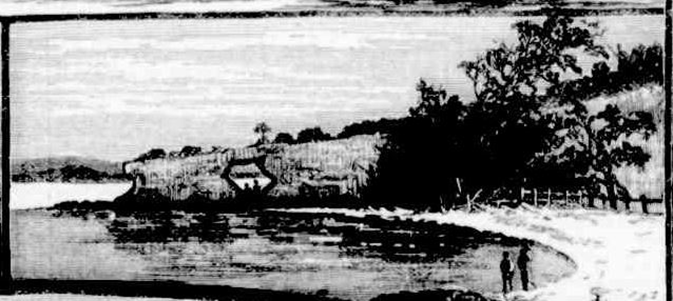
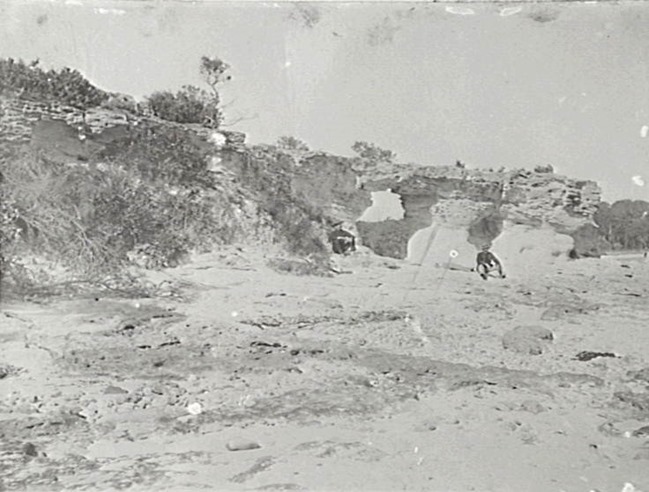
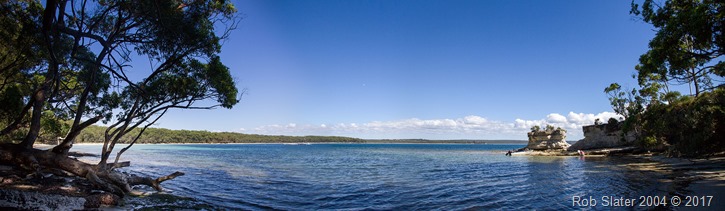
  "Hole in the Wall" is located at the end of the beach near Scottish Rocks. This natural sandstone structure inspired artists and photographers from the time it was first discovered.  The area was first described by early sea explorers as a safe, protected place for anchorage.  Early writings speak of the locations clear water, flat sand bottom and sweeping high headland creating a natural barrier against strong easterly or southerly gales.  Hole in the Wall has been depicted in historical paintings from the very earliest days of exploration.  Unfortunately, the top of the sandstone structure collapsed in the 1980's leaving a U shaped gap.  Some of the romance of the area has been lost but not the beauty or its importance to mariners.


airial

9002_Jervis_Bay_de_Sainson_Louis_Auguste

Painted by Louis Auguste de Sainson in 1826.
Described as - The Astrolabe, moored in nine fathoms, fine sand and shells, three cables
from the beach at Hole-in-the-Wall.
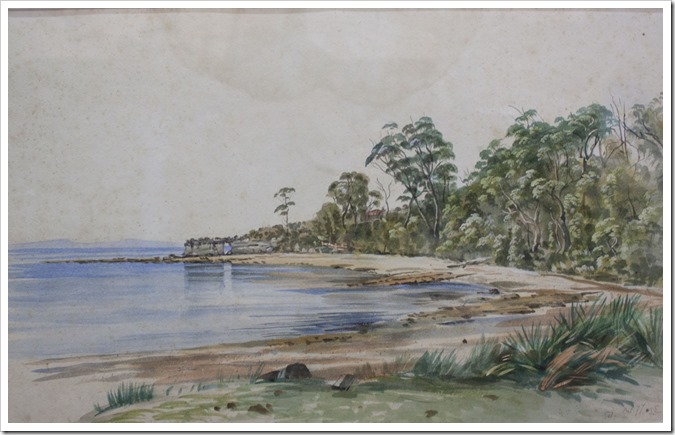
samuel-elyard


Samuel Elyard painting – 1840's

image
As depicted in an article in 1883.

188-Hole-in-the-Wall
Early 20th Century

hole in the wall2

Early 20th Century   

hole in the wall

Early 20th Century

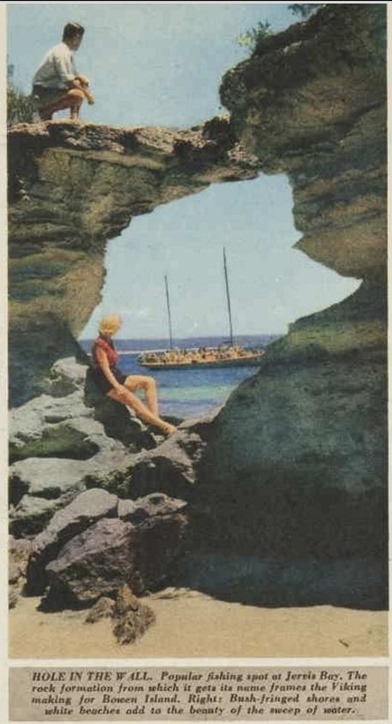
hole in the wall 1953
Australian Womans Weekly 1953

Visiting the area today you will still see vessels of all description sheltering near Hole in the Wall.

2017

The Ketch Atoll II near Hole in the Wall 2017.

young-endeavour-march-31-2017-at-hole-in-the-wall
Like a scene from the 1900's, the Young Endeavour takes advantage of the protection offered by the surrounding terrain adjacent to Hole in the Wall in 2017.
_MG_6249
2014


image

24 March 2017

Ships in Jervis bay.

Late yesterday afternoon I went around to Hole in the Wall and took a few pictures of the Atoll 2,   a beautiful, 2 masted sailing boat,  tucked in close to the shore seeking shelter from the southerly winds.
The conditions were not ideal for taking photographs,  dark and overcast, raining and misty, but the bay looked absolutely beautiful all the same.

attol-2--b
attol-2-a
IMG_5583
boats

Moored near the Atoll 2 was the DMS navy support ship,  Seahorse Horizon.
Built in 1984, the ship was initially operated by the National Safety Council of Australia as MV Blue Nabilla. She was purchased by the RAN in 1990 for use as a surveillance, training, and diving support vessel and renamed, HMAS Protector, she was used as a  Royal Australian Navy (RAN) trials and submarine rescue ship.  During her military career, Protector supported the trials of the Collins-class submarines, and was involved in a search for the shipwreck of the World War II cruiser HMAS Sydney.  The ship was decommissioned in 1998 and, while still owned by the Commonwealth, she is provided to Defence Maritime Services to allow them to support Navy activities under contract.  Renamed Seahorse Horizon, the ship is operated by Defence Maritime Services out of HMAS Creswell as a training and Fleet support vessel.
REF: https://en.wikipedia.org/wiki/HMAS_Protector_(ASR_241)

hole-in-the-wallSeahorse Horizon behind Hole in the Wall.
 
The Huskisson side of the bay was shrouded in thick mist almost obscuring the land , out of the mist appeared two largs ghost like shapes, hard to discern, but as they moved closer you could make out the distinctive shapes of two large navy ships.

hmas-Darwin-and-hmas-Adelaide-111
image

The ship in the foreground is the second of two Canberra-class landing helicopter dock (LHD) ships, HMAS Adelaide .    The ship in the background is the Adelaide-class guided-missle Frigate HMAS Darwin.
Both ships, slowly and carefully moved about the bay in the misty conditions,  the Adelaide finally coming to a halt in front of HMAS Creswell before dropping it’s anchor,   the Adelaide almost dissapeared into the gloom  near  Honemoon Bay.

hmas-adelaide-and-darwin
hmas-adelaide-at-night
Very early this morning I took this photograph of HMAS Adelaide under lights near Hole in the Wall.


image

10 December 2014

Southern Pencillings - By the Raven.

A trip to Jervis Bay1883. Australian Country Journal.
I will post this article written by the correspondent then know as ‘The Raven” in parts.  It’s quite long but takes you back to a time when things moved a little slower.
The article starts off by talking about his stay at the small village of Tomerong in the Travelers Rest Hotel opened by John Parnell in 1857. With the opening of the new southern route to Ulladulla Tomerong became the most important centre between Nowra and Milton, Parnell opened the hotel to cater to the commuters along the road. By 1862 Tomerong had it’s own school, post office and general store.
In 2012 the school celebrated it’s sesquicentenary, 150 years 1862 – 2012.
221-Lackersteen's-Pioneer-Store,-Tomerong-a
p1

Waking up in Tomerong.
 

“It is early morning at Tomerong, the patter of the rain on the roof and against the window is the only sound to be heard, it’s painful regularity palls upon the ear.
Rising from bed and drawing up the binds, I notice that a uniform, dull laden hue pervades everything outside, there is evidently no sign of it clearing up today.

Despair seizes me - This makes the fifth day of imprisonment at Tomerong.Raven was clearly getting frustrated by this time, Tomerong was only around 5 miles away from his objective Jervis Bay, but with the state of the roads and lack of transport it might as well have been a million miles away.

Tomerong a place, under the most favourable circumstances, not calculated to inspire one with cheerful thoughts, Without companions and the books, except an ancient Robinson Crusoe, have three days of miserable incarnation been passed. The spotted china dogs, with guilt collars, and an expressionless stare, which are seated on the mantle piece and the fashion plates on the wall, for the year 1856, in which are several females, also expressionless and in balloon like attire are depicted, now cease to attract. Although the middle of November, a fire is not only welcome, but almost indispensible.
      For the sake of those who have never heard of Tomerong, I may say it consists of a public house, with post office adjoined – wise combination – school, and church, and that it is situated on the road between Shoalhaven and Ulladulla.
My object in coming here was to visit Jervis Bay, the nearest point of which, viz., at North Huskisson, is only about five mile distant.

The rain finally clears and his journey continues to Jervis Bay.

Accordingly the following day, the rain having at least ceasedand there being every prospect of fine weather, I set off for the bay in a buggy kindly placed at my disposal by my land lord (Mr Parnel), a well known identity. Very little, if any good or even cleared land is passed through on the road; the timber principally spotted gum and blackbutt, being of more value than the land upon which it grows, Several timber wagons drawn by bullocks are to be met with; timber getting being one of the main industries of the neighborhood”.

94a    


To be continued,
Entering Huskisson.


part-2-badge
Finally, the Raven reaches Jervis Bay.
government-school-at-huskissonJust upon entering North Huskisson, one’s attention is attracted by an evidently poverty stricken little humpy leaning over so much as to require propping up by saplings. This, I am surprised to learn is the Government school, and has an attendance of 40 scholars. A new building was promised 12 months ago.
The small village of North Huskisson is situated at the north of Jervis Bay. at the mouth of Currumbene Creek. Shipbuilding is it’s main industry, the chief firms interested in this employment being those of Messrs. G. Dent, Thos, McCall and A Conlon respectively. Almost every description of craft is built by these firms; the favourite varieties of wood used being spotted gum for sailing vessels and pine for steamers. There is also a fair sized sawmill here.

A howling wilderness the home of the dingo and curlew,is all that is left of South Huskisson, at one time a large and prosperous township, a mile and a half from the above. It was originated with the idea of it’s becoming the shipping port for Braidwood, but in this the inhabitants, it is, perhaps, needless to state, were disappointed; hence the desolation.St Georges Head at the south of Jervis Bay, where is situated the lighthouse, attracts a great number of visitors, and is a favourite resort of fishing excursionists, shark and schnapper abounding in the locality.
It is some 15 miles distant from Tomerong, the nearest route being via St Georges Basin. a magnificent sheet of water, in shape and appearance reminds me of Sydney Harbour. On the north bank of this lake, or, more correctly speaking, arm of the sea, or, what would in Norway be called a “fjord.” are situated the estates of Messrs. William and Alexander Brice, to of the earliest settlers in the village. These two estates adjoin and together comprise 2560 acres, upon which dairying, as well as a small amount of agriculture. is carried on; They are well watered by the Wandandyan and several other smaller creeks.

A sketch of the residence of Mr. Alex Brice done by “Raven” during his trip.
farms


A day on the Basin.

Being a guest under the hospitable roof of Mr.Willam Brice, a days boating in the Basin is proposed, and of course, gladly acceded to. A short walk brings us to the creek, on the brink of which is a neat little boatshed. We launch our craft, and after half an hours pulling, emerge into the open, upon which the sails are set, and our rate of progress through the water consequently materially increased, there being a pretty stiff breeze bowing at the time. The southerly gales more than any other are felt here.
The two or three fairy-like islands with which the Basin is studded are duly inspected and admired, for to see is to admire in their case.
Mr Raven must have been duly impressed with what he saw that day, especially with the amount of birdlife.
Water-fowl of almost every description are to be seen here.The well know instinct of the Britisher to kill is strong within me, but to satisfy this instinct were to break the laws of my adopted country, it being the close season. There is no law, however, against “running down” moulting swans. Although the sun had not long risen when we started on our trip, he had already been at rest for some time when we once more arrived at the little boat house, after a delightful and appetite-inspiring day.

Clearly from the Raven’s description the Basin was a happy hunting ground for wildlife, other than fish, It’s hard to imagine now that people looked at swans as a resource for food, but there is other evidence included in other articles supporting this. 
 ST-GEORGES-BASIN-VIEW A sketch of the Basin done by “Raven” during his trip.
To be continued. Horse hunting and a trip to St Georges Head.
p3


Hunting horses is a favourite sport of the residents.
Numbers of wild horses in large mobs roam about this neighbourhood; hunting these is a favourite sport of the residence, The day following that spent on St.Georges Basin one of these hunts was organised; to join this, I was invited, but having already made arrangements for going to St, Georges Head, a distance of 11 miles, had to decline running the risk of breaking my next amongst the timber.
    After crossing an arm of St.Georges Basin by which means a great saving in the length of the journey, is effected, we – my host and self – find ourselves following the track to the Head, through as wretched and hungry looking a description of country as it has ever been my lot to see, grasstrees, oaks, reeds and sandstone forming prominent features in the landscape. Fortunately we are able to vary this otherwise monotonous journey by the occasional canter for a mile or two along a splendid beach, It was during one of these latter that I had me attention directed to the peculiar phenomenon known as the “Hole in the Wall”;.Of this I send a sketch, which will do away with the necessity of any further description.
A sketch of Hole in the Wall done by “Raven” during his trip.
hole-in-the-wall


”We came across the remains of Whales”

During this period a small whaling operation was using this part of Jervis Bay to process whales.
We also came across the remains of two or three Whales recently caught here. In travelling along the creek, several small creeks have to be crossed, in doing which, there is a certain amount of risk, in consequences of the existing quicksands. We, however, manages to arrive at our destination without any more serious mishap than my companion, in attempting at the commencement of our journey a short cut, finding himself suddenly rolling on the ground, and his horse bogged up to the girths, We did not try any more short cuts that day.

After what seems like an long and sometimes interesting journey Raven and Companion reached their destination, the majestic Cape St George Lighthouse. Raven goes on to describe the lighthouse and surrounds in great detail adding to our knowledge from this time.

A sketch of Cape St. George lighthouse done by “Raven” during his trip.
lighthouse 


Cape St, George Lighthouse.

       The St.George lighthouse stands on a bold rocky promontory, as the sketch will show, and is superintended by Mr. Gibson, son of Captain Gibson, who for 30 years was pilot of Port Jackson. The tower is of the most substantial character, being built of massive cut stone, and, along with the assistants’ cottages, the signal staff, the meteorological instruments and the flag-room, is enclosed within a stone wall 4ft high. It is connected with Mr. Gibsons private residence, and the assistance’ quarters by a system of electric bells. The lights, nine in number  ( three red, three green, and three white ), are revolved by means of a clock work, which regulated as circumstances require; these lights are visible for a distance of from 15 to 25 miles. A public school is within a short distance. From the summit of the tower a magnificent view of the whole of Jervis Bay, 30 Miles in circumference, and about eight miles across, is to be had.
After partaking of Mr. Gibsons hospitality, we turn our faces homeward, and we are once more following the little-used track through some of the most barren land in Australia.
Another part of his journey has come to an end, it is apparent from Ravens’ correspondence a days journey in this part of the country at that time was something you didn’t take to lightly.
To be continued – Opinions as to the prosperous future sooner or later of Jervis Bay.
p4
After a few exciting days at Jervis Bay the Raven concludes his story, seeing a prosperous future for the Bay.
Amongst the safest harbours of refuge on the east coast.
Opinions as the the prosperous future sooner or later of Jervis Bay are, I think, unanimous. The Admiralty records place it amongst the safest harbours on the east coast, being accessible in all weathers, and the “Nautical Almanac” describes it as ‘superior to Port Jackson, inasmuch as a fleet of the largest ironclads might enter in any conditions under weather, and choose anchorage in from five to six fathoms close in shore.” Some short time ago there was talk of a railway being constructed by the Victorian company from one of the rich coal seams of the coast range – if I remember alright, from the Jamberoo mountain – to this bay; but here the matter ended. It is generally thought that the Illawarra railway will have a terminus here. In regard to the most suitable landing place on this bay, Mr. J. Brache, C.E., late superintendent of mining surveys to the Geological Department of Victoria says; ‘A close investigation of the various landing places in Jervis Bay has decided me in favour of the beach from Plantation Point south towards Darling Roads. There a high beach, with rocky projections, approaches within a short distance, to deep water. six fathoms and over, enough depth for the largest tonnage vessels; whilst the adjoining hills contain stratas of good sandstone to freestone, available for wharf, jetties, and all other building purposes.’
The ‘Raven” has painted a picture of a beautiful, but harsh, and rugged landscape, interspersed with small pockets of activity of the early pioneers, it highlights the isolation and remoteness of Jervis Bay, but like so many other stories concerning the Bay from this period, the correspondents all come to the same conclusion, Jervis Bay has a prosperous future for industry and commerce if the infrastructures are built, the railway, and better shipping facilities being the main concerns.
Its interesting to note, despite much talk and promises these things never materialised.
Because of this inaction, we are fortunate to have the Bay the way it is today.
Additional ref. http://home.exetel.com.au/tomerong/history2/index.htm
http://home.exetel.com.au/tomerong/bullock/

21 February 2014

Hole in the wall.

Then and now.Even in the early 1900’s the  hole in the wall attracted tourists eager to have their photo taken.
Today is no different, the area still attracts eager photographers and sightseers.
Unfortunately the hole has become a gap. The area is spectacular and well worth the small effort to get there.
The two colour images are from today, 21st Feb 2014..
188-Hole-in-the-Wall-rs  hole-in-the-wall-2014-rs
hope-in-the-wall

13 February 2015

Proposed quarantine station for Jervis Bay.

1918 Influenza killed 111,000 people across America.
Fears for Australia.
With the quarantine station located at North Head Sydney becoming inadequate to cope with the increase in immigrants, returning soldiers and ships crews infected by disease, and the fear it could spread throughout the population, a proposal was put to governmant to build a quarantine station away from Sydney at Jervis Bay.

1918 - Despite Jervis Bay being found unsuitable for the station in 1918 it was still being promoted by interested parties.

1919 - In promoting the idea -  Dr. R. Arthur wrote.


"Now is the time if ever, for a beginning to be made with a quarantine station on the northern headland of Jervis Bay. Influenza is raging more fiercely than ever in Britain, and we may assume,  therefore,  that for many months to come ships will be arriving here,  with possible infection on board.

Speaking of the proposed site and lack of conveniences.

'It is certain that the vast majority of people would gladly put up with the inconvenience and discomfort, such as living in a rough camp under canvas would involve."

Speaking of the possible lack of water for the site.

"If not sufficient quantity could be bought from the other side of the bay.  If water could be bought under shell fire to 50.000 men on Gallipoli, there should be no difficulty in providing it at the proposed station.

Those quarantined could occupy themselves pleasantly in bathing, fishing, exploring the bush, and ground could be cleared for outdoor games.  If thought advisable, a canteen where light beer was sold could be established,  and there could also be an open air picture show."

It sound almost enjoyable.

 
1919 - A large Parliamentary party boarded a special train in Sydney and travelled to Jervis Bay to inspect the site of the proposed Quarantine station.
image

The party received a lot of criticism in the press, for being un-necessary and huge waste of taxpayers money on accommodation, transport and extravagant food, it comprised close upon 100 people, including members from the Federal Parliament and State Parliament and confusingly, members from Queensland and Victoria.


The daily Commercial News and shipping list 1919.
“After all the trouble and expense incurred in this expedition, there seems to be little hope of any part of Jervis Bay being selected as a quarantine station.”

 
map

The party travelled down to Bomaderry by special train, They spent the night in Nowra, next morning, travelling by cars to Huskisson.  “Practically all the private cars in the district were engaged in the transport of such a large number of people”.
   On arrival at Huskisson the party was conveyed by Mr. J. Wilson's motor launch, Radium, to the pilot steamer Captain Cook,  the steamer made her way directly to Montague Roadstead.
   The medical men of the party only proceeded a few hundred yards into the bush from the beach.
   It was pointed out by Mr. R. Dent that the anchorage at the spot was amongst the best in the bay, ships being able to ride with absolute safety in all weathers.
   After the inspection, a lunch was served, the creature comforts being on a liberal scale, and leaving nothing to be desired from a culinary standpoint.
   The party then proceeded across the bay to Bowen Island, Hole in the wall and the Naval College. A stiff nor-easter was blowing and made the Captain Cook roll a good deal, a number of the party suffered mal-de-mer.
   The party left Huskisson the same way they came, and the special train returned to Sydney the same afternoon.

1923 – After years of debate, the idea was still being promoted by interested parties to the Government.
With the population of Sydney growing the station on Sydney's North Head was becoming less isolated, Manly was a growing sea side suburb and becoming a summer resort, with the quarantine station situated right against it, there was a grave danger of disease being disseminated throughout Australia.

In the following years despite the precautions, there were many deaths across Australia and at the quarantine station itself. 

Nothing became of the proposal to relocate the Quarantine Station, parties on both sides of the argument were still voicing their opinions.

1931 - An article appeared in the Shoalhaven and South Coast  Districts Advertiser that had the usually placid locals in protest.
A proposal to turn the Naval College into a Quarantine Station. The article went on to criticise the idea.
 

"The idea to turn such costly and superior buildings  for the housing of persons suffering highly infectious diseases was absurd. The townspeople did the right and proper thing in entering vigorous and empathetic protest against the carrying out of the suggestion of the State Government."

 
 1923 – 1950  With better health measures and the improvements in medical science, the cases of influenza and other contagious diseases were diminished to such a degree, the proposed move was never required.

23 November 2015

The Cruise of the Wolverene.

Jervis Bay has played a fundamental roll in the Navy's history.
The Navy has and still does use the bay to developed and train their sailors.   It was first entered by the British Navy In August 1791 by Lieutenant Richard Bowen, aboard the convict transport ship Atlantic, part of the Third Fleet, he sailed into the bay and named it in honour of Admiral John Jervis, under whom he had served.

The navy were  regular visitors and used the bay for rest and recreation as well as the all important shot practice. 

In 1889  the H.M.C.S Wolverine left Sydney Harbour bound for Jervis Bay  to engage in shot practice.  She was a well know warship and had been in Australia  since 1877,  and for some years was the flagship of the Imperial Squadron in Australian Waters.

Progress down the coast was slow,  on leaving the Sydney Heads she encountered relatively calm conditions,  but as she stood out a few miles she encountered a heavy roll, which catching the vessel broadside on,  caused her to tumble about a great deal.

The wind being from the west,  and blowing strongly fore and aft canvas was set,  and this steadied her a little.

A large percentage of her crew aboard formally belonged to the British navy.
These old men-o'-wars -,men showed great aptitude in the performance of their duties,  being noticeable for their activity aloft.


 hms corvette wolverene
 Untitled-1 image


64 pounder.
On the journey south they took the opportunity to drill with the converted 64-ponder guns.
Although they had fine weather progress was very slow,  from 51/2 to 6 knots per hour,  This slow rate was owing to the fact that beneath the waterline the ship is very foul,  having about six months growth on her.

Sunset Friday.
Shoalhaven bight was sighted,  and they dropped anchor in Jervis Bay at half past 9 o'clock.

Nearly one-fourth of the ships company suffered from sea sicknesses during the run down.

Saturday morning.
The weather this day was fine,  she ran out to sea and engaged in shot practice at  a floating target.

A party of officers and the press representatives  put off from the ship,  landed near Hole in the Wall,  and walked across the hill to the Jervis Bay Lighthouse.  The track lay through thick bush, covered with a luxuriant undergrowth of grass, bracken and native flowers,

 nla

On emerging from the bush we crossed an open grassy plain for the lighthouse.
The walk across the breezy uplands proved very enjoyable after the monotonous and never-ceasing roll of the ship on her way down from Port Jackson.

We found the light-keeper and his numerous family in the best of health,  and the lighthouse itself and it's surroundings were in excellent condition,  everything being neat and clean.

Looking seaward from the lighthouse the view is extremely grand.  The great ocean stretched away in front looking somewhat desolate and lonely,  while the long easterly swell dashed on the cliffs at our feet with terrific violence threw huge masses of white feathery spray high into the air,  which reflected all the colours of the rainbow as it fell back into the sea again.

Lieutenant Cohen, assisted by Dr. Knaggs and Midshipman Lewington took a number of views of the lighthouse and the occupants off the houses situated on the bleak, lonely headland,  after which we started the return journey,  leaving a number of telegraphic messages to be dispatched to the city prior to bidding the people who live in this lonely spot farewell.

bw-pic-1

A stiff trudge bought us to the margins of Jervis Bay,  where the cutter was waiting to transfer us to the Wolverene,  lying about a mile away from the shore.

2.15pm  the crew manned the capstan and raised the anchor, to the tune of "Ballyhooley"
in true old-day man-o'-war style.  played by the fife and drum band as the tars beat to their work.

A target was then dropped over the side,  and the Wolverene steamed round while the gun's crews fired at it at ranges varying from 1000 to 1500 yards.  Some excellent practice was made,  the majority of the shots falling on either side of the object aimed at, the general direction of the missiles being good.  Nearly every shot would have holed a vessel.

Riflemen were also stationed on the tops,  and these took long shots at the target: but despite the inducement offered by Captain Hixon of " a pound for every man who strikes it",  they were unable to hit the flag,  owing to the unsteadiness of the vessel.
At the conclusion of the shot practice we stood out to sea,  passing close underneath Point Perpendicular at about 5p.m.   This is a grand headland,  the great perpendicular wall of rock rising out of it's ocean bed to the height if some 200ft.

After clearing the great headland  we stood well out to sea,  obtaining a good view of a fine four-masted vessel,  which,  with most of her canvas spread to the breeze,  was heading for Sydney as our good ship left the bay behind her.
LOOKING-BACK-AT-THE-BAY

Leaving Jervis Bay.

Darkness now settled over the face of the old ocean,  the only signs of life visible to our eyes being the lights of passing vessels and the rays of the friendly beacon shining forth from the lighthouse on the now far distant cape.

The Wolverene made many trips to Jervis Bay for ‘shot practice” but this particular journey to Jervis Bay was at an end,  this report gives us a valuable insight into the life and times of Jervis Bay and the navy around the late 1880's.

 HMS-Wolverene-the-deck-state-libraryDeck of the H.M.S Wolverene
 
And what became of the H.M.C.S Wolverene?
In the early 1880's the Wolverene was presented by the Imperial Government to the New South Wales Government as a drill and training ship for the New South Wales Naval Brigade.
The title of the ship was then changed from H.M.S Wolverine to H.M.C.S (Her Majesty's Colonial Ship) Wolverene. The vessel served as a training ship for the Naval Brigade for quite a number of years.
At the end of her service in that capacity the Wolverene was sold to Mr. Peter Ellison, of Millers Point, Sydney.  Later the vessel loaded coal for South America,  and during the voyage her seams opened,  whereupon the vessel put into Auckland, New Zealand,  where she was condemned in March 1895.  The vessel was subsequently broken up in Auckland Harbour.
BACK
 

26 January 2016

“I thought she was gone”

The S.S. Allowrie – the life and times of this stout little steamer.

S.S. Allowrie, Illawarra & South Coast Steam Navigation Co Ltd
http://acms.sl.nsw.gov.au/item/itemLarge.aspx?itemID=188622

The S.S. Allowrie
Built in Gladscow in 1880 the Allowrie measured 179ft 4inches x 24ft 8 inches x 16ft hold,  she weighed 504ton, was made of  steel and was a two funnel vessel,  The Allowrie was designed for carrying passengers and cargo, including livestock and dairy produce.
Owned by the Illawarra Steam Ship Company the S.S. Allowrie was a well known coastal steamer to south coast ports.
During her working life she made countless uneventful journeys between the north coast port of Nelligen and the far south coast port of Tathra.   Like many coastal steamers working the open seas along the east coast, she had her share of mishaps and adventures.

Some of her reported incidents.

The fate of the Allowrie,  for the first time in her history hung in the balance.
During a great storm that hit the coast the Allowrie was within an ace of giving the gale a name.  When making a hard struggle against the fury of the elements the steamer shipped an immense green sea which completely buried the forepart of the vessel for an unusual length of time,  and caused her to vibrate from stem to stern.  The passengers were below at the time,  and in view of the threatening nature of the weather,  every door and port hole was closed in case of emergency.  Only the captain and officers were on the bridge,  the former exercising the greatest vigilance in his battle against a storm which raged with all the fury of a hurricane.  When abreast of the Shoalhaven Heads and while the vessel was heading for Jervis Bay,  where shelter could be obtained,  the green sea in question came aboard,  and the fate of the Allowrie,  for the first time in her history,  hung in the balance. The great wall of water held the stout little ship under, as if to smother her,  but gradually her head lifted through the angry waters,  and the captain and his men were relieved of a painful suspense. The captain speaking of the incident afterwards said. "I thought she was gone."  The passengers heard the sea come aboard but they little dreamt of the perilous position they were in.


1897 -  She took the passenger from the wrecked steamer S.S Kameruka back to Sydney.  The Kameruka was a total loss after hitting the reef at Pedro Point near Moruya.

1889 - She sustained a large hole in her bow after running into a pier in Wollongong Harbour and had to be beached for repairs.

1900 a 63 year old passenger suffocated on board in front of his wife and fellow passengers, the autopsy showed he had a piece of meat caught in his wind pipe.

1900 During a full force gale the Allowrie went to the assistance of the 4 masted Drumalis which was drifting helplessly in close proximity to the rocks in Wreck Bay.  - Continue reading about the Drumalis from a previous post.

1903 - Despite  many doubting it could be done by such a large vessel, she successfully negotiated the Shoalhaven River,  well known at the time for it's sand bars and rocks,  she docked at Nowra Wharf in front of a large gathering of onlookers.

1903 - Trying to repeat her previous Shoalhaven River journey, she ran aground on a sand bar near Greewell Point, the ship was undamaged and was later successfully pulled free by the dredge Altleon, she finished her journey without further incident.

1907 During one of her trips south she encountered very heavy seas,  tossed about quite severely she was lucky to escape disaster after one of her propellers had all  it's blades stripped clean off the shaft,  she limped into Botany Bay for safety.

1908 – She struck an unmarked reef at the entrance to Batemans Bay and lost two of the blades off the starboard propellar,  she refused to answer the helm and went aground on the mud bank,  the steamer Moruya came to her assistance and towed her off.

1908 - On a trip to Tathra one of her crew was sleeping on a pile of timber on the deck,  the ship lurched and he was tossed over board and despite an extensive search was never seen again.

1910 the Allowrie was out of service,  in the later half that year she was dismantled,  leaving nothing but a hulk.


“Allowrie”  Aboriginal word meaning  “pleasant place near the sea” or “high place near the sea”

BACK