.

.
HOME OF THE LADY DENMAN - Local history isn't always about the big story - the everyday story of life in the early development of the region can be a fascinating, entertaining and educational journey.
Showing posts sorted by relevance for query hmas yarra. Sort by date Show all posts

10 September 2018

Sloop HMAS Yarra

The naval sloop HMAS Yarra would have been a familiar shape on the horizon for the residents and visitors to Jervis Bay in the late 1930's.

yarra-01


HMAS Yarra was a Grimsby-class sloop of the Royal Australian Navy which came to the bay on many occasions to conduct training exercises leading up to the second world war, sometimes alone,  other times as part of larger operations involving the Australian fleet.


image

Lost Anchor - Buffeted during a gale.
1936 August. - Anchored off HMAS Creswell she was caught in a strong northerly gale which reached speeds of 50 mph.  She rocked so violently a timber whaleboat tethered beside the ship was splintered to pieces within minutes.  A heavy swell whipped up by the gale came across the bay tossing the Yarra  so violently she lost one of her anchors when the chain snapped.  With this, the captain ordered full steam and the sloop sailed across the bay seeking shelter in the lee of Point Perpendicular. 

HMAS Canberra, also in the bay had her boat boom carried away in the violent storm, other boats were in danger of being smashed by the cruiser. Two divers were dispatched from HMAS Canberra to recover the Yarra's anchor, the operation was carried out in very difficult conditions.


image


Ken Stephens a young seaman on the Yarra fell overboard. 
         Stephens: -  "I went to put my foot on the Jacobs ladder", he said.  And found it was not there."

An open boat was immediately lowered and his shipmates had a difficult and dangerous time effecting the rescue. Stephens collapsed when he reached the deck and received medical attention.

1938 - The Yarra had a further association with Jervis Bay when H.B. Farncomb, a graduate from the Jervis Bay Naval College was appointed the captain of the Yarra.

War service.
1942 - War was raging across the Pacific.  HMAS Yarra was involved in rescuing 1800 troops from the liner Empress of Asia after she was dive-bombed by the Japanese and set on fire, Captain
W. H. Harrington by commendable seamanship took his ship alongside the blazing liner allowing the troops to come aboard. Meanwhile, the Yarra's gunfire helped save other ships in the convoy.


image


1942 - May,  HMAS Yarra was sunk during action with the loss of 138 including the Captain and all officers, they were killed in the action or died subsequently on the rafts. The action was described as one of the most gallant in Australian naval history.

Navy Minister Mr Makin described the gallantry of the HMAS Yarra's crew in fighting a far superior enemy until she was sunk.

  'At dawn on March 4 while escorting 2 merchant vessels and a minesweeper from Java to Australia the Yarra and her charges were attacked 350 miles south of Java
by three Japanese heavy cruisers and 4 destroyers. Against such odds, the battle lasted less than 30 minutes and the Yarra and her convoy were sunk.
The Yarra after trying to save the convoy by ordering a covering smoke screen fought to the end and went down with colour flying. Only 13 of her compliment
were saved after spending 105 hours in the water.

Take the time to watch this short well made documentary about the courage of the captain and his crew against overwhelming odds.

http://www.navy.gov.au/hmas-yarra-ii


image

14 February 2017

Ships in the Bay.

HMAS Yarra.

hmas-yarra-14th-feb-2017---aTaken before sunrise with her running light on.

hmas-yarra-14th-feb-2017

It was fairly early with dim light so please excuse the fuzziness at full size.

Today we have HMAS Yarra (IV), the sixth of six Huon Class minehunters in the bay. She isn’t a big ship at only 52 meters long but has some very unique features.

Her hull design is shock resistant with a low magnetic and acoustic signature.  This allows the ship to operate in hostile mine environments.   When mine hunting,  propolsion and precision manoeuvrability is achieved using retractable thrusters.

Puzzled solved - This explains how this morning she was doing tight pivitol circles while at anchor. I was wondering how she was able to do this as I couldn’t see any sign of her engines working . 

The Ship uses variable depth sonar to search for and prosecute mines.  Upon detection, the ship deploys the remotely operated Mine Disposal Vehicle (MDV) or clearance divers to identify and neutralise mines. The MDV, equipped with a searchlight, camera, sonar and disposal charge, is controlled from Ship's operations room.


She is the sixth Huon-class minehunter to have been built for the Royal Australian Navy and the fourth warship to be named after the Yarra River in Victoria.  Built in Newcastle, she was commissioned in March 2003.

 
hmas-yarra-14th-feb-2017--b


image
 

5 October 2017

On this day 1911

The Royal Australian Navy officially came into existence.
 

The announcement that Australia was to have its own navy would have a significant impact on Jervis Bay.  During the 1840's  the bay was best known as a port for exporting wool from the highlands.  South Huskisson ( present-day Vincentia) grew into a bustling town with hundreds of people involved in the wool trade.  Ships called into the bay and were loaded with wool transported by bullock teams on the newly constructed wool road connecting Jervis Bay with the interior.  Jervis Bay was finally becoming what many had wanted and predicted, a centre for industry.   Around 8 years later the boom had finished and South Huskisson had almost completely disappeared back into the bush with little evidence any sort of town ever existed.   The bay had once again slipped back into a slow-moving sleepy district, best known for a small shipbuilding industry based at Huskisson. 


Reliable transport to Sydney had always held back developement around the bay,  the announcement by the government Australia was to have its own navy and shortly after would build the Royal Australian Naval College at Jervis Bay thrust the Bay into the headlines once again.  Jervis Bay had now become a major focus for the navy and the rest of Australia.

Before Federation in 1901, five of the six separate colonies maintained their own naval forces for defence. The colonial navies were supported by the ships of the Royal Navy's Australian Station which was established in 1859. The separate colonies maintained control over their respective navies until 1 March 1901, when the Commonwealth Naval Forces were created.  Originally intended for local defence, the navy was granted the title of 'Royal Australian Navy' in 1911 and became increasingly responsible for the defence of the region.
Ref:https://en.wikipedia.org/wiki/Royal_Australian_Navy

1901 - There were moves by the Commonwealth Defence Authority to establish an Australian navy.

In the years following 1901 there was much discussion from supporters and the opponents of the scheme.  The controversy revolved around the costs involved in Australia establishing and maintaining its own Navy. 

1903 the Australian Government paid an annual contribution to the Royal Navy of 200.000 thousand pounds for an auxiliary squadron.

1909  -  Since the Defence Conference of 1909 Australia had gone steadily forward with a definite and progressive naval policy.

1909 – It was clear Australia was to have its own navy when the Federal Government ordered two torpedo destroyers and to have a third constructed in Australia.


image
image
HMAS_Parramatta_1910

HMAS Parramatta.


"When they arrived in Australia in the destroyers Yarra and Parramatta, the men of Australia's nucleus fleet wore the distinctive letters 'H.M.A.S.' to show that they were of His Majesty's Australian ships. The designation has received official sanction at the hands of the King, and the High Commissioner has received from Downing street a letter covering a dispatch from the Secretary of State for the Colonies, to the Governor-General, to the effect that His Majesty has been graciously pleased to approve of the naval forces of the Commonwealth  being designated the Royal Australian Navy  and of the ships of that navy being designated his Majesty's Australian Ships. Following this arrangement, It is added, ' the citizen naval forces of Australia will receive the official title of the "Royal Australian Naval Reserve".

yarra-01

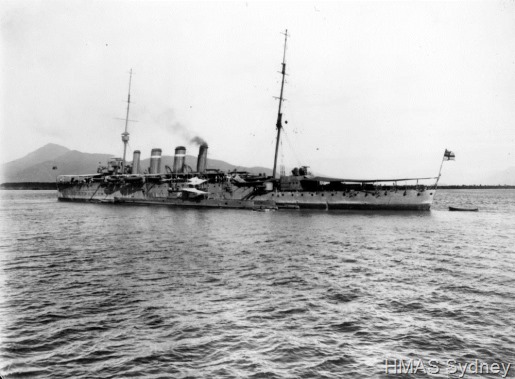
H.M.A.S Yarra

1912 -  A circular was sent out to all state premiers informing them of plans to establish a Royal Australian Naval college and facilities thereby afforded to boys between 14 and 16 years who are desirous of following a maritime life.

1912 – Recruiting for the navy was temporarily suspended owing to lack of accommodation at the Williamstown training depot. The permanent establishment at Williamstown was 88 men.

1913 - Following indecision and controversy work began to build the
Royal Australian Naval College at Captains Point Jervis Bay which was officially opened in 1915..

image


The rise and fall of South Huskisson – Continue reading.


image


7 April 2018

Ships in the bay

April 7 2018
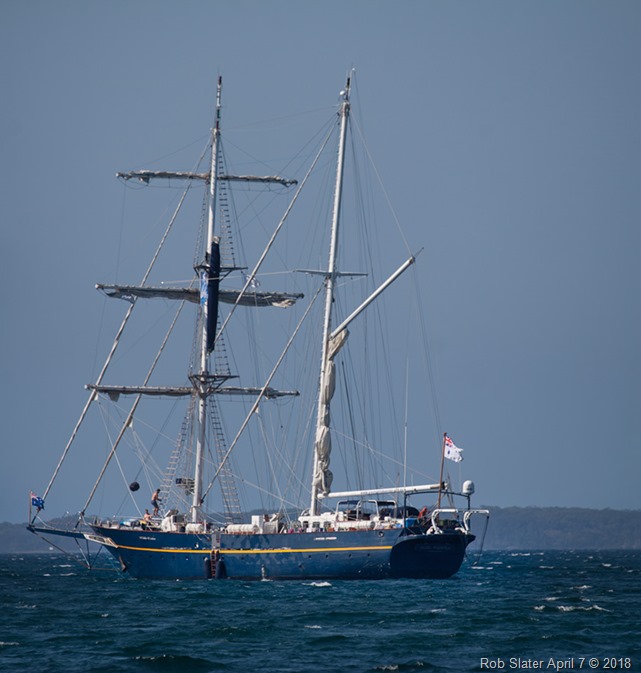
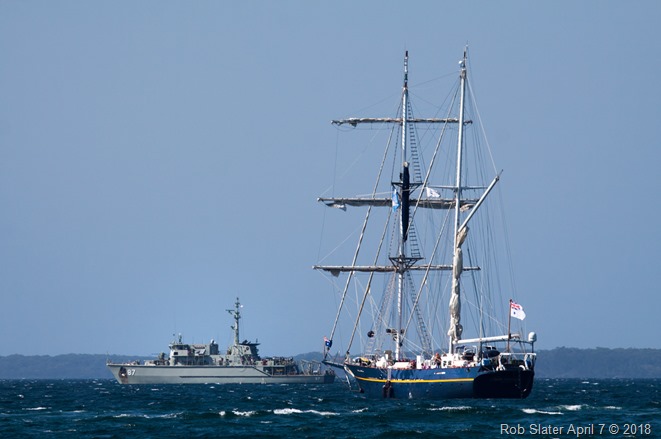
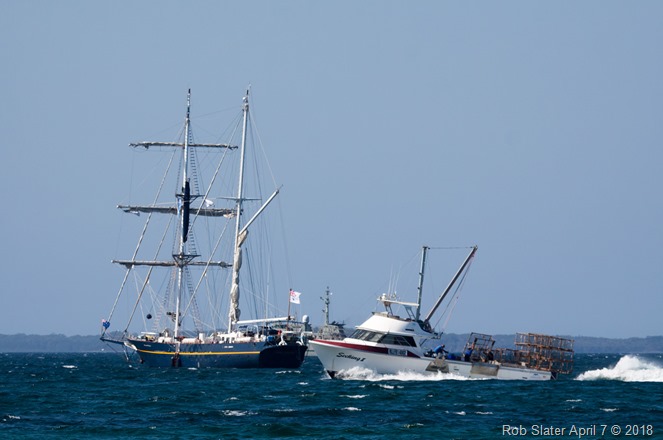
The beautiful tall ship Young Endeavour is anchored off Huskisson today, she makes a beautiful elegant sight, her sails are furled tight against her masts and her flag is flying proud in the stiff north east breeze currently blowing across the bay. She is making her way to Sydney from Victoria expecting to arrive there on the 13th April.
Young Endeavour is operated and maintained by the Royal Australian Navy, the vessel is used to provide sail training to Australian youth.

Untitled_Panorama1

HMAS Yarra is also in the bay and at the time I took the photographs was in close proximity to the Young Endeavour.


IMG_2508

Seaking II, One of the last remaining commercial fishing trawlers operating from Huskisson is seen astern of the Young Endeavour.

IMG_2506


Continue reading about the previous visit of the Young Endeavour to Jervis Bay.

Continue reading about HMAS Yarra.


image


3 October 2017

On this Day Jervis Bay 3rd October 1913


In what must have been an impressive display the first fleet of the Royal Australian Navy comprising the flagship H.M.A.S. Australia and her sister ships Sydney, Melbourne, Encounter, Psyche, Cambrian, Parramatta, Yarra and Warrego assembled in Jervis Bay for final preparations before their journey to Sydney to steam into Port Jackson as part of Fleet Week.

HMAS_Australia_1914
hmas sydneyHMAS_Melbourne_(1912)_-_Project_Gutenberg_eText_18333HMAS_Encounterhmas PsycheHMS_Cambrian_1910_AWM_302155HMAS_Parramatta_1910yarra-010002


image

27 February 2018

First telephone call between Jervis Bay and Tasmania

April 1936.
In an age where we take the simple act of making a telephone call for granted,  it's hard to imagine a time without this every day convenience.

The first telephone call was made between Jervis bay and Tasmania since the new cables had been laid was made by an Officer of the H.M.A.S Yarra. He was quite surprised at the clearness of the telephone saying, "It seemed as though he was ringing locally"


image