 |
 Next Chapter - Photo Rob Slater April 2019  |
.

29 April 2019
Vessels in the bay.

27 April 2019
Old Huskisson 1959
The building with the chimney was the local billiard room which originally stood on Owen Street between the old BP garage and the Huskisson Pub.
 |
| Copyright Jervis Bay Maritime Museum |
Nowra Park House 1880s

Thanks, Dee for the wonderful photograph.
23 April 2019
The Dent investment.
1904 - George Dent senior was rapidly approaching his nineties but could still swing an axe that would put many a young man to shame. Described as the "grand old man" of Jervis Bay he was quoted as saying " the hull is sound as ever, but the spars are going."


One of the more profitable ships the Dents bought was the S.S.Riverina, a three-masted screw steamer of 2801.0 (imperial tons),
27 January 1 am - In hazy conditions bought about by bushfires in Gippsland, the Riverina was running at full speed when she ran ashore onto Island Point east of Cape Everard. The shock from the impact was terrific and came without warning for the passengers. The forward lookout screamed out a warning " breakers ahead" and despite the captain putting the steamer into full astern, she struck almost immediately. The captain tried in vain to reverse the steamer off the rocks by putting her into full astern but the steamer was stuck fast. The ships carpenter sounded the hold and found water rushing into the engine compartment and number two hold. Captain Prehn ordered the boats to be lowered taking the passengers safely away from the ship which was found to be stranded 150 yards from shore. The crew set about making a makeshift camp with food and water for the frightened passengers. Signals of distress were fired and soundings were taken around the vessel, finding 12 feet aft. The ship's officer was dispatched in a boat to intercept any passing vessel and give them notice of the stranding. The steamer Wendouree arrived at the scene at noon, some of the passengers were safely taken onboard and she set sail for Sydney.
Despite the ship resting in a very exposed position she was still stable and standing on an even keel. This allowed salvage teams to recover much of her cargo. She weathered a storm during her time ashore and came through relatively unscathed, allowing the salvage work to continue.


The Auction.
14th February 1890 - There was a large attendance at the John Fraser and Co.'s rooms when the wrecked steamer was put up for auction. There was an estimated 400 tons of cargo still on board and the biddings commenced as 500 pounds and increased by 50-pound bids in rapid succession until the vessel was knocked down to Mr Dent for the sum of 1050 pounds.
Recovery.
27 February - Mr Dent arranged for the steamers Trident and Sophia Ann to head to the Riverina which was still upright and intact despite the recent heavy weather.
28th February - The steamer Sophia Ann arrived at the scene but due to very poor weather had to run for shelter back to Eden where she stayed for a few days. She was joined by the steamer Trident, and in calm weather arrived at the scene of the stranding together.
Dent and his team of workers quickly went about their business recovering a large quantity of cargo. He carried with him a powerful portable boiler and engine which was put on board the Riverina to facilitate the lifting of the heavy machinery which was submerged in 12 feet of water but could be seen at low water. Three divers had to feel their way in the discoloured water to secure the machinery and the cargo which was submerged in the vessels hold.
The only cargo remaining dry were cases of currents and some vinegar. With Sophia Ann alongside the men recovered valuable winches, anchors, chains, sails, and other furnishings.
The ship was badly damaged, immediately under the stokehold was a large hole through which Captain Laidman says " a Sydney tram could go through."
The weather co-operated allowing Dent and his men to make good progress. They had to work as quickly as possible to recover as much as they could, should a severe southerly storm develope, the vessel could break up. The decks of the ship had not sprung and she was still upright but moved about in an unnerving manner whenever a strong wind from the south blew.
The Dents investment was paying off.
After everything of value was salvaged the vessel was abandoned becoming a total wreck.

18th March - Marine Board Enquiry.
The board found the wreck was caused by the wrongful act of Captain Prehn. His certificate was suspended for six months.
The vessel had on board a cargo valued at £32,000, fully £20,000 of which is insured in Sydney offices, as follow: — Australian General £6000 - Alliance Marino, £5000; Pacific Company, £1800; Sydney Lloyds, £3000 ; New South Wales, £600 ; China Traders, £400 ; South British, £200 ; North Queensland, £1200, and the remainder in other offices
Continue reading about the Dents.
1864 – Ideal for shipbuilding the plentiful supply of spotted gum near Huskisson attracted George Dent Snr to Jervis Bay. Setting up his shipbuilding operation on the banks of Currambene Creek George rapidly gained a reputation for producing ships of all sizes to the highest standards. By the 1890s the Dent family were well established in Huskisson. George and his sons couldn't rely on shipbuilding alone to support their large and growing families.
The family realising early that tourism was a growth industry which could turn a handy profit, built and ran some of the earliest guest houses in Huskisson. Members of the family were involved in the transport industry running passenger services to and from Nowra. They ventured into the profitable Grass Tree gum collection industry which thrived in the area around 1885. In 1896 the Dents operated a sawmill near Huskisson employing 35 men. Tragically in 1910 James Dent 64, was killed while harvesting timber. Members of the family served on the local Clyde Shire Council Board based at Tomerong, they were involved with many decisions which shaped Huskisson in the early years.
The Dents built the present day Huskisson Pictures as a community hall for the local people in 1913. By the 1930's the large family, men, women and children were involved in all aspects of the Huskisson community. Cricket, tennis, fundraising, peace day celebrations, community dances, school functions, market stalls, members of the family served on the local church committee helping to organise and run many fundraising events. They operated fishing vessels taking tourists around the bay. They helped build the first pedestrian crossing over Moona Moona Creek. 1902, They became involved in the newly formed Jervis Bay Railway Extension League, urging the government to have the railway extended from Bomaderry to Jervis Bay. The Lady Denman Ferry, the iconic centrepiece of the Jervis Bay Maritime Museum was built by the Dents in 1911. They were community spirited and risk takers, entrepreneur's, in the true sense of the word.
One of the more challenging business ventures the Dents invested time and money in was stranded ships.
When a vessel became stranded on the coast, efforts were made to recover anything of value before the remains were sold at auction by the underwriters. The Dents attended auctions and bought some of the stranded ships in an effort to turn a profit from the salvaged cargo, fittings and machinery. It was a very risky business, many investors lost money because the ship would sink or be torn apart by storms before anything of value was saved.
1890 - S.S. Riverina.

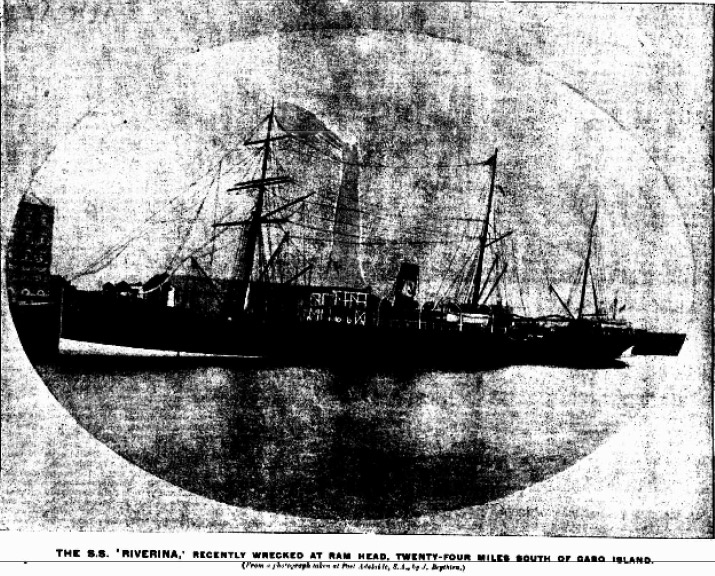
One of the more profitable ships the Dents bought was the S.S.Riverina, a three-masted screw steamer of 2801.0 (imperial tons),
27 January 1 am - In hazy conditions bought about by bushfires in Gippsland, the Riverina was running at full speed when she ran ashore onto Island Point east of Cape Everard. The shock from the impact was terrific and came without warning for the passengers. The forward lookout screamed out a warning " breakers ahead" and despite the captain putting the steamer into full astern, she struck almost immediately. The captain tried in vain to reverse the steamer off the rocks by putting her into full astern but the steamer was stuck fast. The ships carpenter sounded the hold and found water rushing into the engine compartment and number two hold. Captain Prehn ordered the boats to be lowered taking the passengers safely away from the ship which was found to be stranded 150 yards from shore. The crew set about making a makeshift camp with food and water for the frightened passengers. Signals of distress were fired and soundings were taken around the vessel, finding 12 feet aft. The ship's officer was dispatched in a boat to intercept any passing vessel and give them notice of the stranding. The steamer Wendouree arrived at the scene at noon, some of the passengers were safely taken onboard and she set sail for Sydney.
Despite the ship resting in a very exposed position she was still stable and standing on an even keel. This allowed salvage teams to recover much of her cargo. She weathered a storm during her time ashore and came through relatively unscathed, allowing the salvage work to continue.


The Auction.
14th February 1890 - There was a large attendance at the John Fraser and Co.'s rooms when the wrecked steamer was put up for auction. There was an estimated 400 tons of cargo still on board and the biddings commenced as 500 pounds and increased by 50-pound bids in rapid succession until the vessel was knocked down to Mr Dent for the sum of 1050 pounds.
Recovery.
27 February - Mr Dent arranged for the steamers Trident and Sophia Ann to head to the Riverina which was still upright and intact despite the recent heavy weather.
28th February - The steamer Sophia Ann arrived at the scene but due to very poor weather had to run for shelter back to Eden where she stayed for a few days. She was joined by the steamer Trident, and in calm weather arrived at the scene of the stranding together.
Dent and his team of workers quickly went about their business recovering a large quantity of cargo. He carried with him a powerful portable boiler and engine which was put on board the Riverina to facilitate the lifting of the heavy machinery which was submerged in 12 feet of water but could be seen at low water. Three divers had to feel their way in the discoloured water to secure the machinery and the cargo which was submerged in the vessels hold.
The only cargo remaining dry were cases of currents and some vinegar. With Sophia Ann alongside the men recovered valuable winches, anchors, chains, sails, and other furnishings.
The ship was badly damaged, immediately under the stokehold was a large hole through which Captain Laidman says " a Sydney tram could go through."
The weather co-operated allowing Dent and his men to make good progress. They had to work as quickly as possible to recover as much as they could, should a severe southerly storm develope, the vessel could break up. The decks of the ship had not sprung and she was still upright but moved about in an unnerving manner whenever a strong wind from the south blew.
The Dents investment was paying off.
After everything of value was salvaged the vessel was abandoned becoming a total wreck.

18th March - Marine Board Enquiry.
The board found the wreck was caused by the wrongful act of Captain Prehn. His certificate was suspended for six months.
The vessel had on board a cargo valued at £32,000, fully £20,000 of which is insured in Sydney offices, as follow: — Australian General £6000 - Alliance Marino, £5000; Pacific Company, £1800; Sydney Lloyds, £3000 ; New South Wales, £600 ; China Traders, £400 ; South British, £200 ; North Queensland, £1200, and the remainder in other offices
Continue reading about the Dents.
12 April 2019
HMAS. Canberra
We were sent these amazing images onboard HMAS Canberra taken shortly before she sailed for duties in Shrilanka, India and beyond.
The helicopter featured is a Sikorsky Seahawk. The Seahawk can handle anti-submarine warfare (ASW), anti-surface warfare (ASUW), naval special warfare (NSW) insertion, search and rescue (SAR), combat search and rescue (CSAR), vertical replenishment (VERTREP), and medical evacuation (MEDEVAC).


I recently designed and fitted an emblem to the side of the helicopter at HMAS Albatross.
Each helicopter crew has their own insignia, this one fly's under the insignia "Warlock."
 |
| Drawn and finished - Rob Slater 2019 |
9 April 2019
Large Steamers - Small inconveniences - 1858
Timing and patience were a necessity in days gone by.
The first steamers to ply the south coast were relatively small nimble craft. Their small size and shallow draft helped when crossing the shallow basins and rivers mouths where sand bars often created problems for the larger vessels.
The south coast between Sydney and Moruya was developing quickly driven by agriculture, the mainstay of most rural communities, but times were changing, other industries, tourism, coal and the blue metal trade were beginning to develop driving the need for faster larger ships along with better port facilities to service the growing fleets of shipping companies like the Illawarra Steam Navigation Company. (ISNC) that serviced the south coast of New South Wales, from 1858 to the early 1950s. They carried livestock and passengers and became know as the "pig and whistle line."
Robinson Basin at Kiama opened in 1876, became an important port of call for the new steamers. The excavated stone from blasting the basin was crushed and used for road construction and set into motion the development of the blue metal industry in the Kiama region, which still exists today.
Belmore Basin at Wollongong was another important port south of Sydney. The smaller easily manoeuvred shallow-draft steamers suffered less trouble entering the basins and the rivers. The Crookhaven, Clyde and Moruya rivers all posed a challenge for the coastal steamers.
The Illawarra Steam Navigation Company almost having a monopoly on the south coast shipping industry commissioned larger ships capable of carrying more cargo and passengers. The larger, faster more stable steamers could accommodate passengers in greater comfort making sea travel a quicker, pleasant option for reluctant sea travellers.
515-ton were examples of large steamers performing a weekly service along the south coast of NSW.
 |
| Paddle Steamer S.S.Illawarra (11) 533 tons and 190 feet in length |
 |
| S.S.Bega - 567 tons |
 |
| S.S.Kameruka - 515-ton |
The passage south.
Passengers leaving Sydney could enjoy a perfectly calm voyage with little or no swell. Arriving at the entrance of the river all could appear calm and apparently easily negotiable, only to be greeted by the "stand-off" signal flag displayed on the flagstaff of the pilot station positioned near the entrance of the harbour. The vessel was then bound to standoff, and wait until the pilot considered the entrance safe to enter, this came about simply because the vessels arrival coincided with low tide. The vessel had no option but to wait offshore, or as more frequently happened continue on to the next port or seek shelter and wait for hig tide. The reverse was true when the steamers tried to leave the river mouth. The shifting bars caught many steamers in there grip.
Experienced captains would if possible time their arrival for the high tide, sometimes waiting at Wollongong or Kiama for up to three hours, which was preferable to tossing about in the swell before leaving for the Crookhaven. If a berthing position wasn't available they would be forced to continue their journey. Vessels sometimes anchored in Shoalhaven Bight to await the tide change.
Other vessels arriving at the Crookhaven and seeing the 'standoff" signal would continue on to Jervis Bay where they would spend the night anchored in the calm and protected waters near Hole in the Wall. On the most part, it is reported the inconvenience was treated with good humour, especially when the men on board indulged in fishing, with many good catches of snapper reported. Once the tide changed they would continue their journey back to the Crookhaven.
A myth surrounding this story has the Crookhaven Station pilot, Captain Craig, only allowing steamers to enter after passengers and crew had caught a certain amount of fish. Of course, this was pure coincidence.
Another benefit of the delay, a fine haul of fish for friends and family patiently waiting at Greenwell Point.
Dredging and building breakwaters went someway to relieve the problem, but over a short time, the ever moving sandbars returned, the problems for the ISNC, the steamer captains, and their passengers would once again require patience.
1883 - the ISNC steamer Illawarra was frequently detained in port for hours waiting on sufficient water to enable a safe crossing of the Crookhaven bar, the wait on a swaying vessel caused many passengers, men, women and children to suffer seasickness. The situation was becoming unbearable for local business people and travellers who were forced to rely on one or two bar-bound steamers to conduct their commerce. The situation motivated local businessmen to push the Minister for Works to urgently extend the railway line from Kiama to service the people and industry of the south coast.
There are many examples of steamers caught on the sand bars at Crookhaven Heads, I have listed many in a previous post - Continue reading.
By 1895 newspaper reports under the heading "Bar Harbours" appeared showing the current soundings at many bars along the east coast.

Moruya.

By 1912 despite constant dredging by the Public Works Department the problem at Moruya was so bad and dangerous, the Illawarra Steam Navigation Company stopped all passenger service to Moruya landing all passengers at Batemans Bay. They started
a motor car service delivering passengers between Batemans Bay and Moruya leaving the bar crossing to cargo steamers only.
The situation still goes on today, the steamers and manned south coast pilot stations have all but disappeared, small and large pleasure craft still have to treat any bar crossing with care and respect.
2 April 2019
Leaving Jervis bay
 |
| Rob Slater - April 2nd 2019 |
 |
| Rob Slater - April 2nd 2019 |
1 April 2019
Whaling Jervis Bay
As can be seen from this short and not complete list of whaling ships which came into Jervis Bay, the bay was at one time a very busy location for the whaling industry.
1870 - The Hobart Town Barque Alladin towed two sperm whales into Jervis Bay to secure the blubber and boil down.
1871 - The barque Othello cast anchor with 65 tons of sperm oil. She took a 10 sperm whale off Jervis Bay two day before anchoring in the bay..
1871 - The whaling barque Metaris came into the bay to try out a large sperm whale.
1871 - The American whaling barque Eliza put in to Jervis Bay for water. She carried 1400 barrels of oil.
1872 - The Sydney whaling barque Metaris, had been at sea for 10 months before putting into Jervis Bay to recruit. She had sixteen tons of sperm oil.
1872 - The whaling barque Waterwitch put into the bay to recruit. She carried twenty tons of sperm oil.
1872 - The barque Alladin put into the bay, she carried twenty tons of sperm oil.
1872 - The American whaling barque Asmanby has put in to recruit. She has been twelve months out, and has 700 barrels of black oil and 300 of sperm oil.
1872 - The whaling brig Louissa, 5 months at sea put in to recruit with 5 tons of sperm oil.
1872 - The barque Sea Shell towed two sperm whale into the bay for processing, they had been caught thirty miles off the bay.
1872 - The American whaling barque Three Brothers put into the bay to recruit, with 1400 barrels of sperm oil aboard.
1872 - Melbourne whaling barque Mary Hamilton 3 months at sea put into Jervis Bay to repair a lost bowsprit, she carried no oil.
1872 - The brig Velocity, four months at sea put into the bay with 4 tons of sperm oil.
1873 - The brig Velocity put into the bay to recruit. She reported green water and drift wood eighty mile offshore.
1873 - The Whaling barque Runnymede, 9 months at sea, put into Jervis Bay to recurit. She carried nine tons of sperm oil.
1873 - The barque Waterwitch put into the bay, fourteen months at sea, she carried 14 tons of sperm oil. During the voyage crew member Joseph Williams from Hobart, he fell from aloft and was instantly killed.
Continue on to more information about the whaling industry in Jervis Bay.
Huskisson

Owen Street Huskisson, The last building on the left was the original Huskisson Hotel. There was no problems with traffic in those days.

29 March 2019
Cattle Steamer S.S Anerley 1900

The advent of steamers meant larger hauls of livestock could be transported over longer distances at quicker speeds. In Australia, sheep and bullocks were transported long distance across the oceans of the world. Australia had strict regulations to ensure the safe passage of animals, bullocks being the biggest trade were either tethered to the deck of the vessel or held in wooden stalls in the hold.
On average losses of stock on long trips were relatively low, but long overseas voyages could result in cattle arriving at their destination in an appalling condition, this affected the price the investors would get for their stock, sometimes investors lost money.
Loading and unloading livestock could be a challenge in itself. The better ships and wharves were set up with ramps, giving relatively easy access onto the ship, others slung the beasts on and off the ship using overhead cranes. Where the dock facilities were inadequate or non-existent the vessel would stand offshore, the cattle were hoisted over the side into the water then swim to shore. The success of this method often relied on the health of the animal, drownings were common, others were taken by sharks attracted by the activity.
Many things influence the welfare of the stock, their condition at the time of loading, how many were carried, the distance they were transported, by far the biggest factor which could affect the health and safety of the animals was the weather.
The following story is about the struggle of one ship against the ferocity of nature, the survival of the vessel, the crew and the stock rested on a knife edge for 4 long days.

The weather was fairly good.
May 25 - Spirits must have been high for Captain Robertson and his crew as they cleared Newcastle harbour bound for South Africa, The 1887 ton steamer Anerley was almost new and fitted with the best equipment. The weather was fine and the ship was fully laden with some of the finest cattle in Australia. Not far into the voyage the mood quickly changed. A strong southerly gale and what was described at the time as a " strong hurricane" engulfed the vessel. The seas rose quickly threatening to sink the ship and all on board, it was so bad she rolled from side to side almost rails under. Captain Robertson put her head into the teeth of the gale and reduced her speed, although scarcely moving ahead, great volumes of water thundered over the forecastle and deluged her fore and aft.
She carried 10 tons of fodder, a hull laden with coal, and 330 head of cattle tethered to her decks and in pens below, most of them of the very best stock. Each time a sea came onboard the beasts on deck were carried, with their fittings, either along the deck smashing into the ship's machinery or over the side of the ship, dead cattle were strewn across the ship. The noise of the violent storm was overlaid with the sounds of the death groaning, the moaning, and the sickening, piteous outcries of helpless beasts.
 |
| The depiction of a scene such as the Anerley must have experienced. - Amazon. |
May 27 - The hurricane showed no signs of abating, the steamer still drove her nose into the oncoming swell, each approaching mountain of water threatened to engulf her. Dead and maimed bullocks lay about the deck in heaps, but still, nothing could be done. Barely a dozen of the original consignment held their footing. As night approached the stench from the hold ventilators was so terrible the officers could hardly remain on the bridge.
With the decks awash with constant water, much of which was finding its way below. Captain Robertson directed his crew to batten down the holds which had been left open for ventilation for the poor beasts below. Battling hurricane force winds, mountainous seas and a steeply pitching deck while fighting the fear of being washed overboard or crushed by untethered bullocks at any time, these tough men strained to lash down the hatches. This action exasperated the blight of the animals in the hold, dashed about in their wooden pens suffocating in the thick air, one can only feel pity for the terror these animals suffered.
Out of 330 animals, only 65 remained alive on board, and these were by no means in good condition. In their endeavours to save the animals and the ship from disaster Captain Robertson and his crew were exhausted with anxiety and fatigue. They could have scarcely held out much longer.
The long slow haul down the coast now found the vessel standing off Jervis Bay where she signalled to the Jervis Bay Lighthouse keepers that she had lost a large number of bullocks overboard.

May 28 - The weather moderated and the hatches could be taken off, revealing a revolting spectacle below, a stench absolutely overpowering arose through the open hatches. Carcases of beasts lay strewn about, timber stalls were broken and scattered like matchwood. The moderating weather allowed the captain to enter the sheltered waters of Jervis Bay. During this ordeal, the Anerley had only travelled 140 miles at the rate of a knot and a quarter an hour. The news of which shocked the shipping industry and could hardly be believed.
This gives us some insight into the extreme conditions the ship and crew faced.
During the ordeal, Captain Robertson tried in vein three times to reach the safety of a port, but the conditions were so bad he was forced to keep the ships head toward the sea for fear of foundering.
After a nights rest the steamer left the bay and headed for Williamstown, the crew cleared her decks and hold of the carcases on the journey, arriving on the following Saturday, two hundred and sixty cattle had been cast overboard. Sitting alongside the wharf, the Anerley attracted a lot of attention from onlookers, she was a sorry sight, displaying all the signs of a fierce battle against the elements.
"As the vessel lies at Williamstown pier she does not look anything like the taut and trim steamer she did when she left Newcastle, almost new on Friday week."
"In the history of cattle shipping, it has rarely happened that such a disaster has overtaken a vessel off this coast."
Unlucky steamer.
June 7 - After the experience of almost losing the ship and the dreadful loss of cattle, you wonder how these men could put back to sea. But shortly after arriving in Melbourne, repairs to her holding pens was carried out, the Anerley's hold was loaded with horses and cattle and coal and she set off for South Africa, when she arrived in Durban news was received that 210 animals had been lost on the voyage. Another disastrous voyage for the Anerley, her owners, and the poor creatures involved in the live animal trade.
1904 - Steamer wrecked.
The steamer Anerley, owned by Messrs. Watts, Watts, and Co., had been trading to Japan for some little time, she went ashore on a voyage from Japan to Fusan, and became a total loss.
Continue reading about dead cattle strewn acroos the shore of Jervis bay.
Continue reading about the terribel ordeal of the Ship City of Melbourne and the loss of prize race horses.
26 March 2019
Ships in the bay – HMAS Brisbane (III)
As the sun rose above the horizon the soft hazy silhouette of a large warship could be seen approaching Jervis Bay, with the training ship Sycamore moving across the bay in the foreground.
 |
| Photo Rob Slater 2019 |
 |
| Photo Rob Slater 2019 |
HMAS Brisbane (III) continued to make some quick turns as the two smaller craft weaved around the ship. I had seen this type of action before and was told by navy personel they were conducting defensive exercises against attack from small vessels.
 |
| Photo Rob Slater 2019 |
Her last turn was an impressive site, she laid right over as she powered through a tight 180-degree turn. Shortly after, the small vessels left for HMAS Creswell and Brisbane continued crisscrossing the bay at a more leisurely pace.
 |
| Photo - Rob Slater 2019 |
A friend of mine who served as a stoker during his career in the navy told me of the excitement felt onboard as a large warship did sharp turns under full power.
Continue reading about HMAS Brisbane(III)
Subscribe to:
Posts
(
Atom
)