 The old boat frame arriving at Lady Denman Park. The old boat frame arriving at Lady Denman Park. John Hatton secured the frame from a boat builder in Batemans Bay. Originally housed under cover in the Settree Boat Shed it had to make way for the Crest Restoration project and today it stands in the open alongside the old boat shed. This old frame gives you an insight into the process that goes into making a boat. Hopefully once the Crest if complete this old frame will again find some shelter from the elements.. |
 |
| Present day. The blackened area on the bow was caused by the 2001 Xmas Bushfires that ravaged the area…….The old frame was lucky to survive… |
 |
| |
.

8 July 2016
Yesterday and Today


Aberation of Intellect
| As reported in the South Australian Chronicle and Weekly Mail 14 Feb 1880. |
 |
 838 gross tons, 615 net. Lbd: 251'4" x 28'3" x 16'6". Iron steamship, 3 masts Barque rigged, built by J & G Thomson of Govan, Glasgow for the ASN Co. Designed as a passenger vessel, carrying 194 in two classes on the Australian coastal run. |
| |
5 July 2016
Whaling Jervis Bay.
| These small pieces of information are important insights into the movement of steamers into and out of Jervis Bay. |
| |
| |

4 July 2016
The plight of the mariner.
 A typical Barque – a public domain image. A typical Barque – a public domain image.1875 the “good” ship Indus. Setting sail and leaving the safety of the harbour for the open sea must have been quite an amazing experience. The early sailors had to have trust in many things, the captain they would hope had the experience and knowledge to get them to their destination, they would have to have faith in their vessel to be able to handle extremes in weather that could push the limits of man and equipment. How bad a condition must a vessel be in to make sailors refuse to go to sea. January 12th 1875. The Indus left Newcastle port laden with coal for Dunedin, around Nobby’s Head she was becalmed and with no wind to drive her windmill the pumps failed to relieve her of the water now seeping through her hull, as a consequence she returned to port for repairs. January 13th 1875. Four seamen off the Indus were sentenced by the courts to eight weeks jail with hard labour for refusing to go to sea , alledging she was unseaworthy. February 20th. News was received from Captain Mc’Coll that the “ Indus had gone down south of Jervis Bay, all crew were saved”. In this case the opinion of the crew members that refused to go to sea appears to have been justified. As reported by the correspondent from the 1875 Newcastle Chronicle. |
 |
| But the final word must go to the correspondent from the Morning Bulletin. |
| |
| |

Back to the elements
| I have been watching this old boat in amongst the mangroves on Currambene Creek for the last couple of years slowly being reclaimed and dissolved back into the natural elements from which it was made. |
 |
| I took the photograph below a few weeks ago, the basic structure had broken up, there was not much left. |
 |
|
|
| Today the remains have completely disappeared. The recent high tides have broken up what was left into small pieces and distributed them across the mud flats never to be seen again.. |
| |
Ships Compas
| This beautiful fluid compas is one of the may items in the museums collection. |
 |
| |
1 July 2016
Samuel Elyard Painting.
| A beautiful watercolour of the Cape St George Lighthouse by Samuel Elyard in 1871. |
 |
| Continue reading. |
| |
30 June 2016
East Coast Low - 1974
| In a previous post we covered a devestating East Coast Low that formed off the coast in 1974 named the Sygna Storm” Named after the 53,000-tonne Norwegian bulk carrier Sygna that went aground near Newcastle.. |
| The first amazing shot shows the wall of water reaching higher than a telegraph post smashing on the reef that lays just in front of the wall. Richard Quinn … “The photograph was also taken looking down from the quarter deck aprox 50 ft above sea level, so it’s anyones guess how big the sea was”… |
 |
| The photograph above show us the aftermath of the waves intrusion. The photograph is very similar to the recent photographs of the June storm damage to the base sent to us by Paul Newman. |
| Thank you Russ for sending us these incredible photographs. |
| |
Huskisson - brisk winter morning
| A lone fisherman walks beside the breakwall hoping to catch his breakfast. While a catamaran heads out of the creek and into the morning sunrise. |
 . . |
| . |
| |
29 June 2016
Cape St George Light House
http://jervisbaymaritimemuseum.blogspot.com.au/
| The vegetation that usually obscures your view of the ruins from where this photograph was taken was totally burnt out in 2006 as bush fires ravaged Booderie National Park, the charcoal rendered coastal heath yeilds a rare view of the ruins. |
 |
| Click Here - Further reading about this once magnificent lighthouse and the controversy surrounding it’s location. |
 |
| |
Whale Tail–Wreck Bay
| Whale season is upon us and if you are lucky enough to be near our beautiful coast especially near wreck bay, you are more than likely to have a close encounter or two. |
 |
| Migrating whale “tail slapping” with Pidgeon House mountain in the background. |
| |
27 June 2016
Old buildings of Huskisson.
| Bessy Stewart tea room, Owen Street Huskisson – Later turned into the first chemist shop in Huskisson. |
 |
| |
Museum Artifacts.
| Here are just a few glimpses of some of the items in the museum’s collection that aren’t on display at the moment. |
 Head of a whale harpoon, launched from a harpoon gun. Head of a whale harpoon, launched from a harpoon gun. |
 Detail of the the firing mechanism of a hand held rifle used to launch small harpoons. |
 |
| Tip of the bomb lance from the gun above. |
 |
| Flight from the bomb lance above. |
 The gun is very heavy and I should imagine would produce quite a kick on firing. The gun is very heavy and I should imagine would produce quite a kick on firing. |
|
Bomb lances were introduced with shoulder guns to solve the problem of getting close enough to a whale to lance it, particularly in ice fields, and eliminate the often hazardous hand lancing operation. |
| |

24 June 2016
S.S. Koonya - seeking shelter in Jervis Bay.
| The Koonya was a wood carvel screw steamer built in 1887 at Hobart. The vessel Koonya was placed into weekly trips between Sydney and Moruya. The vessel had a relatively uneventful life till her shaft broke off near Jervis Bay on the 10 June 1897. She was towed into the bay by the steamer Murray during the night. It took approximately a fortnight till the vessel returned to her regular journeys. |
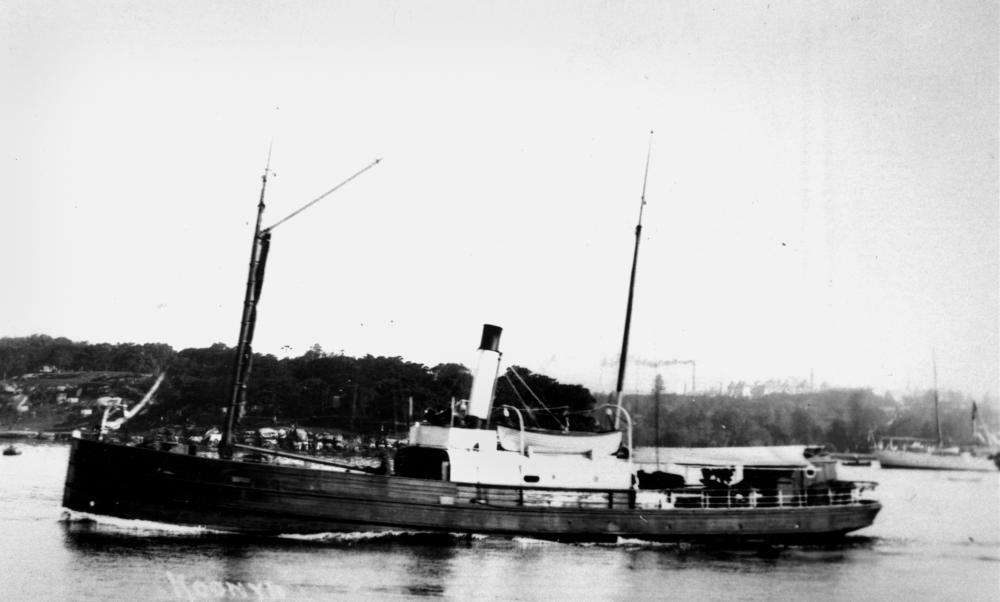 Public Domain Image. |
 |
|
|
| Eventually her luck ran out. |
| The Koonya was wrecked on January 25th when it struck Doboy reef off Cronulla Beach, Port Hacking whilst carrying passengers & cargo between Moruya and Sydney. |
 |
| Public Domain image. |
| |


23 June 2016
Owen Street Huskisson. 1916
Originally thought to be the same house, we have had and interesting email from "Dee Boys" adding to our information... |
 |
| Jess Rossen House Owen Street Huskisson 1916. |
 |
| . |
 |
| |
21 June 2016

Subscribe to:
Posts
(
Atom
)