.

.
HOME OF THE LADY DENMAN - Local history isn't always about the big story - the everyday story of life in the early development of the region can be a fascinating, entertaining and educational journey.

5 October 2017

On this day 1911

The Royal Australian Navy officially came into existence.
 

The announcement that Australia was to have its own navy would have a significant impact on Jervis Bay.  During the 1840's  the bay was best known as a port for exporting wool from the highlands.  South Huskisson ( present-day Vincentia) grew into a bustling town with hundreds of people involved in the wool trade.  Ships called into the bay and were loaded with wool transported by bullock teams on the newly constructed wool road connecting Jervis Bay with the interior.  Jervis Bay was finally becoming what many had wanted and predicted, a centre for industry.   Around 8 years later the boom had finished and South Huskisson had almost completely disappeared back into the bush with little evidence any sort of town ever existed.   The bay had once again slipped back into a slow-moving sleepy district, best known for a small shipbuilding industry based at Huskisson. 


Reliable transport to Sydney had always held back developement around the bay,  the announcement by the government Australia was to have its own navy and shortly after would build the Royal Australian Naval College at Jervis Bay thrust the Bay into the headlines once again.  Jervis Bay had now become a major focus for the navy and the rest of Australia.

Before Federation in 1901, five of the six separate colonies maintained their own naval forces for defence. The colonial navies were supported by the ships of the Royal Navy's Australian Station which was established in 1859. The separate colonies maintained control over their respective navies until 1 March 1901, when the Commonwealth Naval Forces were created.  Originally intended for local defence, the navy was granted the title of 'Royal Australian Navy' in 1911 and became increasingly responsible for the defence of the region.
Ref:https://en.wikipedia.org/wiki/Royal_Australian_Navy

1901 - There were moves by the Commonwealth Defence Authority to establish an Australian navy.

In the years following 1901 there was much discussion from supporters and the opponents of the scheme.  The controversy revolved around the costs involved in Australia establishing and maintaining its own Navy. 

1903 the Australian Government paid an annual contribution to the Royal Navy of 200.000 thousand pounds for an auxiliary squadron.

1909  -  Since the Defence Conference of 1909 Australia had gone steadily forward with a definite and progressive naval policy.

1909 – It was clear Australia was to have its own navy when the Federal Government ordered two torpedo destroyers and to have a third constructed in Australia.


image
image
HMAS_Parramatta_1910

HMAS Parramatta.


"When they arrived in Australia in the destroyers Yarra and Parramatta, the men of Australia's nucleus fleet wore the distinctive letters 'H.M.A.S.' to show that they were of His Majesty's Australian ships. The designation has received official sanction at the hands of the King, and the High Commissioner has received from Downing street a letter covering a dispatch from the Secretary of State for the Colonies, to the Governor-General, to the effect that His Majesty has been graciously pleased to approve of the naval forces of the Commonwealth  being designated the Royal Australian Navy  and of the ships of that navy being designated his Majesty's Australian Ships. Following this arrangement, It is added, ' the citizen naval forces of Australia will receive the official title of the "Royal Australian Naval Reserve".

yarra-01

H.M.A.S Yarra

1912 -  A circular was sent out to all state premiers informing them of plans to establish a Royal Australian Naval college and facilities thereby afforded to boys between 14 and 16 years who are desirous of following a maritime life.

1912 – Recruiting for the navy was temporarily suspended owing to lack of accommodation at the Williamstown training depot. The permanent establishment at Williamstown was 88 men.

1913 - Following indecision and controversy work began to build the
Royal Australian Naval College at Captains Point Jervis Bay which was officially opened in 1915..

image


The rise and fall of South Huskisson – Continue reading.


image


3 October 2017

Battling a storm off Cape Horn in the Barque Peking 1929.

This incredible footage was taken by a sailor aboard the 4 masted barque Peking as she rounded Cape Horn during a storm. It gives you a dramatic insight into the difficulties ships and their crews could deal with in the course of their life at sea. 

Tremendous storms were often encountered by ships travelling along the south-east coast.  Looking through this blog you will find many stories about ships, crews and passengers fighting for their lives battling monstrous seas stirred up by hurricane-force winds


The Peking Battles Cape Horn was filmed by Captain Irving Johnson in 1929, & was voiced over by him in 1980.


image

On this Day Jervis Bay 3rd October 1913


In what must have been an impressive display the first fleet of the Royal Australian Navy comprising the flagship H.M.A.S. Australia and her sister ships Sydney, Melbourne, Encounter, Psyche, Cambrian, Parramatta, Yarra and Warrego assembled in Jervis Bay for final preparations before their journey to Sydney to steam into Port Jackson as part of Fleet Week.

HMAS_Australia_1914
hmas sydneyHMAS_Melbourne_(1912)_-_Project_Gutenberg_eText_18333HMAS_Encounterhmas PsycheHMS_Cambrian_1910_AWM_302155HMAS_Parramatta_1910yarra-010002


image

28 September 2017

Wreck of the Martha and Elizabeth May 1855.


There are many shipwrecks in the Shoalhaven area, some have a story to tell while others leave us in wonder as to the fate of the ship, crew and passengers.  The people involved in this story found themselves in a rapidly deteriorating life-threatening situation where small decisions and quick actions made the difference between life and death.

The story of the Schooner Martha and Elizabeth is one of heroism, and a great deal of luck. 
The fact that there were no casualties in such dire circumstances is amazing.

As you read the story try to put yourself in their situation.   It's pitch black, you trying to stay upright on a twisting, pitching, rolling ship,  all around you the noise of the ship smashing and grinding against the cliffs down both sides of the ship,  timbers are splintering and coming apart around you, the rigging is hanging everywhere,  the ship is quickly breaking apart.   The fearful shouts and screams from the passengers trying to be heard over the sound of crashing waves engulfing the ship, the captain shouting orders to his crew, the wind-driven rain against your exposed wet and cold skin.  These people were in a desperate struggle for survival.

The schooner Martha and Elizabeth under the command of Captain Anderson was on a voyage between Melbourne and Newcastle when she ran into difficult weather and currents
close to Jervis Bay.


April 26th -  At 5.30pm. nearing Jervis Bay they sighted Cape St George,  the wind at this time was variable from the S.S.E, with rain and thick weather, Captain Anderson steered the vessel N.E by N. 

7.30pm - The wind was variable, with heavy showers and the current setting was very strong to the southward.

8.pm - Captain Anderson found the current setting put the vessel down upon Point Perpendicular, he immediately tacked to the southward.

8.40pm - Finding the schooner would not fetch the south-head of Jervis Bay, on the port tack, the captain tacked to the N.E.

8.50pm - At this time all was calm,  but, the vessel was setting in fast to the breakers with a heavy swell from the eastward. 

9.pm - Finding the vessel close to the cliff,  with no possibility of saving her, they cleared away, and launched the boat but owing to the heavy ground swell the boat filled and parted from the ship with one hand,  Robert Jellicar in her, but he, fortunately, caught a rope  and was saved by hauling him over the stern of the schooner.

9.30pm - the vessel came stern on,  the main boom struck the cliff and she parted amidships.  the vessel payed around to starboard and was driven into a gully in the cliff just large enough to admit her lengthways. Upon entering the vessel struck instantly abaft,  the sea breaking furiously over her. 
Finding she could not last many minutes they endeavoured to get a line ashore by means of a small grappling.   Finding the grappling would not hook the rocks one of the hands R. Jelliear,  got footing by swimming from the stern,  while another,  John Rogers,  jumped from the bowsprit, which instantly afterwards parted from the vessel.  The remaining hands, with the captain's wife and sister, had robes slung around their bodies and hauled ashore by those ashore,  the captain was the last to leave the vessel. The crew and the captain's wife and sister had scarcely any clothing,  and not a shoe to their feet. They had scarcely secured a footing on the slippery rocks when the vessel broke up.

11.pm. - The vessel had broken into small pieces.  After some searching in the dark, they found a small ledge in the rocks where they all assembled for the night.  It was intensely cold, with a strong easterly wind and incessant rain throughout the night. 

April 27th.
First light revealed a desperate scene.
 
- The survivors could see nothing of the Martha and Elizabeth other than some small pieces of wreckage,  nothing could be saved.

Assending the cliff
. They found themselves at the base of steep cliffs, they now had to find a way to the top,  which they did with great difficulty.   The area they were in was isolated with no help close by,  to make their way to the Shoalhaven they had to contend with thick high scrub trees and in some places wade through waist-high swamps.   Having no shoes and scarcely any clothes made the task more painful.  After walking about 18 miles they had the good fortune to come across Mr Kinghorn's whaling station.   Captain William Kinghorn set up a land based operation on the northern side of the bay near Montague Point on the Mount Jervis property belonging to his father Alexander Kinghorn.  How long the station remained in operation is unknown

They remained with Captain Kinghorn for the night and were kindly treated.

image

Captain Kinghorn.


28th April - The party proceeded to the Shoalhaven where they were heartily made welcome by Captain Noel,  of the steamer Nora Creina, and received from him a passage to Sydney.

30th April - After an uneventful trip, the party arrived in Sydney at about midnight, they were most grateful for their lives and to those from whom they received so much kindness.

An amazing story!.


Specifications: Martha & Elizabeth. Schooner, 81 tons. Built Clarence River, 1843; reg. Melbourne, 277/1854. Length 67 ft. Operated in the timber trade off Wilson's Promontory in the 1850s.

                         Nora Creina 142 gross tons, 93 net. Lbd: 133'7" x 18' x 7'7". Iron paddle steamship built at the Neptune Foundry Waterford Ireland for the Commercial S N Co., Waterford. 1853 owned by A G Robinson, Sydney. 1854 purchased by the Shoalhaven S N Co., Sydney and worked the Sydney - south coast ports of New South Wales as a passenger - cargo vessel. February 1857 of the unofficial Illawarra S N Co. (read - Kiama S N Co) Sold 1861-2 to Far East interests. Wrecked October 1849

Meaning: Abaft - in or behind the stern of a ship.

Ref: https://www.flotilla-australia.com/iscsnco.htm


image


Huskisson then and now.

40-Huskisson-Wharf-c

Huskisson-Wharf-2017

An interesting comparison, the top photograph was taken circa 1929, the bottom photo was taken September 2017.


image

Huskisson 2017

As summer warmth approaches getting up early is becoming easier. The rewards for the early risers is well worth the effort.

Untitled_Panorama3
IMG_3085a


image

21 September 2017

Hole in the wall - through the ages.

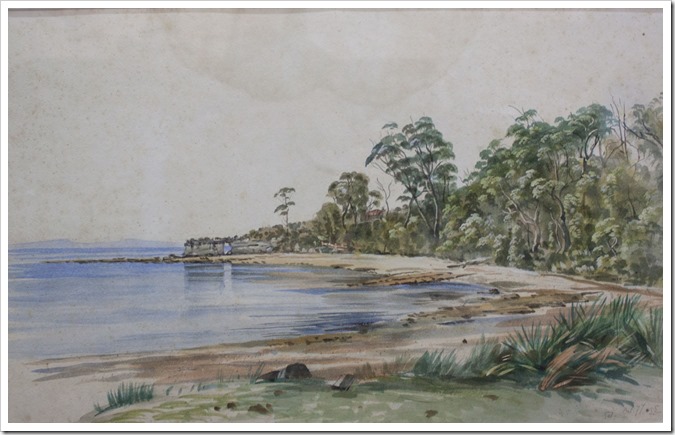
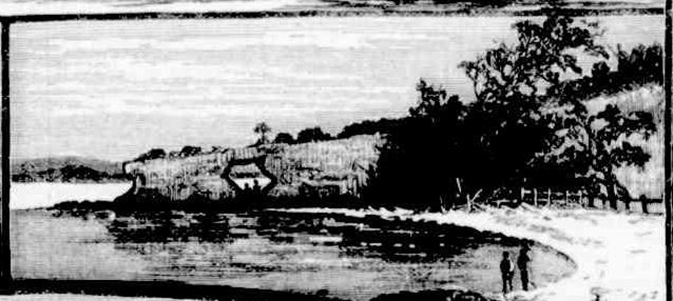
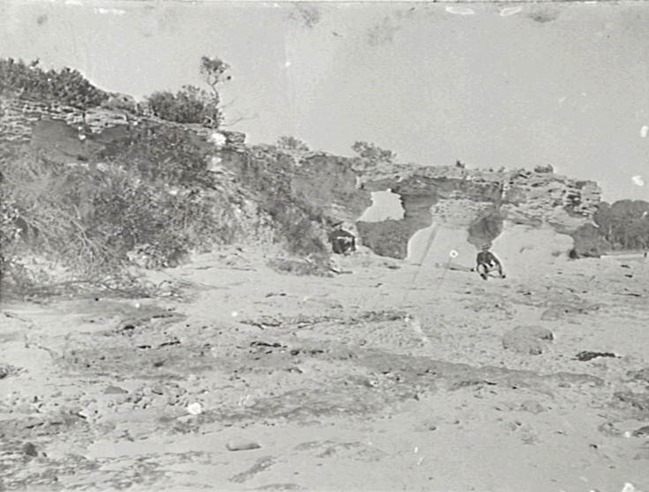
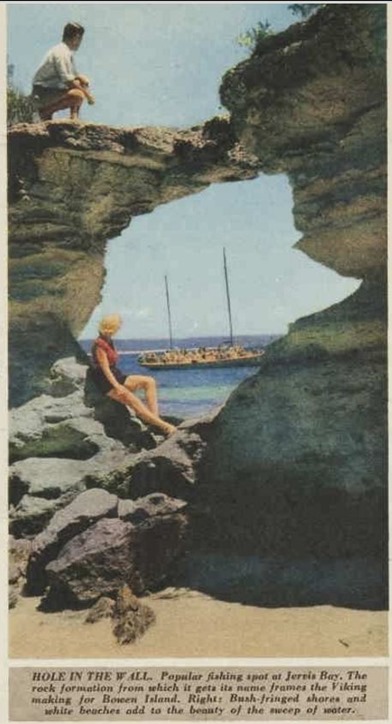
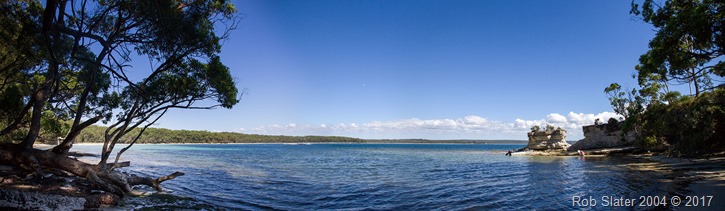
  "Hole in the Wall" is located at the end of the beach near Scottish Rocks. This natural sandstone structure inspired artists and photographers from the time it was first discovered.  The area was first described by early sea explorers as a safe, protected place for anchorage.  Early writings speak of the locations clear water, flat sand bottom and sweeping high headland creating a natural barrier against strong easterly or southerly gales.  Hole in the Wall has been depicted in historical paintings from the very earliest days of exploration.  Unfortunately, the top of the sandstone structure collapsed in the 1980's leaving a U shaped gap.  Some of the romance of the area has been lost but not the beauty or its importance to mariners.


airial

9002_Jervis_Bay_de_Sainson_Louis_Auguste

Painted by Louis Auguste de Sainson in 1826.
Described as - The Astrolabe, moored in nine fathoms, fine sand and shells, three cables
from the beach at Hole-in-the-Wall.

samuel-elyard


Samuel Elyard painting – 1840's

image
As depicted in an article in 1883.

188-Hole-in-the-Wall
Early 20th Century

hole in the wall2

Early 20th Century   

hole in the wall

Early 20th Century

hole in the wall 1953
Australian Womans Weekly 1953

Visiting the area today you will still see vessels of all description sheltering near Hole in the Wall.

2017

The Ketch Atoll II near Hole in the Wall 2017.

young-endeavour-march-31-2017-at-hole-in-the-wall
Like a scene from the 1900's, the Young Endeavour takes advantage of the protection offered by the surrounding terrain adjacent to Hole in the Wall in 2017.

_MG_6249
2014


image

18 September 2017

On this day–September 20 1930


image

Today marked what may be regarded as the closing of the final chapter in the history of the Royal Australian Naval College at Jervis Bay.

This morning, the Illawarra Company's steamer Bermagui headed for Sydney with the last consignment of machinery and general equipment which will be taken to Garden Island. This afternoon witnessed the departure for the Flinders Naval Depot of the last motor lorry laden with the personal effects of the small party of naval men who remained behind yesterday to complete the

Dismantling and packing.

For several weeks past, under the supervision of Engineer-Commander L. Carr, the huge task of closing down the college has been steadily carried out. At the end of June, the cadets left the college, and after five weeks' leave resumed their training at the Flinders naval depot, and to those who have not had the opportunity of visiting the training school, its magnitude and beautiful surroundings would come as a revelation. Situated on a small headland on the southern shores of Jervis Bay, the college occupies an area of some 300 acres and was virtually a township in itself. Rows of spacious and picturesque cottages, which would be the envy of many city dwellers, stand back from pine-shaded avenues, while others command an uninterrupted view of the waters of Jervis Bay, guarding the entrance to which are the sentinel-like cliffs of Point Perpendicular.

A walk through the college grounds yesterday afternoon conveyed the impression of a visit to a township from which the inhabitants had suddenly fled. Streets and houses which a few months ago had resounded with the cries and laughter of children and the homely clatter of busy housewives were strangely silent. As if to complete the atmosphere of desertion, blinds were drawn at all the windows, while the gardens and front lawns, which only a short time ago had been so proudly and carefully tended, began to show signs of neglect. A fine playing area and parade ground facing the cadets' barracks, known as the quarter-deck, which to naval men are looked upon as the holy of holies, is now nothing more than a grazing paddock for horses. At nightfall, the feeling of loneliness and isolation is accentuated. The faint glimmer of a few oil lamps now takes the place of the blaze of the electric light, which a little while ago shone welcomingly from the windows, the officers' wardroom, and scores of residences.


image

Building the Royal Australian Naval College at Jervis Bay was bathed in controversy from the time it was first announced in 1911 until the time it was finished in 1915.  After the first cadets graduated with many entering World War 1 and going on to have remarkable careers the facility was deemed a great success. Unfortunately, Australia in 1930 was in the grip of the great depression and the college was seen as an unnecessary expense for the nation.  Most of the college was closed with some of the buildings turned into holiday accommodation.  The Navy still used the facility but in a much more limited way.

00864_Uralba.tif

The coastal steamer Bermagui, was built by the Ailsa Shipbuilding Co Ltd, Troon, Scotland in 1912. She was requisitioned for naval service as an auxiliary minesweeper on 30 October 1939 - https://www.flickr.com/photos/41311545@N05/5663926754


The images below appeared in the Australian Womens Weekly in 1953.


playing-golf


womans weekly 1953


click on images to enlarge.


REF: http://www.navy.gov.au/hmas-bermagui
        https://www.flickr.com/photos/41311545@N05/5663926754

Continue reading about The Australian Naval College (HMAS Creswell).


image

On this day.

17th September 1856 –
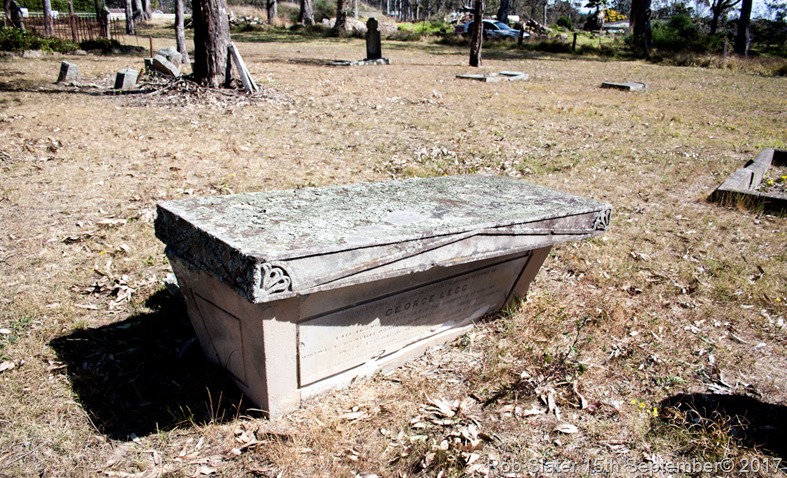
Government Surveyor George Legge was drowned while crossing the Shoalhaven River  The nearby island was named Legge’s Island in his honour.

grave-stone-2017

In a small run down historic cemetery located next to the main road near Worrigee, you will find amongst a few dilapidated tomb stones one that is quite distinctive in its design.
The worn out description carved into the tombstone describes the unfortunate death of a "Mr George Lecc" who accidentally drowned while trying to cross the Shoalhaven river on horseback on the 17th September 1856.

IMG_3005

His name has been miss spelled on the tomb stone, it's actually supposed to read "George Legge". George Legge was a young well respected 24-year old who made a bit of a name for himself by being appointed the Government Surveyor to the Shoalhaven District.

He was responsible for surveying the Sassafras Area in the early 1850's.

He was drowned near Burrier trying to cross the Shoalhaven River on horseback.  At 10 am he was heard cooeing by his friend Mr. J.L. Biddulph, from the opposite side of the river intimating that he was
about to cross the river.  When Mr. Biddulph arrived at the crossing place he saw his friend's horse floating in the river dead, but no sign of the rider.
He immediately procured a boat and went in search of Legge. They continued the search until Friday, when a black fellow, by diving, bought up the body.

The cemetary has a collection of run down tomb stones, many are lying on the ground, some are still standing.

IMG_3007

Some of the other Tombstones.


image


It would seem Mr. Legge was riding a young horse with a martingale, which he neglected to let loose when taking to the water. The Martindale bound the horses head down and drowned him and the rider.

15 September 2017

On this Day 2017

A large fire broke out at Summercloud Bay a few days ago. Pushed by strong westerly winds the fire soon spread right across the southern headland of the bay. Fortunately all campers and workers at HMAS Creswell were evacuated early. At this time no major damage to buildings as been reported. A vast area of the Boogerie National park lays in ashes.
I took this photo this afternoon from Callala Beach showing the extent of the fire.


Untitled-1

image
The extent of the fire today as illustrated by the NSW RURAL FIRE SERVICE web site.
For more details go to.
https://www.rfs.nsw.gov.au/fire-information/fires-near-me


image

14 September 2017

Ships in the bay

KETCH-2017-SEPTEMBER-14-OFF-HUSKISSON

This afternoon a beautiful ketch sat gently swaying back and fourth at anchor out the front of Huskisson.  The strange light was the result of smoke being carried on a stong SW wind from a large bushfire burning near Summercloud Bay in Booderie National Park.

KETCH-2017-SEPTEMBER-14-OFF-HUSKISSON-a


image