.

.
HOME OF THE LADY DENMAN - Local history isn't always about the big story - the everyday story of life in the early development of the region can be a fascinating, entertaining and educational journey.

13 May 2015

Lois Johnson Exhibition

Examples of some of the fine artworks on display in the Science of the Sea Gallery by Lois Johnson.
IMG_9486 IMG_9487
MORE
BACK

Desikoko discovery

graham-Hinton-May-2015
Graham Hinton seen here holding up relics from the Desikoko, discovered in the early 80’s by a father and son while investigating reports by local fishermen who told them of an unknown wreck, the relics were donated to the museum in April.

The Desikoko was built in Huskisson in 1934 by A.Settree and foundered near Newcastle in 1942.

A comprehensive post about the adventurous life of this beautiful ship will be posted soon.

BACK

12 May 2015

Jervis Bay Snippets 1907

 
Shoalhaven Telegraph April 1907.
image

This articles takes us back to a time when simple games and quickly arranged sporting events were enough to keep the population of Huskisson and surrounds happy,  you can feel the sense of community from the article.
      It also shows us how the Dent Family of shipbuilders were diversifying into tourism,  and just how much the people from the district were hoping that the long proposed tram way would eventually arrive at Jervis Bay and bring prosperity to all.

74-Owen-Street,-Huskisson-1920s---a Huskisson main street.


There was to have been a regatta at the Bay on Saturday,  but the strong and treacherous westerly wind caused the owners of the boats some uneasiness,  and finally agreed to postpone the event.

About mid-day quite a crowd had turned up to the wharf - almost the entire population one would think - including many ladies.

There are three boats engaged in fishing at Currambine,  and their crews - as jolly and  "sporty" a crowd as could be found anywhere - provided some amusement.

They matched one another against each other in skiffs,  and someone else against the winner,  until every man had beaten all the others.  Then they repeated the performance in pairs and finished with a boys' race.

"A tarpaulin muster "raised a few  "bob" for a duck and dinghy race.  Jimmy May,  who has been the "duck"  in similar event for years volunteered to keep out of Charlie Ganderton's clutches for 10 minutes.  The chase was very funny while it lasted,  but Jimmy succumbed in three minutes.

An adjournment was made to the tram terminus,  at least where it might be,  and a handicap footrace was run.  Charlie Ganderton was again victorious,  though he just beat L. Dent.

The genial host of the Jervis Bay Hotel then introduced a game for the ladies he said,  but they were a bit shy at first,  though they made warm when they started.  A stick with a shilling on top was the objective,  and the competitors were expected to knock the silver off,  after being blindfolded and turned inside out,  the ladies did well at this,  but Mr Cambourn's chivalry surely let them chance one eye at the shilling.  It was amusing to see some of the attempts,  and everyone was in great humour.

hp1

Jervis Bay Hotel from this time. J. Cambourn Licensee

The regatta will be held on Saturday week.  It's a bad day to expect visitors,  but,  of course,  it suits the fishermen,  and they make the race.  A few field sports might be arranged for the afternoon,  thus filling in the day.

Mr Cambourn in making baths at the Bay.  He has erected a dressing shed,  and with wire netting purposes to make the place perfectly safe from sharks.

With a magnificent sheet of water, sea and lake fishing, oil launches,  sailing boats,  shooting,  oysters,  and excellent accommodation,  Jervis Bay cannot have any superior as a tourist resort.  Messrs Fred and Dick Dent each has an oil launch,  and there will shortly be another available,  in expectation of a good time summer.

Mr Dick Dent has been giving the lobsters a trial,  but they are not to plentiful just now.  He has had some good catches,  and the price paid for them in Sydney makes the game fairly remunerative.

If the tramway idea is carried through,  those people who have property at the Bay will be on a  pretty good wicket.  There are a fairly large number of houses scattered about now,  and it does not seem to much of a strain on the imagination to picture the whole of the land between,  say,  the school and the hotel,  built upon,  and kept going to a very large extent by a tourist trade.

 
BACK

11 May 2015

Kingfisher – Returns home

The story so far.      Extract from information supplied by David Lewis.
The 30 foot fishing boat was offered as a donation to the museum,   recently it was partially submerged at it’s mooring near Gosford.

Built shortly after World War Two at A.W.M Settree’s (Alf’s Father) boat shed on Currambene Creek for the purpose of fishing for kingfish on and beyond Jervis Bay.

Kingfisher has an excellent provenance.  From details of its construction and the men who built her,  through to it’s working history as well as details on all it’s owners which included until recently John Settree,  grandson of the builder.  All major repair work and much of it’s maintenance has been carried out over the years at the Settree boat shed on Currambene Creek.

Apart from the
Crest, currently undergoing restoration in the Settree Boatshed at the Museum,  there are no other vessels with such a long term attachment to Huskisson than the Kingfisher. 

Having recently been sunk up to her gunnels will have had no real effect on the timber hull,  but urgent steps will be taken by a skilled engineer to prevent damage to the engine and gearbox.

The museum and local community are very fortunate to have the Kingfisher donated and returned to Huskisson, and to also have John Settree at hand to give direction and advice and a willing band of hard working volunteers

The Museum would like to acknowledge the hard work done so far by Graeme Kenny in making it happen.

8th-may-2015-j

Graeme Kenny standing on the stern of the Kingfisher Friday 8th May 2015

The work continues and our coverage will follow the progress…
IMG_9200
BACK

10 May 2015

9 May 2015

Moon rise over Jervis Bay

We have had some spectacular moon rises during last week, the moon came up over the horizon as a huge orange ball.  After all the recent rain it’s been a magnificent week of crystal clear skies and offshore winds.
IMG_9089

8 May 2015

Kingfisher returns home

Today was another historic day in the history of local shipbuilding and the museum.
4.30p.m today, the timber trawler Kingfisher arrived securely tethered to a large trailer all the way from the central coast town of Wow Wow.

She has returned not far from the area where she was built by local boat builder A.W.M Settree.
I took a few photo’s of the historic occasion and soon I will supply more details about this hand crafted vessel, and how and why she has returned to Huskisson.

 kingfisher-2015-arriving-at-museum---f

John Settree who worked along side his father Alf Settree and grandson of A.W.M. Settree, building timber boats on the foreshore of Currambene Creek,  can be seen here in blue watching the unloading of the Kingfisher.

8th-may-2015 8th-may-2015---b 8th-may-2015-l
The men worked into the dark to secure the Kingfisher.
panna

 BACK

7 May 2015

Shoalhaven Snippets

 
Small stories from local newspapers.
Shoalhaven Telegraph, January 7th 1903 _ The new Shoalhaven by-laws

“Any person who shall suffer any kind of swine or any ass,  horse, mule, sheep, goat, or any horned cattle belonging to him or her,  or under his or her charge, to stray or go aboard or to be tethered or de-pastured in any street or public place within that portion of the municipality beyond the town boundary shall,  on conviction,  forfeit and pay for such offence a sum not exceeding forty shillings and not less than five shillings”

Moona Creek 1903.
A correspondent,  writing from Jervis Bay,  draws attention to the need of a footbridge across Moona Creek.
Moona Creek Footbridge design - Shoalhaven Telegraph, July 1921.
The trustees of Deas-Thomson Estate, of 2500 acres,  submitted a design for a footbridge over Moona Creek 340 ft long. _ It was decided by council that the plan was not up to a standard design.
1106-Footbridge


walking-bridge-remnants-2walking-bridge-remnants

I took these this morning, 7th May 2015, there are still some remnants of the footbridge to be seen.

image

Daily coach to Captains Point – The Shoalhaven News and South Coast Districts Advertiser. 1913

Ben Loutit has started a daily coach to Captain’s Point, arriving here about seven o’clock each night,  and departing the next morning early for Nowra via Huskisson.
    It is also the intention of Mr Thomson to start a similar line for the convenience of Captain Point residence.

In 1913, Travellers were transported by horse and buggy with the journey from Nowra to Huskisson taking 2 hours or more,  depending on the weather and road conditions.

Ben-Louttit's-passenger-coach 
By 1916, vehicle’s had replaced the horse drawn passenger coaches.
The roads were still in a bad state, potholed, corrugated, and poorly maintained, the trip would often have been a very uncomfortable affair.

First-service-car-of-George-Dent

George Dent, always one of the first to see opportunity, quickly invested in transporting visitors and locals.
Above is George Dents first Service Car.

image

The above advertisement appeared in the Shoalhaven Telegraph 1916.

School of Arts Huskisson. 1913
The School of Arts is making headway just now.  Cards and Dominoes and Chess for the winter evenings,  with and occasional concert.

Meaning: Moona, Aboriginal for plenty.

BACK

6 May 2015

Rainbow Warrior leaves the bay

I was Johnny on the spot today – pure chance had me in the Booderie National Park with camera in hand,  and was lucky enough to catch the Rainbow Warrior leaving the bay.
The vessel has been anchored near Honeymoon Bay for some days now and today the winds were a brisk offshore westerly, the roll of the ocean had calmed down,  it was a good day for sailing.
The photo shows her passing under Point Perpendicular,  sails set as she headed north towards Sydney.
See previous post with video.

 IMG_8965a shooting into the morning glare and reflections without a polarising filter wasn’t the ideal.
pana
IMG_8984a Also the sky has a little dust from out west being blown in by the strong westerly winds, the air wasn’t a clear as normal….
BACK

5 May 2015

100 YEARS AGO – Jervis Bay

I found this article titled “HINDS HUSKISSON HAUL” in the Shoalhaven Telegraph dated Wednesday 28TH 1915, while I was researching information about the early days of fishing in and around Jervis Bay.   It turned out to be something completely different.
It appears the local police 100 years ago were kept very busy as well.

image


At the Police Court, yesterday before the P.M Constable Hinds, of Huskisson,  presented a batch of offenders.

    Peter Kinimont pleaded guilty to two charges of over-loading and was fined 10s and 6s costs,  for each indiscretion,  14 days allowed to pay.

    W. A McKenzie,  for exceeding his liquid-carrying capacity, was fined 5s and 6s costs.
 
     Jim Casey,  against whom a prohibition order is in operation,  pleaded guilty to being found on licensed premises.  - The Jervis Bay Hotel, The constable said that Casey went into the bar and called for drinks,  but the licensee refused to serve him, Fined 20s and 14s costs.

     Jimmy May pleaded guilty to using language that the P.M. characterised as vile,  and was fined 40s and 6s costs.   On a further charge of carrying excess cargo,  Jimmy was fined 10s and 6s costs.  He was allowed 14 days to induce the ghost to walk.

     Robert Turnbull,  who carried a fair load to the court,  was fined 10s and 6s costs for being “moiled” and 60s and 6s costs for using insulting language to Constable Hinds.
     “Can you pay that ?” asked senior constable Donnellan.  “Sixty bob ? – Oh No.” said Robert,  and he went to the seaside at Wollongong for a month.

      John Manning who failed to appear,  was fined 5s and 6s costs for being unable to disguise his insobriety.


Interesting set of fines for an interesting set of offences.
Meaning: Moiled - move around in confusion or agitation.

image

Following on from the previous story about insobriety and alcohol affected locals, I came upon another story.  This one had the Jervis Bay Licensee, W. J. B. Cambourne,  prosecuted for serving drinks to 5 sailors from the HMAS Franklin of the College at Captains Point on a Sunday.

Franklin copy1916: Tender HMAS FRANKLIN at the RAN College, Jervis By Malcolm Perkins
https://www.flickr.com/photos/41311545@N05/5250499965/
you can see this mage and more on the Horatio J. Kookaburra flickr page.


Constable Hinds’ was a busy man.


In 1915 it was illegal to sell alcohol on a Sunday,  unless the person was a lodger or bone-fide traveller,  to be a bona-fide traveller one had to live 10 miles or more from the establishment serving alcohol..

To make it more interesting,  the party concerned had travelled by sailing boat from the college and not by road.


The prosecution, after expert opinion was tendered by Lieutenant Morton Henry Moyes from Captain’s Point,  an expert in measuring distance,  told the court,  “the college by water was less than ten miles,  and less than 10 by road, even if you had to use alternative routes when the road was in a bad way after rain, it was still 10 chains short of 10 miles”.

In the Licensee’s defence they argued the licensee had asked the men if they were bona-fide travellers?  and the men had answered yes!.   
    The licensee presumed the men had travelled by road and was unaware they had come by boat, they were in their uniforms, so he knew they were from the college.
    The defence argued there had never been any warning given to the licensee before,  and the hotel under other licensee’s had served many men from the college for many years  beforewithout any problems.
    It also stated it was a general belief,  the college was 10 miles from the hotel in question, and 10 chains was only a small shortfall, and could be accounted for, depending on which track you had to use.
    The defence also argued that travel via the bay,  should not be considered a public thoroughfare.

After much argument.

The final Judgment.
The P.M. Mr Clegg, thought it quite possible the defendant thought it reasonable to serve the men from the college on a Sunday because it had been a custom to serve liquor to men from the college in the past.
        P.M. :  “That was not a reasonable conclusion,  the licensee should have made better enquiries to elicit the facts and made reasonable enquiry to the distance travelled”.
       He also stated, “A man was not a bona-fide traveller if he visited a hotel solely for the purpose of obtaining a drink, and in this case the party in question appeared to have had no other object in going to the hotel but to obtain a drink”.

The P.M. said he had weighed the evidence without any bias,  but he was glad he had been able to come to a decision,  as it was a bad thing to have the temptation of a hotel where the men and boys at the college could get a drink on Sundays.

”How times have changed”

A fine of 3 pounds was imposed.

The P.M, allowed 30s each for the witnesses.
8s for Constable Hinds.
8s costs to Court.
2 pounds 2s professional costs.


Meaning - A chain is a unit of length. It measures 66 feet, and 80 chains in one statute mile.
.

The above story has a sad story attached to it,  it involves the 5 sailors, loss of life and heroism. I will post that another time.

BACK

4 May 2015

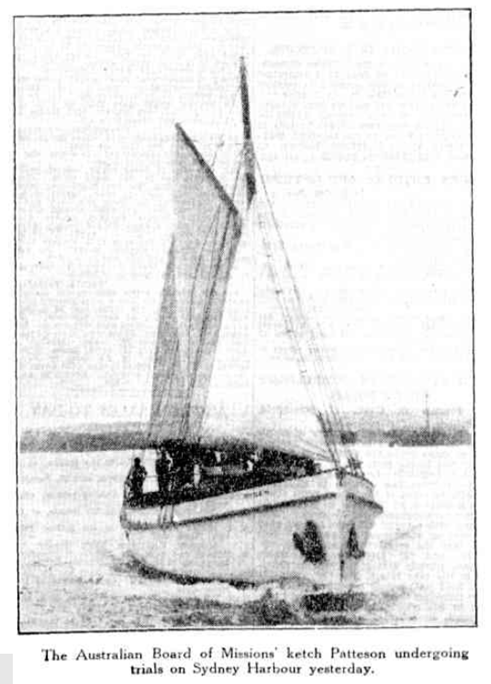
The Ketch Patteson 1934

image

 The new mission ketch Patteson, entered Jervis Bay seeking shelter from heavy seas.

Sydney Morning Herald Jan 19 1934.

image
The vessel which was completed for the Australian Board of Missions in January 1934 measures 46' x 13' x6'3" (13.72 m x 3.96 m x 1.91 m).

image

January 19 1934
Leaving Sydney on January 19 she encountered heavy weather,  battling on, it was noticed that two large sharks were following the vessel.  The Patteson kept her engines running continuously for four days, with mountainous seas sweeping over the little vessel.  Finally, it was decided that the ketch should put into land to ascertain it’s exact where-a-bouts.  To the surprise of the crew, it was found that they were at Jervis Bay,  87 miles down the south coast when they had imagined they were well on their way north towards the New Hebrides. The ketch had traveled 800 miles during this time.
The Patteson proceeded back up the coast to Sydney,  and adjustments were made to the faulty compass and instruments. 


image
The crew from the Patteson – left to right, Carl Halverson.  Capt. W. Delmer, A.Cant. L.J.Warren.

Her adventure didn’t end there.

In what was an amazing piece of navigation, during her second attempt to get to her destination she was forced back to Sydney after her rudder broke near Middleton Reef,  the crew were forced to sail 600 miles with the aid of a jury rudder back to Sydney for repairs.
The rudder consisted of two paddles from the small life boat, strapped to either side of the ketch.  Running into heavy weather and huge seas,  the paddles required two men to work,  it was extremely difficult and tiring to try and steer the vessel in heavy weather,  strong winds blew her many miles off course,  but she handled the conditions admirably, and was regarded by her crew as an exceptionally fine sea boat. 


1


Third attempt.
Leaving Sydney on March 8 for the third time, the crew must have been thinking “what next”, On this trip she battled through a cyclone between Lord Howe Island and Noumea and finally made their destination on March 21,  four days later than expected..


Details of vessel.

The   Patteson   was   built   at   Neutral   Bay at   the   yards   of   Mr.   Lars  Halvorsen,   and she   sailed   on   January   15   for   the   New Hebrides,  where   she   will   be   used   for mission   purposes. She   is   fully   rigged,  and   is   fitted   with  a   30   horse-power   Fairbanks-Morse-Diesel engine,  which   will   enable   her   to   maintain an   average   speed   of   eight  knots,   and   to attain   a   maximum   of   about   12   knots.   The main  cabin,   situated   in   the   centre   of   the ketch,   is   10   feet   long,   and  has   a   width   of 13   feet.   Quarters   are   provided   for   the crew  forward,   and   there   is   a   hold   aft   for passengers’   luggage  and   stores.   The engine-room   is   fitted   with  fuel   and   air tanks,  and  contains   a   dynamo   and   accessory engine  in   addition   to   the   main  equipment.   Electric   lighting   is   installed,  and a   small   searchlight   will  be   carried.


Meaning: Jury rudder – a rudder constructed for temporary use.

REF: Australian Maritime Museum - http://collections.anmm.gov.au/en/objects/details/64543/rig-and-sail-plan-for-ketchrigged-vessel-patteson;jsessionid=9AC31D95EAD0FB9A77E54BFEE5072C33?ctx=2898f0bb-0225-4dba-840d-86012ccd4700&idx=145


image

2 May 2015

Rainbow Warrior

If your wondering what the two masted ship is anchored on the far side of the bay at Montague Roadstead is ?,…..  it’s the Greenpeace vessel the ‘ Rainbow Warrior”.  It looks like a scene from the early 19th century, when sailing ships would call into the bay and seek shelter at Montague Roadstead from storms, or to resupply their water and food, and sometimes recruit men for a life at sea on the old whaling ships..
rainbow-warrior
The sailing ships of their time were  highly evolved technical achievements,  this ship is no different.  view the video to find out more about this amazing ship.

Early this morning before dawn I could see a large array of bright red lights reaching into the sky on the far side of the bay, on what appeared to be a four masted boat of some description. It wasn’t until after the sun rose and I shot this pic with my long lens, I could make out what it was,  it still didn’t explain the four masts, until i watched the video.
 

HOME

1 May 2015

30 April 2015

Latest Exhibition

IMG_5684

It’s a great time to visit the museum, there are currently two exciting exhibitions on display. In the Vera Hatton Gallery we have the Gallopoli Exhibition, a collection of images from the Gallipoli campaign.

The other exhibition is a collection of beautiful prints by local artist Lois Johnson, Lois lived in Japan between 1986 to 2007,  she studied and learnt traditional Japanese woodblock painting techniques, her work interprets these themes and subjects through the eyes of a western observer, as part of the display are skillfully carved woodblocks that clearly illustrates the skill involved in making these prints.

IMG_5683Lois incorporates subdued embossing in her artwork, the work is stunning and should not be missed.


28 April 2015

Jervis Bay Snippet.

image

Evening News Thursday 2 1903

Seagoing tugs ventured up and down the coast looking for incoming vessels to tow into ports, it appears from the story below, the race to secure a tow became very competitive and dangerous.

It was reported in Sydney to-day that a some what exciting incident occurred off Jervis Bay on Tuesday afternoon,  between two well known tug-boats.  The boats involved are the Port Jackson, of Messrs, J and A Browns fleet, and the Advance,  one of the Messrs, Fenwick’s well known tugs.

It is understood that the tugs had been off the coast,  as usual,  looking for a tow,  and their quarry was the Italian ship Beecroft,  a wheat laden vessel from the Argentine for Sydney.

The two tug boats were both racing for the Beecroft – the Port Jackson on the starboard side,  and the Advance on the port side.  The former was about half a length off the Advance,   and looked as if her captain was going to have first say to the captain of the ship.
The Advance,  it is alleged,  then ported,  and came up under the ship’s stern,  to the starboard side,  and,  in doing so,  struck the Port Jackson a sliding blow on the port side,  cutting through an iron band into the hull,  and gliding forward carrying with her part of the band,  and buckling it somewhat,  The Advance it is further alleged,  ported just before,  thus accounting for the sliding blow and buckling of the band.  The Port Jackson was struck almost amidships,  and near the coal bunker. She then steered a bit seaward,  but afterwards straightened up,   and proceeded alongside the Beecroft,  and made terms with the captain.  The Port Jackson,  therefore,  got the tow.

Both tugs were eventually wrecked.

1908 - The Advance: The Tug Advance was involved in another collision of Catherine Hill Bay,  this time while she was engaged in trying to secure the tow for the 4 masted Barque the Iverna on Christmas Day 1908.  No explanation for the collision was forthcoming, other than it there was heavy fog at the time.  the collision resulted in the  Advance overturning,  the boiler exploded and she foundered,  despite the captain of the Iverna lowering boats, and an exhaustive search no crew were found,  the following morning the mate of the Advance floated onto shore and was rescued.

Follow this link to see a Youtube video of the wreck. – very interesting – video link

1910 - Port Jackson:   The Port Jackson went ashore 5 miles North of Nora Head and become a total wreck.  All hands reached shore safely.

If you would like to read more about the fascinating story of Tugs,  follow the link below. 

image Tugboats

by Randi Svensen, 2011.

Early steam tugs oiled the metaphorical wheels of trade by freeing sailing ships to make or leave port in unfavourable winds or by towing them between ports when there was insufficient wind. When oversea ships became powered, tugs assisted these large, unwieldy vessels to manoeuvre in ports, and also provided valuable salvage and fire-fighting services.

Continue Reading

24 April 2015

Anzac Day.

Huskisson Street March –  commencing at 11.00am.

A camera on Gallipoli.
Opens Saturday 25th – 10am.
To coincide with the 100th Anniversary of the Gallipoli Campaign, the museum will have an amazing collection of images by Charles Ryan on display – this is another quality exhibition and one you should not miss.

war-poster
  IMG


The Museum has a book by Alan Clark about the Waratah Recruiting March that set off from Nowra on Tuesday November 30, 1915, it was the biggest crowd Nowra had ever seen.
It’s a fascinating book with some amazing images from the time.
Available from the Museum’s gift shop.

HOME