.

.
HOME OF THE LADY DENMAN - Local history isn't always about the big story - the everyday story of life in the early development of the region can be a fascinating, entertaining and educational journey.

27 March 2014

T.S.S Merimbula – On this day 1928

poster
If you take a leisurely walk out to Bosom Beach near Currarong following the signs to the Merrimbula ship wreck, you might expect to see something that resembles a ship.  What you will find is a small pile of twisted, rusted steel.  The remains strewen across the rocks belie the once beautiful steam ship T.S.S Merimbula which carried passengers in luxury and comfort along the coast.


1928 The last voyage of the T.S.S Merimbula.

T.S.S. Merimbula was a large twin screw steamship belonging to the Illawarra and South Coast Steam Navigation Company. Launched on 25th Novermber 1909 the steamer was the largest vessel ever ordered by the company. She was a luxuriously appointed ship, able to carry 80 first class and 20 second class passengers on regularly passages between Sydney and Eden.

March 26th -
With Captain O’Connor at the helm she left Sydney for Bermagui and Tathra.
She sailed into increasingly bad weather.

2

March 27th Merimbula runs aground.

Just before 1am travelling at 14 knots, 3 miles to the west of her set course the 13 passengers were woken by the grinding impact of the vessel driving onto the rocks at Abraham’s Bosom where she stuck fast. In heavy rain, the engines were stopped and everybody arrived on deck. The crew battled to free the lifeboats which had become stuck. Rescue rockets were fired but failed to attract attention. The Captain believed the vessel was in no immediate danger and sent the passengers back to the lounge, still with their lifejackets on. There they spent the remainder of the night drinking coffee and eating sandwiches. Rain continued the following morning as the lifeboats were lowered. No lives were lost and the passengers were rowed across to the mouth of Currarong Creek where they found shelter in a fisherman's hut. Currarong in those days was very remote and Captain O'Connor and the crew walked across Beacroft Peninsula to the lighthouse at Point Perpendicular. He then telephoned the Illawarra and South Coast Steam Navigation Company in Sydney to advise them of the grounding.
35 passengers and crew had been safely landed.

Merimbula Survivors camped
Merimbula survivors camped.

28th March -
Assessors arrived at the wreck site and concluded there was a remote chance of refloating the vessel.

29th March -The next day the Merimbula it was determined the vessel was no going to be salvagable, the salvage operation was cancelled.
image

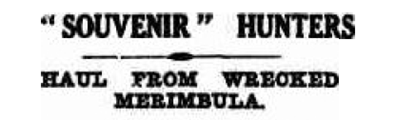
5th April - An article appeared in the newspapers telling of the sudden appearance of souveneer hunters entering the wreck via the gaping hole torn in her bows, clambering over the wreck "like crows round the carcus of a beast"
No one was left to protect the cargo and other valuables, men women, girls and boys entered the wreck and it was a case of the first there got the pick.
In the bush within a mile of the steamer were stacked piles of pilfered goods, rum, wisky, motor tyres, sewing-machines, prams, tables – everything that was not screwed down. Car loads of stuff have been removed. Men and women crawled into the heart of the ship and carried away toys, fruit, books, brooms, and even casks of beer. There was no one to stop them.

6th April - The remains were sold at auction for 300 pounds to Mr. A.W.Carey, of Melbourne, the cargo was not included in the sail.  The new owner gambled on the vessel being salvagable.
The new owner now had to advise the owners of the cargo that it must be salvaged within a week.

By the artice above it doesn't sound like much would be left.

After some time the battered remains  slid beneath the sea, The gamble didn't pay off as the ships back broke and slipped down the reef into deep water, now only the bow section remained visable on the rocks.
The loss of the Merimbula marked the termination of the Illawarra and South Coast Steam Navigation Company's passenger services, and subsequent to 1928, they confined their activities only to cargo services.


870-SS-Merimbula-A1579-SS-MerimbulaWRECKED-ON-SHORE

Passenger report.
One woman said that after the mishap, “The first half hour's alarm and excitement, resembled a picnic more than a wreck. Immediately the captain gave the signal that there was no cause for worry, the passengers overcame their fears, and, after having a drink of coffee, played the piano and sang until morning then taken ashore, and put in the day in small huts, occasionally used by, fishermen. In order to maintain the cheery atmosphere, Mrs Sparks, the steamer's relieving stewardess, played records on the gramophone until the cars arrived from Nowra”.Lifeboat arriving with survivors
Lifeboat arriving with survivors.

landing-the-passengers
Ships description.

Having a length of 209' 6", (63.86m) breadth of 32' 2" (9.8m) and depth of 21' 1" (6.43m). A fast speed of 14 knots was achieved through twin triple expansion engines. At the time the Merimbula was described as the most beautiful vessel to steam Australia's waters.
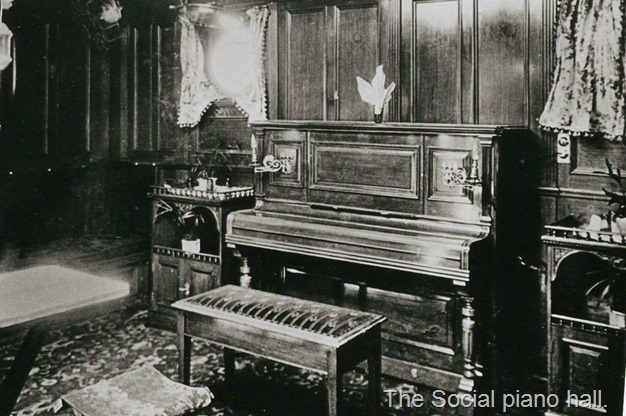
She had state rooms, large dining areas and a social hall which could be enjoyed by 106 passengers, along with an exquisite body and superstructure (11,011 gross tonnage).The vessel, however, was found to be unstable in some sea conditions. To increase stability, a large number of cast iron blocks were placed in the hold.


On boarding a high degree of luxury awaited the passengers of the Merrimbula.

875-Merimbula-social-hall

871-Merimbula-saloon


873-Merimbula-deck


Today.
Not much can be seen of this once grand vessel, over the years the exposed remains of the bow have all but disappeared from the rocks.

947-SS-Merimbula-wreck 946-SS-Merimbula-wreck Wreck of Merimbula 23.2.10


Venture beneath the surface and you will discover another story.
Just off shore you will find the remains of the vessel on a sloping reef where it came to rest after slipping back into the sea.
The remains are located adjacent to the north side of the reef which extends from Whale Point. Wreckage can be located in 4 meters of water and extends out from the reef to a depth of approximately 13 meters.
You will find sections of the hull plating, an anchor, engines, as well as large winches, and most impressive are the boilers rising from the bottom.
Pictures showing what was left of the bow of the beautiful vessel, as it gradually disintegrates over time.

merimbulawinch One of the winches
photo courtesy of NSW Environment and Heritage.
http://www.environment.nsw.gov.au/MaritimeHeritage/researchcentre/wreckmerimbula.htm
 

I first dived this wreck around 1979, it was a fun easy and interesting dive, on one particular dive we had a large school of giant King Fish circling above and around one of the boilers, we collected a few lobsters amongst the strewn wreckage. If you intend to dive this location, check the weather, the area is exposed to nth and east swells and winds, and can be dangerous.

Historic Shipwreck
The Merimbula is a gazetted Historic Shipwreck, under Section 5 of the Commonwealth Historic Shipwrecks Act 1976. The listing applies to the shipwreck and all relics associated with the shipwreck.Currarong8aa

Lady Denman display
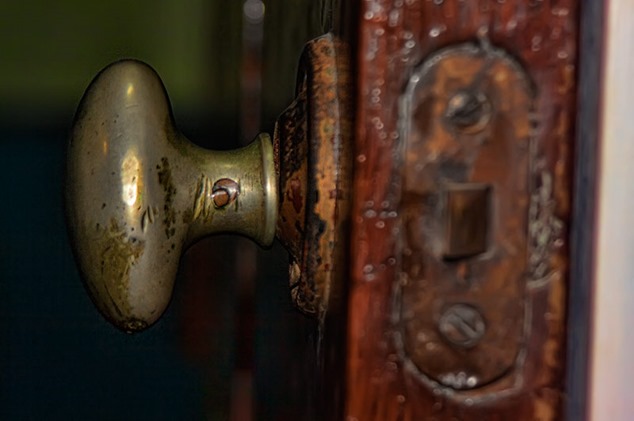
The museum has a collection of objects salvaged from the Merimbula, as well as historic photographs and information on display. Most notably a beautiful set of large timber doors from the kitchen.
The picture below is one of the door knobs off the door…you will have to visit the museum to see the rest…

 
DOOR-KNOB

Continue on to more images taken recently.


Ref”
.
http://www.environment.nsw.gov.au/MaritimeHeritage/researchcentre/wreckmerimbula.htm
. http://www.michaelmcfadyenscuba.info/viewpage.php?page_id=117
. http://trove.nla.gov.au/ndp/del/article/81115432
. http://www.southcoastregister.com.au/story/999653/wreck-that-ended-our-age-of-steamers/
. http://www.powerhousemuseum.com/collection/database/?irn=212159#ixzz2wfLIoz3r

25 March 2014

Mystery objects.

mysteryobgect1 mysteryobject2 Can you identify these objects.
Seen here are a couple of close up photographs relating to one of the displays in the museum.
Do you know what display and object they belong to ?


Feel free to leave a comment below.

The mystery has been solved, and in quick time, I will have to make the next one harder.

  • Greg Rickard I'm sure there's a trick to this but I'll have a go; the left one is a boot and the right, a porthole?

  • Admin: yes! the first one is a boot, and yes, the second is a port hole of sorts?....but what are they used for???

  • Carol Sheen: diving?

  • Greg Rickard I think Carol Sheen is correct. I'm saying porthole and an old style brass diving helmet and the boots are also used for diving and contain lead weights on the bottom? My great grandfather was a pearl diver and wore this type of gear.

  • Admin: You are both right.
    Visit the museum to see this amazing piece of equipment, and a here is a remarkable photograph showing how it was used.

    diving-suit diving-suit---Tim-Wray


  • New exhibition opens 31st March

    The successful Galamban exhibition has now closed and a new exhibition will open on
    March 31st and run through to the 11th of May

    Portraits-exhibition Portrait Exhibition
    This should be a very interesting exhibition, a collection of artwork and photographs of portraits in different media.
    A collection of old and new, from the past to the present.
    Portraits, if done well can draw you into the picture and give you an amazing connection with the person or people depicted.

    10am – 4pm. 7 days
    In the Vera Hatton Gallery

    24 March 2014

    Surfing the Spit – Jervis Bay

    479-Huskisson's-rock-swimming-pool,-1960s 1960’s style.
    This scene has been repeated hundred’s of times.
    If you go to the Spit at the entrance of Currambene Creek when we have some swell rolling into the Bay, you will see local and travelling surfers riding the waves across the Spit.
    These days it’s the Stand Up Paddle Boarders who have claimed the Spit as their own.

    This photograph captures a group of Long Boarders enjoying themselves around 1960.

    Currambene Creek


    Another timeless image in the Museum’s collection
    655-Early-view-of-Currambene-CreekLooking north, the spit can bee seen on the right.


    49-Aerial-view-of-Field-Street-and-Settree-boatyard

    Aerial view of Huskisson that shows the Settree boat yard on the banks of Currambene Creek.

    Cows Grazing.
    I love the cows grazing on the footpath, you don’t see that anymore!

    The cows are grazing on the corner of Sydney Street and Field Street near the picture theatre.

    22 March 2014

    The Coolangatta, Shoalhaven connection

    On this day: March 22 1974
    REMAINS ON BEACH A cyclone which hit Queensland uncovered the remains of the Brigantine Coolangatta and deposited them on North Kirra Beach. The Coolangatta had been driven ashore 130 years earlier and wrecked in 1846.

    Ref: photograph and article.


    Coolangatta's story 1846.
    She had been sitting at anchor for 5 weeks unable to enter the Tweed due to silting in the bar.
    At the time she was carrying two convict prisoners (George Craig in irons, and William George Lewis), ready to load red cedar logs at the Tweed River for Sydney.
     
    Ironically it was a severe cyclone that tore the Coolangatta from her anchors and drove her onto the shore. Captain Steel was ashore at the time and unable to get back to the ship because of the sea conditions. Their attempt to row their small boat through the surf saw them stranded on the beach when the boat was damaged in the surf.
    ”As the cyclone intensified the ship was torn adrift, the prisoners freed, and all aboard “saved themselves by swimming through the surf at the imminent risk of their lives”...”

    coolangatta-mapThe captain, crew and prisoners reached the pilot station at Amity Point on Stradboke Island having walked from Point Danger along the beach. They were fed nightly by friendly Aborigines, the journey of 70 miles took six days.


    In 1883 government surveyor Henry Schneider when sent to “plan a town at Point Danger” saw the wreck and named the adjacent “Coolangatta Creek” in field notes.
    It is believed that this naming was responsible for the name given to the new township of Coolangatta when the first allotments were auctioned in 1884.”

    The connection to the Shoalhaven. alexander berryAlexander Berry.
    The Coolangatta was built by James Blinkcell in 1843 for Alexander Berry whose property, Coolangatta Estate, adjoined Coolangatta mountain located on the northern bank of the Shoalhaven River.
    Berry first visited the Shoalhaven in January 1822 taking the cutter Snapper into Crook Haven (formerly Shoals Haven on the charts) from which he proceeded overland to examine the country on either side of the river. The rich alluvial soils and natural grassy 'meadows' led him to choose the Shoalhaven as the site for an estate and he returned in June 1822 to occupy it.
    The Estate still exists and is now a first class winery and restaurant that uses the original buildings, well worth a visit.

    “For my headquarters I fixed on the north side of the river at the foot of a hill called by the natives ‘Collungatta’. I located the 10,000 acres grant in this locality”

    ‘Collungatta’ was the Aboriginal word for fine view, a description that Berry found difficult to dispute.

    1925 it was exposed by another storm only to disappear beneath the sand once again. The old wreck was located by rutile miners, 30 feet below sand level, in 1954.  In 1973 the Queensland Government tried to blow it up as it was proving a hazard to shipping and surfers – unsuccessfully.  On 22 March 1974, another cyclone dumped it high on the beach and souvenir hunters quickly removed what the sea and the Government had been unable to destroy in 127 years.


    Ship Description:
    brigantine A brigantine is a two-masted vessel with her foremast fully square rigged and her mainmast rigged with both a fore-and-aft mainsail (usually a gaff sail) and square topsails (and possibly topgallant sails).
    Coolangatta; Brigantine; 88 tons; 19.2 x 5.2 x 2.7 m


    ”But we neither wished to elbow any one, nor to be elbowed”
    Ref: Biography – What a life, it makes interesting reading.

    Ref:
    .  http://www.wrecksite.eu/wreck.aspx?55434
    . http://www.couriermail.com.au/archive/news/coolangatta-owes-its-name-to-a-surveyor-with-a-sense-of-history/story-e6frep3f-1225852127161
    .
    http://trove.nla.gov.au/ndp/del/article/12895679?searchTerm
    . http://monumentaustralia.org.au/themes/disaster/maritime/display/92189-coolangatta-shipwreck
    . ref:http://en.wikipedia.org/wiki/Coolangatta,_Queensland#Schooner_Coolangatta
    . Coolangatta estate

    20 March 2014

    Floating Dock A.F.D.17

    on-slipLongest ocean tow in history.
    Our research so far has gone a long way in confirming the anonymous information sent to us describing the floating dock you see in the picture supporting the Ferry?
    as the Admiralty Dock A.F.D.17.
    The dock was involved in the longest tow in maritime history, starting from Reykjavik Fiord, Iceland to Sydney in 1945.
    Enduring Atlantic gales, German Submarines and long hard hours of difficult sea conditions for the crew.

    A.F.D 17 was based at Cockatoo Island until 1964 when it was scrapped.
    Read more.

    Used around the world, these types of floating docks were a vital part of the war effort during WW2
    They were responsible for performing major repairs and keeping many allied war ships sea worthy.

    afd17 
    Enlarge the images to read an account of this amazing sea journey.

    AFD17_Freemantle-col

    Enlarge to follow the epic journey.world-map-with-map-of-AFD17


    Ref: Google Books
           Royal Navy Research Archive

    18 March 2014

    Figurehead on show.

    figure-headIf this figurehead could talk I'm sure it would have some exciting stories to tell of wild storms, oceans travelled and places seen.
    The museum is home to a fine collection of maritime figurines.
    This picture shows the detail of just one of these amazing figures.
    A carved and painted figurehead of a country girl that once adorned the bow of the Wool Clipper Ship Coonatto, that was eventually wrecked off the coast of Beachy Head, Eastbourne in 1876.
    The figurehead was salvaged from the wreck.
    On a voyage from Australia to London loaded with copper ingots and wool, she pilled up near Beachy Head in the English Channel on 21 Feb. 1876. Most of her cargo was salvaged but the COONATTO was lost.
    The figurehead “Sailors Lass” had resided beside a pond, within the grounds of East Dean Manor House near Seaford for almost 100 years, then was brought to the United States in the very early 1950’s. The figurehead is carved in the style of a country girl in simple dress; her face and hair have been carved with grace and sensitivity.

    wreck-remains figurehead-now Nowdays, the debris of Coonatto lies amongst the chalk boulders and gullies at the base of the Seven Sisters Cliffs,
    Eastbourne and can be reached by clambering along the shore at low tide.
    Photo by Pete Mason.
    And as she appears now within the museum.
    stamp stamp2 Ref: Stamps were produced featuring the Coonatto


    coonatto


    Coonatto

    . Coonatto - an Aboriginal word for a food-bearing tree.
    . Description: She had very fine lines, but was a very wet vessel (a vessels which takes much water on board during bad weather at sea.)
    . Usage: She was used in the service between the Thames and Australia for her whole life as a cargo vessel.
    . Captain: She was mostly under command of Captain Begg, a hard driving captain.
    Her best passage was when she sailed from the Thames and after a passage of 66 days.
    . Sources: Origins Orient and Oriana by Charles F. Morris. The Colonial Clippers by Basil Lubbock.
    . Wreck Site
    . Sold: at Auction to and Australian buyer in 2008 and can now be seen in the Lady Denman Museum Huskisson..

    Ship type – A Clipper was a very fast sailing ship that had three or more masts and a square rig.
    In brief, they had a pronounced bow flare, sleek appearance, generally fine lines and in action, an ability to reach and maintain speeds previously unmatched.

    16 March 2014

    Jervis Bay

    bay-rise-3

    Sienna rise.
    Another beautiful day to be wondering around the foreshore in the early morning.
    Winds were westerly, the sky was varied hue’s of sienna, mixed with blue and gold.

    14 March 2014

    Mini Museum

    mini-museumHere is an original idea that took 35 years to develop.
    In my wildest dreams, my home would be filled with amazing relics from our planet’s history. My shelves would be filled with things like dinosaur fossils and lunar rocks, constant inspiration in every room.
    Read more.

    13 March 2014

    Big Bird learns to fly.

    )

    Since we have our own resident “big bird” that cruises the fish pond nearly every morning
    We had a follower send us this fun little video showing an abandoned pelican’s first flight.

    Huskisson Police Station

    104-Police-Station,-Huskisson-rsEarly Days at Huskisson.
    This picture shows a very early Huskisson Police Station.
    It also served as the State Electoral office and the Government Savings Bank of NSW.
    If you have any old pictures of Huskisson or Jervis bay and surrounds we would love to post them here for you.
    Email: Your Contributions

    12 March 2014

    Lady Nelson

    Further to our story about the Lady Nelson and her exploits we have been sent this fantastic picture showing the beautiful replica of the Lady Nelson from Malcolm Riley, Media and Community Relations Manager, Bureau of Meteorology, Tasmania and Antarctic Region.

    Lady Nelson from Malcolm Riley
    The original Lady Nelson like this replica must have made and impressive site under full sail coming into the various harbours and bays during it’s explorations along the coast.
    Read more of the fascinating story from the log books of the Lady Nelson, especially the reference to it’s time in Jervis Bay and it’s interaction with the local Aboriginals…

    Galamban Exhibition

    Your opportunity to see the Galamban exhibition is running out fast.
    the Exhibition closes on the 23rd of March.
    Details on the exhibition page.

    10 March 2014

    Lady Nelson – on this day

    The fascinating story of this world famous ship and it’s association with Jervis Bay.

    Captain – Lt. James Grant.
    The Lady Nelson was an Armed Survey Vessel called a Brig.
    52ft 6 in in length, Beam 17ft 6in and a draft of 12ft with the keels lowered.
    She carried 17 crew.
    Armament, 6 Brass carriage guns 3 and 4 pounders.

    SLIDING KEELS LADY NELSONShe was small at 60 tons but served the colony well between
    1800 –1825.
    She was fitted with three Shank sliding or drop keels (actually removable centreboards). (The Shank keels were the invention of naval architect Captain John Schank.) The fore and aft centreboards were 3 feet long, and the centre one was 6 feet long. With them up the vessel drew only 6–7 feet instead of the 13 feet that would be more usual for vessels her size.
    She had been designed to be hauled up into shallow water.

    CONTINUE READING


    Lady Denman in dock

    on-slipAnother amazing image comes to life.
    It’s one of many in the Museum’s collection that needs there story to be recorded.
    Continued research is being carried out on the museum’s slide and photographic collection.
    If you have any information about this photograph, or what’s in this photograph, please contact us here.
    No matter how small of insignificant you think it may be, it may just be the information we need to complete the story. yourcontributions@gmail.com

    Hints
    1. We have had a little piece of information given to us by an anonymous contributor who seems to think the floating dock the Denman sits in, is the Admiralty dock AFD17, if so this dock has it's own epic story, can anyone confirm this information please.

    2. More information has come to light and is being researched by the Museum's Curator Graham Hinton.

    5 March 2014

    Mokau photo

    wreck photo 2014 John Kinsey from Sussex Inlet has sent us another fantastic image of the Mokau.
    Wrecked on the shore near the entrance to Sussex Inlet in 1922
    see the previous story and video of the wreck as it remains today..

    No further information is available about this photo at this time.

    March Newsletter out now.

    NEWSLETTER ARTClick here to see the latest newsletter
    MARCH NEWSLETTER HERE.
    This month you can read stories about.
    .  Antiques Dealer Gordon Brown who is coming to the museum.
    . The upcoming Portrait Exhibition.
    . A story from the museum curator Graham Hinton, it’s very interesting!
    . The ongoing restoration of the Crest.
    and more,

    Royal Australian Historical Society

    shoalhaven river -rs file off web 2014 Shoalhaven Excursion
    Saturday 6 – Sunday 7 April 2013
    (RAHS in conjunction with Shoalhaven Historical Society, Shoalhaven Family History Society, Bolong Historical Society and Berry Historical Society)
    We have a weekend excursion planned for the weekend after Easter on Saturday-Sunday 6 - 7 April in the Shoalhaven area, in conjunction with local Shoalhaven societies.
    Saturday 6th April 2013

    3 March 2014

    Below the decks of the Lady Denman

    inside-the-ferry-2014 inside-the-ferry--2-2014 The romance didn’t match the reality.
    Walking the decks of the Lady Denman Ferry, housed safely within the walls of the museum it’s easy to romanticise  about  crisscrossing Sydney Harbour on this grand old lady. She and many other ferries carried passengers to all corners of Sydney.


    I doubt if much attention was paid to the hard working crews on these old timber ferries.Above are a couple of pictures from below the decks of the Lady Denman as she stands today within this fantastic museum.
    One can imaging the heat and noise churning out of the engine during operations back and forth across the harbour, straining against current and swells.
    The engineers and fitters worked in cramped conditions, in these shots you can see the cradle the engine was originally mounted into, without the engine you get a false sense of space which in reality isn’t usually there. The creeking and groaning of the timbers as they moved with the motion of the Ferry, combined with the smells of diesel and oil must have been hard to bear for those below here decks.

    Can you help with details about working on the ferry, we would love to hear your story.
    You can comment below or contact us here at yourcontributions@gmail.com
    become a member of the blog we welcome your input.